For centuries, William Shakespeare fans and historians have anchored the legendary playwright’s origins to Stratford-upon-Avon, the idyllic riverside Warwickshire town that still draws millions of tourists annually to visit the preserved cottage where he spent his childhood. While Shakespeare built his legendary career and rose to fame in London, almost no physical traces of his life in the British capital have survived to the modern day. Now, a newly unearthed 17th-century map is reshaping what scholars know about the Bard’s life in London, pinpointing for the first time the precise location of the only home he ever purchased in the city – a space where experts believe he may have drafted his final works.
The groundbreaking discovery was made by Lucy Munro, a Shakespeare and early modern literature professor at King’s College London, who stumbled across the map by chance while researching unrelated materials in the London Archives. Munro describes the find as a long-missing piece of the puzzle that fills critical gaps in the fragmented historical record of Shakespeare’s adult life. “It supplies extra bits of the jigsaw puzzle” of Shakespeare’s life, she explained of the document, which was publicly disclosed by King’s College London this week.
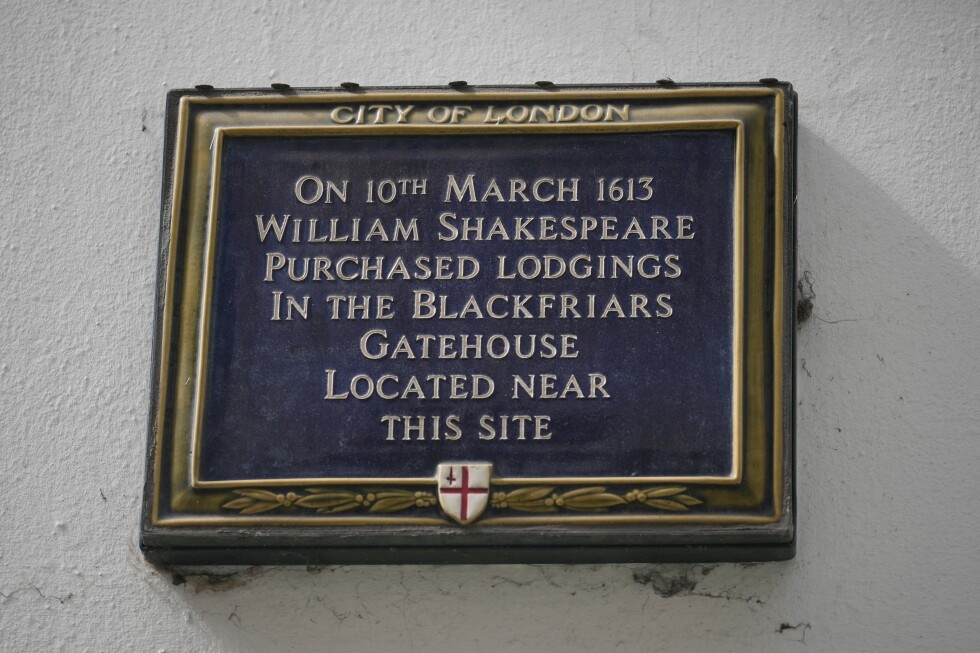
Historians have confirmed since the 19th century that Shakespeare purchased a Blackfriars district property near the Blackfriars Theatre in 1613, but the exact coordinates of the dwelling had remained a centuries-old mystery. Up until now, only a vague plaque on a 19th-century building in the area marked that the playwright once had lodgings “near this site.” The detailed precinct plan Munro uncovered clearly maps out Shakespeare’s home: a substantial L-shaped dwelling converted from a section of a former 13th-century Dominican medieval monastery, including its original gatehouse.
Following King Henry VIII’s dissolution of the monasteries in the mid-1500s, the former friary grounds were redeveloped for secular use. The wider Blackfriars precinct already held the Blackfriars playhouse, an indoor theatre that Shakespeare co-owned. In the decades after the dissolution, the neighborhood was a desirable enclave populated by nobility, high-ranking courtiers and royal officials. By the time Shakespeare purchased his property there, however, the area was gradually becoming more accessible to wealthy non-aristocrats, even as prominent local residents continued to protest the presence of the playhouse, dismissing it as a public nuisance. Munro notes that Shakespeare, while financially successful, was associated with the somewhat disreputable world of professional theatre, making his ownership of a Blackfriars home a revealing snapshot of his social status in early 17th-century London.
Unlike the grand family home Shakespeare built with his play profits in Stratford-upon-Avon (where he died in 1616 at age 52), the London property has been lost to history. Scholars have long debated whether Shakespeare used the home as a personal residence or simply rented it out to generate income. But Munro argues that the home’s size and its location just a five-minute walk from the Blackfriars Theatre suggests the playwright spent far more time in London in the final years of his career than historians have previously assumed. It is very likely, she says, that he wrote his final collaborative works – *Henry VIII* and *The Two Noble Kinsmen*, both co-created with playwright John Fletcher – within the walls of this long-lost house.
Will Tosh, director of education at Shakespeare’s Globe, the modern reconstruction of the open-air Elizabethan playhouse where many of Shakespeare’s works premiered, praised the discovery as a transformative contribution to Shakespeare scholarship. “Munro’s discovery provides a dazzling new sense of Shakespeare the London writer,” Tosh said. “She’s helped us to understand how much the city meant to our greatest ever dramatist, as a professional and personal home.”
After Shakespeare’s death, the property passed to his daughter Susanna, and remained in the Shakespeare family for more than 50 years. Along with the map, Munro also uncovered two additional archival records that detail the sale of the home by Shakespeare’s granddaughter Elizabeth Hall Nash Barnard in 1665. Just 12 months after the sale, the entire structure burned to the ground in the Great Fire of 1666, the devastating blaze that destroyed most of medieval London.
Today, the site of Shakespeare’s home sits within London’s modern financial district. Only a handful of faint traces of its history remain: a small fragment of the original medieval friary wall still stands, the nearby street name Playhouse Yard honors the long-gone theatre, and the Cockpit pub sits directly across from the property’s coordinates. The 1600s map labels the pub’s current location as “the Sign of the Cock,” a documented 17th-century tavern. Historians say it is easy to imagine Shakespeare and his fellow actors and playwrights gathering there for drinks after performances – a theory supported by contemporary archival complaints that local playhouses encouraged the spread of “tippling houses” in the neighborhood.