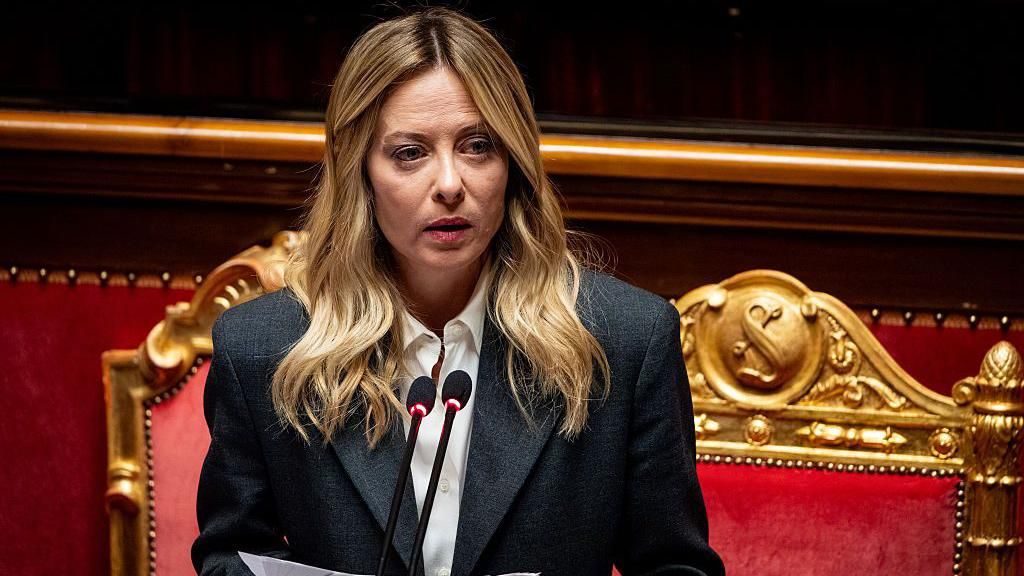
In a significant shift that underscores growing rifts in Italy’s longstanding alignment with Israel and changing political tides ahead of next year’s national election, Italian Prime Minister Giorgia Meloni has announced her government will not renew the bilateral five-year defense cooperation agreement between Rome and Tel Aviv. The decision was framed as a response to “the current situation” in the region, though no further specific details were provided by the prime minister’s office.
While Italy and Israel have maintained historically solid diplomatic and security ties, relations have deteriorated sharply in recent weeks amid a series of escalating diplomatic spats. Last week, Italian officials summoned Israel’s ambassador to Rome after Israeli forces fired warning shots at a convoy carrying Italian UN peacekeepers deployed in southern Lebanon. The incident left one Italian vehicle damaged, though no peacekeepers were injured. Just days later, Israel reciprocated by calling in Italy’s top diplomat to protest harsh comments from Italian Foreign Minister Antonio Tajani, who publicly condemned what he called Israel’s “unacceptable attacks” on Lebanese civilians.
According to data compiled by the Stockholm International Peace Research Institute (SIPRI), Italy ranks as the third-largest supplier of arms to Israel, though Italian exports accounted for just 1.3% of all Israeli arms imports between 2021 and 2025. The United States and Germany hold the top two positions as Israel’s leading arms providers. Meloni’s announcement puts Italy in line with a growing bloc of European nations that have already paused or restricted arms exports to Israel since the launch of Israel’s large-scale military offensive in Gaza, which began after the October 7, 2023 Hamas attack that killed roughly 1,200 people in southern Israel and took 251 hostages into Gaza. As of the latest update from Gaza’s Hamas-run Ministry of Health, more than 72,330 Palestinians have been killed in Israeli military operations across the territory, including 757 fatalities recorded since a fragile ceasefire took effect in October 2025.
Domestically, the decision to end the defense pact renewal comes after months of mounting public pressure on Meloni’s administration. Hundreds of thousands of Italian citizens have participated in mass street protests and general strikes across the country demanding an end to arms sales and security cooperation with Israel, a call that has gained growing traction among voters. Until recently, Meloni’s right-wing coalition government had stood as one of Israel’s firmest allies in Europe, refusing to join the expanding group of nations that have formally recognized Palestinian statehood.
However, a key turning point came in late March, when Meloni’s coalition lost a high-profile national referendum on judicial constitutional reform. Political analysts widely framed the result as a de facto vote of no confidence in the government’s overall popularity, particularly its unpopular alignment with Israel and the current U.S. administration under President Donald Trump. With just 18 months remaining before Italy holds its next general election, Meloni has begun systematically adjusting her policy rhetoric to distance herself from these increasingly unpopular political associations.
In recent weeks, the rift between the Italian prime minister and the U.S. president has widened publicly. After the referendum defeat, Meloni described ongoing military escalations between the U.S.-Israel alliance and Iran as part of a dangerous pattern of international intervention that operates “outside the scope of international law”. Earlier this week, she issued a rare public rebuke of Trump, calling his recent disparaging remarks about Pope Leo XIV “unacceptable” and confirming the pontiff had her full solidarity.
The comment drew an immediate and harsh response from Trump, who told leading Italian daily *Corriere della Sera* that he was “shocked at her” conduct. “I thought she had courage, but I was wrong,” Trump said, adding that Meloni “does not care whether Iran has a nuclear weapon and would blow Italy up in two minutes if it had the chance.”
For months, Trump’s public support for Meloni was seen as a key political asset for the prime minister, with her supporters framing it as a unique opportunity for Italy to gain privileged influence in Washington as a leading interlocutor for the European Union. But as Trump’s approval rating has plummeted among Italian voters — a January public opinion survey found 63% of Italian electorate holds a negative view of the U.S. under his leadership — that close association has become a significant political liability. Meloni’s decision to distance herself from both Trump and Israel is widely interpreted as a calculated move to rebuild support among centrist and left-leaning voters ahead of the 2027 election.
In the days following the public exchange between Meloni and Trump, senior members of her government have rushed to defend the prime minister’s position while reaffirming the core of the Italy-U.S. alliance. “Italy’s alliance with the U.S. is built on mutual loyalty, respect, and honesty,” Foreign Minister Tajani wrote on social media platform X. “On Pope Leo XIV she said exactly what all of us Italians think. The prime minister and the government defend and will always defend only and solely the interests of Italy.” Defense Minister Guido Crosetto echoed that framing, noting: “Being allies does not mean accepting everything in silence, but having the courage to clearly state what one believes to be right.”
Italian defense ministry officials told the BBC that they are still assessing what concrete legal and operational changes the decision to scrap the defense pact renewal will bring to existing security cooperation frameworks between Italy and Israel.