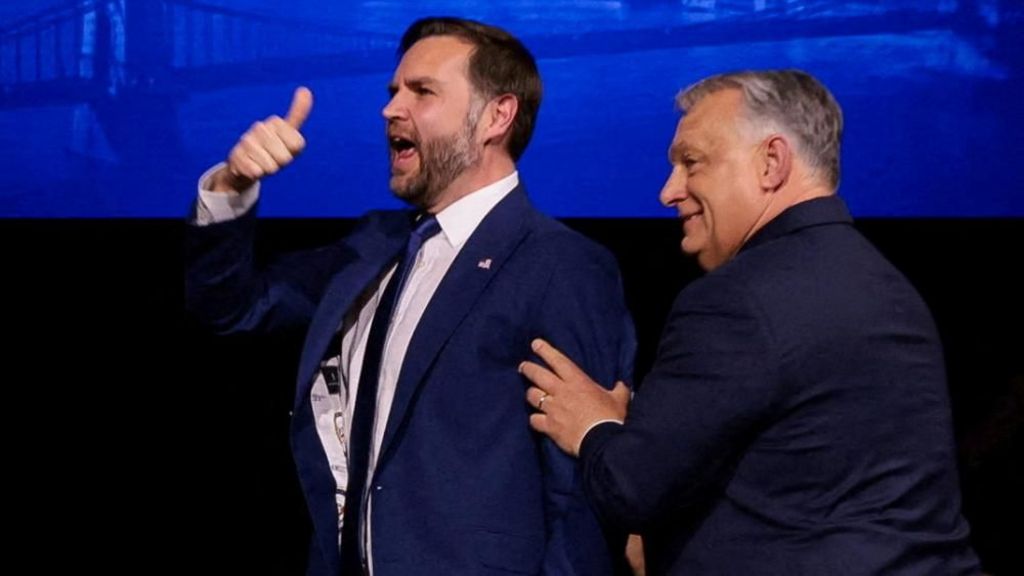
Five days after Hungarian opposition leader Péter Magyar’s landslide election victory ousted long-serving Prime Minister Viktor Orbán, U.S. Vice President JD Vance has publicly defended his controversial pre-vote campaign visit to back the incumbent, while signaling willingness to cooperate with the incoming government.
Vance, who traveled to Hungary to campaign for Orbán just five days before polling day, told Fox News that the visit was fully justified. He described Orbán as a “great guy” who delivered a “very good job” for Hungary, and praised him as one of the only European leaders willing to push back against what he called bureaucratic overreach from the European Union based in Brussels. Though Vance said he was disappointed by Orbán’s electoral defeat, he stressed he remained confident that the U.S. would build a productive working relationship with Magyar and his new Tisza Party administration.
Magyar, who led Tisza to an unexpected landslide win that ended Orbán’s 12-year consecutive rule, had previously criticized Vance’s intervention, warning ahead of the vote that no foreign nation had the right to interfere in Hungary’s domestic electoral process. But in a conciliatory shift on Monday, Magyar acknowledged that the U.S. remains a critical and powerful NATO ally, and confirmed he would be open to holding talks with U.S. President Donald Trump or any other American official who reaches out.
In the aftermath of the election, Hungarian politics is moving rapidly toward a transition of power. Orbán will remain in office in a caretaker capacity until Magyar is formally sworn in, and President Tamás Sulyok has called the three party leaders that won parliamentary seats to a meeting scheduled for Wednesday. Under Hungarian constitutional rules, Sulyok is tasked with convening the new parliament and nominating the next prime minister by May 12. However, Magyar has publicly called on Sulyok — whom he has labeled a puppet of the Orbán administration — to carry out these duties as quickly as possible and then step down from office. The incoming prime minister has indicated he expects to take office around May 5, and possibly even earlier. Sulyok’s office has publicly rejected calls for his resignation, but confirmed the meeting Wednesday will focus on setting a timeline for convening the National Assembly and nominating the new head of government.
In one of his first major policy moves since the election, Magyar announced plans to overhaul Hungary’s state-controlled media landscape. Revealing that he was never granted airtime on public television during his time leading the opposition until an invitation extended Monday morning, just days after he swept Orbán’s Fidesz party from power, Magyar turned down the initial invitation. He pledged to suspend all news programming on Hungary’s public radio and television until structural reforms can guarantee unbiased, independent coverage. Magyar outlined his vision for an independent governing board to oversee state media, modeled on the framework used by the BBC and other established independent public broadcasters across Europe.
Based on the latest preliminary election results, Tisza secured a two-thirds legislative supermajority with 135 out of 199 parliamentary seats — a threshold that gives the new government the power to amend the constitution and roll back the wide-ranging policy changes enacted during Orbán’s tenure. Magyar has said he expects Tisza’s final seat count will grow once all ballots are counted, expanding its supermajority even further.
Magyar has laid out an aggressive first 100-day policy agenda rooted in combating the widespread corruption he says flourished under Orbán. He described Hungary as the poorest and most corrupt member state of the European Union, and announced plans to launch two new government bodies: an Anti-Corruption Office and a National Asset Recovery and Protection Office. He also pledged to begin the process of joining the EU’s European Public Prosecutor’s Office, a step Orbán consistently refused to take during his time in office. Under Orbán’s administration, Hungary gained international notoriety for a system of cronyism that directed hundreds of millions in public contracts to politically connected allies, while independent judicial oversight was systematically eroded to undermine the rule of law. Magyar has repeatedly argued that the country was “robbed bare” under Orbán, with billions of euros in public funds disappearing from state contracts, and corruption operating at an industrial scale.
Magyar’s top immediate priority is unlocking tens of billions of euros in frozen EU funding that was suspended over concerns about rule of law breakdown and democratic backsliding during Orbán’s tenure. An estimated €17 billion in cohesion funding is currently suspended, and Hungary is also awaiting approval for an additional €16 billion in defense-related loans. European Commission President Ursula von der Leyen confirmed Tuesday that she had spoken with Magyar following his election victory, saying the bloc stood ready to begin swift work to restore the rule of law and bring Hungary back into alignment with shared European values.
The international community is also pushing for a shift in Hungary’s policy on aid to Ukraine, after Orbán imposed a veto on a €90 billion aid package for Kyiv in the weeks leading up to the election. Magyar has indicated the veto is no longer relevant to the incoming government, noting that Hungary already opted out of the latest Ukraine loan package alongside two other EU member states last December. German Chancellor Friedrich Merz has publicly called for the Ukraine aid to be unblocked “very quickly” following the Hungarian government transition. Merz met with Magyar earlier this year in Munich, and Magyar has confirmed Berlin will be one of his first foreign destinations after taking office.