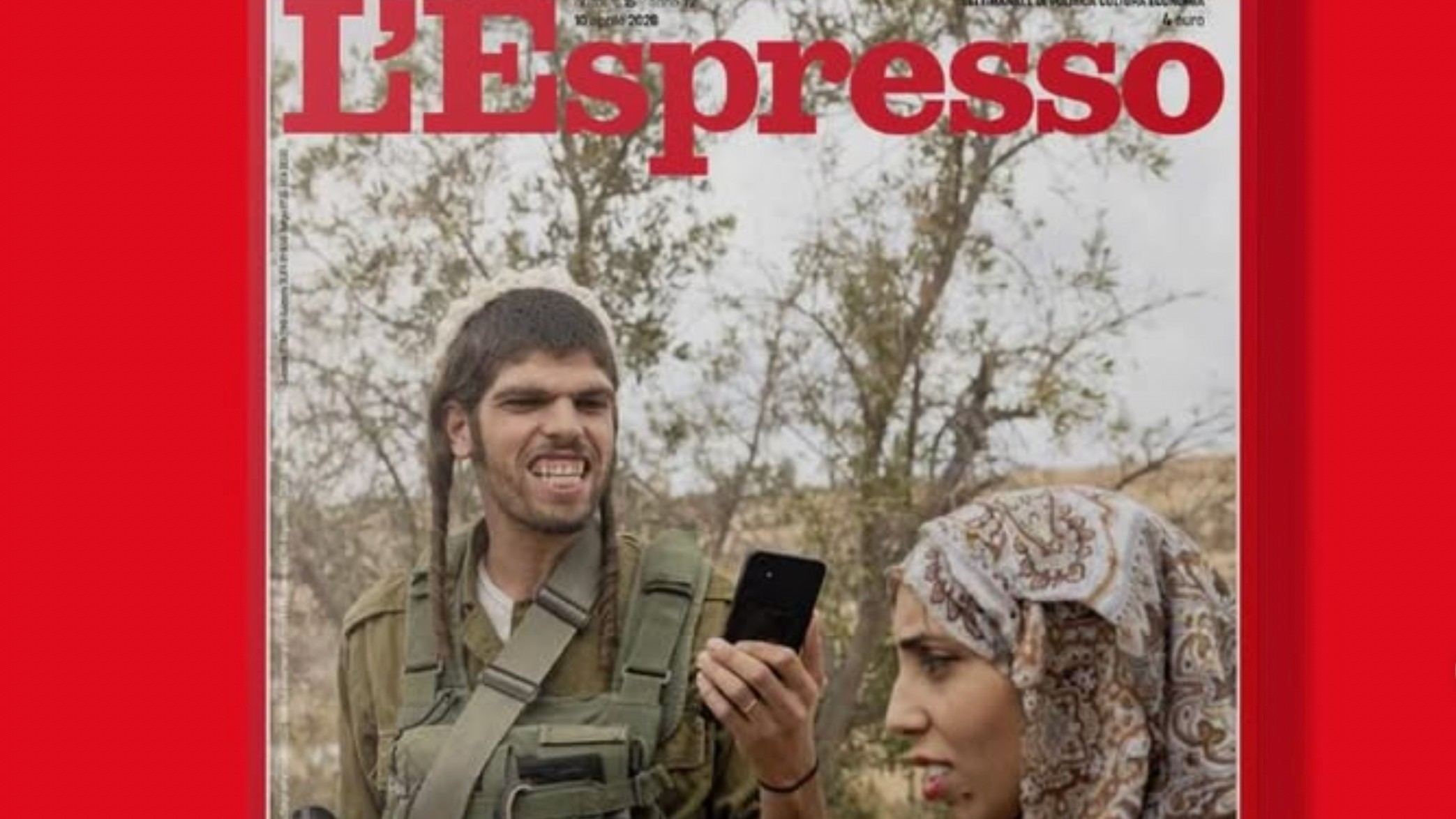
A heated diplomatic controversy has ignited across European and Middle Eastern media circles after Israel’s ambassador to Rome, Jonathan Peled, launched a scathing attack on a leading Italian current affairs magazine, labeling its recent cover highlighting systematic violence against Palestinian communities in the occupied West Bank as antisemitic and manipulative.
The April 10 print edition of L’Espresso featured a striking image captured by award-winning Italian photojournalist Pietro Masturzo, paired with the blunt headline “Abuse.” The spread was paired with a months-long investigative project examining the rapid expansion of Israeli settler movements in the occupied territories and its devastating cumulative impact on Palestinian civilian life. The specific photograph at the center of the debate was taken on October 12, 2025, the opening day of the annual olive harvest in Idhna, a small Palestinian village located west of Hebron, as part of Masturzo’s long-form documentary project chronicling daily life under Israeli occupation.
In a public post on X, Peled condemned the publication’s choice of cover, arguing that the image deliberately distorts the on-ground reality of Israeli security operations. He claimed the spread perpetuates harmful anti-Jewish stereotypes and fuels sectarian hatred, writing that “responsible journalism must be balanced and fair” when covering the Israeli-Palestinian conflict. Going further, the ambassador insinuated without providing any supporting evidence that the image could have been digitally altered to misrepresent events.
Masturzo, the photographer behind the image, has pushed back forcefully against Peled’s claims, releasing a detailed contextual breakdown of how the photograph was captured. He explained that moments before he took the shot, a group of armed Israeli settlers – one of whom, the figure visible in the frame, was disguised in an Israeli army uniform – backed by active-duty Israeli soldiers with obscured faces, had entered the village to block local Palestinian farmers from accessing their olive groves for the annual harvest. The settler’s confrontational gesture captured in the frame, Masturzo added, was a deliberate act of dehumanization: the man mimicked the call a shepherd uses to gather livestock, speaking to the Palestinian farmers as if they were animals rather than people.
Variations of the image and other photographs of the same confrontation have already appeared in multiple international outlets, confirming the authenticity of the reporting and the consistency of documentation of settler violence in the region. In an Instagram post defending the decision to publish the image, Masturzo emphasized that the frame captures a widespread reality that global media too often chooses to ignore. He noted that the project is not only intended to expose human rights violations against Palestinians but also to stand in solidarity with Palestinian photojournalists who risk their lives daily to document abuses against their communities.
The investigative reporting inside the magazine, written by journalist Alae Al Said, draws on first-hand testimonies from Palestinian residents across the Jordan Valley, where settlers backed by Israeli military forces carry out near-daily attacks on civilian communities. One resident, a father of six, described how dozens of settlers stormed his village, destroying local infrastructure, assaulting civilians, demolishing residential structures, and stealing community livestock. In another high-profile case documented in the piece, settlers seized full control of a critical natural water spring that supplies multiple Palestinian villages, with one resident noting that “they’ve colonized all the water sources.”
The reporting also calls out the international community for its inaction, specifically criticizing recent statements from U.S. Secretary of State Marco Rubio, who voiced vague “concern” over settler violence last month. The magazine dismisses such statements as empty rhetorical gestures that do nothing to hold Israel accountable for its policies in the occupied territories, concluding that the United States remains the primary global backer of the ongoing colonization of Palestinian land, allowing systematic violence to proceed slowly, silently, and relentlessly.
Online, the controversy has drawn widespread backlash against Peled’s criticism, with thousands of social media users arguing that the image accurately reflects the daily reality of occupation that Palestinians have endured for decades. Many commentators have highlighted the power of the image to convey systemic dehumanization more effectively than longer written reports. One user noted that “With this one photograph you somehow told the story of contempt and impunity more effectively than thousands of existing images of brutal violence. It’s a reminder of the power that photography can still wield, despite everything.” Others have sarcastically echoed the ambassador’s claim, joking that simply documenting on-ground reality in the West Bank is now labeled antisemitic.
The controversy comes amid a sharp escalation of violence across Palestinian territories since Israel launched its military campaign in Gaza in October 2023. Official data from the Palestinian Health Ministry puts the total number of Palestinians killed in Gaza at more than 72,329, with over 172,000 wounded. In the occupied West Bank alone, Israeli forces and settlers have killed at least 1,050 Palestinians since the war began, according to ministry data. The most recent fatal incident documented came just days ago, when Israeli soldiers beat a 68-year-old Palestinian woman to death during a military raid on her home in Jayyous, a town in the northern West Bank.