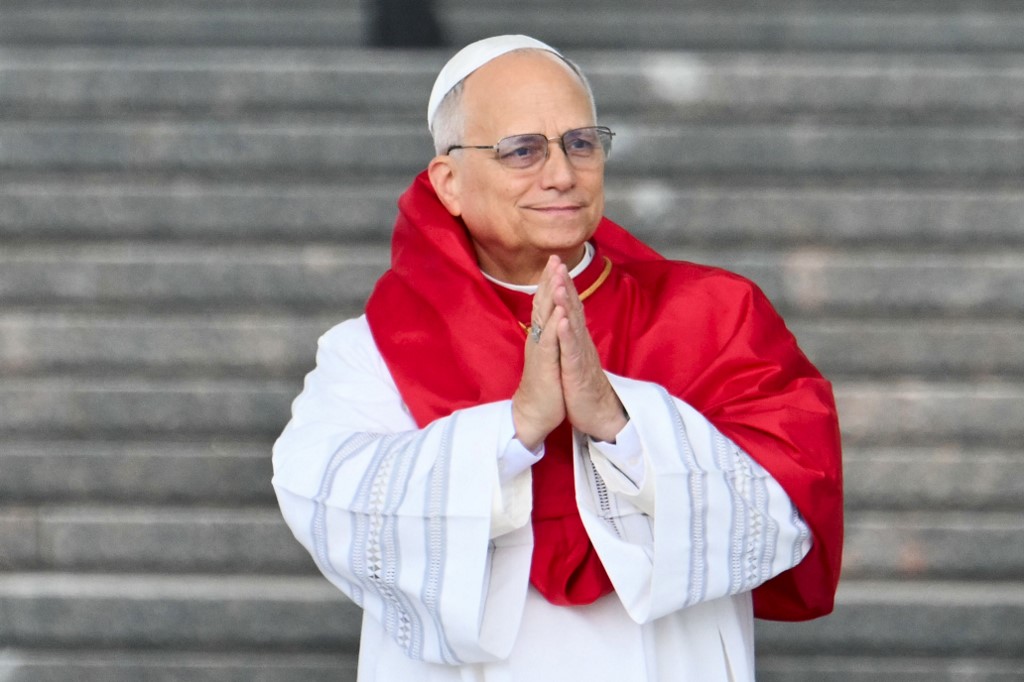
On a historic Monday that marked the first papal visit to Algeria in modern history, Pope Leo XIV wove together spiritual reflection and bold political messaging, blending calls for domestic reform with a global rebuke of exploitative power dynamics. The American-born pontiff, who traces his religious roots to the Augustinian Order founded on the teachings of the North African-born Christian thinker Saint Augustine, made history as the first leader of the Catholic Church to set foot on Algerian soil, the birthplace of his order’s namesake.
The landmark day was not without shadow: two major events dominated headlines alongside the visit: a high-profile public clash with U.S. President Donald Trump over the pontiff’s opposition to the war on Iran, and a failed double suicide bombing just 50 kilometers outside the capital Algiers that marked the first major extremist attack in the country since 2012.
Beginning his itinerary in the capital Algiers, where he was welcomed with full official honors, Pope Leo XIV first offered prayers at the iconic Martyrs’ Monument, a memorial honoring the thousands who died during Algeria’s 1954–1962 war of independence from French colonial rule. Standing at the site that carries deep national and diplomatic resonance, amid ongoing tensions that continue to strain Franco-Algerian diplomatic relations, he framed lasting peace as a project rooted in reconciliation. “Peace is only possible through forgiveness,” he told assembled guests. “The true struggle for liberation will only be definitively won when peace of hearts has been achieved.”
Moving from the memorial to a formal address before Algeria’s top political leadership, including President Abdelmadjid Tebboune, and the international diplomatic corps, the pontiff turned his attention to domestic political reform. Three leading global non-governmental organizations, including Human Rights Watch, had publicly called on Pope Leo XIV in the days leading up to the visit to raise human rights concerns with Algerian officials, who have faced sustained accusations from rights defenders of cracking down on opposition since the 2019 Hirak pro-democracy movement that forced longtime authoritarian leader Abdelaziz Bouteflika from power. Rights groups document widespread arrests, detentions and convictions of activists, journalists and government critics in the years since the movement.
In his address, Pope Leo XIV urged Algerian authorities to embrace greater political openness and empower a free civil society, particularly for the country’s large youth population. “The true strength of a country lies in the cooperation of everyone in achieving the common good. The authorities are called upon not to dominate, but to serve the people and their development,” he said. “I therefore urge those of you who hold authority in this country not to fear this prospect and to promote a vibrant, dynamic and free civil society, in which young people, in particular, are recognised as having the capacity to contribute to broadening the horizon of hope for all.”
The pontiff also used the platform to deliver a veiled rebuke of global power politics, condemning “ongoing violations of international law and neo-colonial tendencies” in an implicit critique of Western foreign policy in the Middle East. The comment came amid an intensifying public feud with Trump, who has launched repeated attacks on Pope Leo XIV over his increasingly vocal opposition to the U.S.-Israeli war on Iran. On the Sunday before the visit, Trump publicly stated he was “not a fan of Pope Leo” and falsely claimed the pontiff supported nuclear proliferation. On Monday, the U.S. president doubled down, refusing to walk back his comments and labeling the pontiff “weak.”
Speaking to reporters on his flight from Rome to Algiers, Pope Leo XIV pushed back on the conflict without escalating it, saying he had “no intention of entering into a debate” with Trump and was not “afraid” of his administration. “The Church has a moral duty to speak out very clearly against war,” he said. “I don’t think the message of the Gospel should be distorted as some are doing.”
As the pontiff delivered his address in Algiers, news broke of a coordinated attack in Blida, a city located roughly 50 kilometers south of the capital. Two suicide bombers detonated their explosive devices, killing themselves: one outside the city’s central police station, and another roughly 500 meters from the first site. Four additional unexploded bombs targeting police and public spaces were successfully defused by security forces, and an unconfirmed number of civilians were injured in the incident. Algerian authorities had not issued an official statement on the attack as of Monday evening. Security analysts noted that the heavy security deployment around the pope’s visit in Algiers likely pushed attackers to shift their target to the neighboring city.
Despite the unrest, the visit proceeded as scheduled, with Pope Leo XIV traveling to Annaba, the site of ancient Hippo where Saint Augustine served as bishop, for scheduled events on Tuesday. In his welcoming remarks on Monday, Tebboune expressed Algeria’s “immense pride” in hosting the pontiff on the land of Saint Augustine, whom he called “your spiritual father and one of the most luminous minds in the history of human thought.” Catholics make up less than 0.01% of Algeria’s population, where Sunni Islam is the official state religion, with most Catholic residents being European expatriates or sub-Saharan African students. Tebboune also praised the pope’s “courageous stance” against Israel’s military campaign in Gaza and the humanitarian suffering unfolding across the Gulf region.
The Algeria stop is the first leg of Pope Leo XIV’s inaugural multi-nation trip to Africa, which will continue with visits to Cameroon, Angola and Equatorial Guinea before the pontiff returns to Rome on April 23.