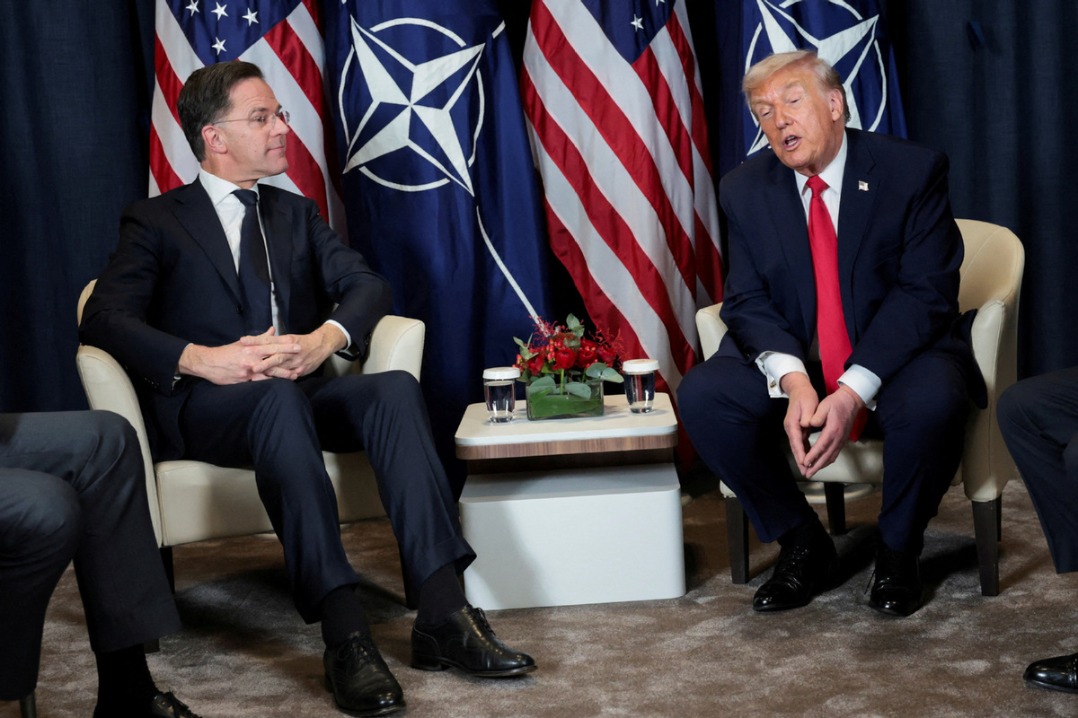
The growing divide between the United States and the North Atlantic Treaty Organization has deepened further in recent days, after a planned meeting to repair strained transatlantic ties ended with President Donald Trump publicly lashing out at the 75-year-old alliance he has long criticized. Following Wednesday’s closed-door talks with NATO Secretary General Mark Rutte in Washington D.C., Trump took to his social media platform to issue a blunt rebuke of the military bloc, which the U.S. has led since its founding in 1949. Writing in all capital letters, Trump declared: “NATO wasn’t there when we needed them, and they won’t be there if we need them again.”
This latest accusation aligns with a long-running narrative Trump has pushed since returning to the White House: he insists NATO should have directly joined U.S. and Israeli strikes on Iran, a demand that ignores the alliance’s core founding mandate as a strictly defensive collective security pact, designed to respond to attacks on member states rather than launch offensive military operations.
Rutte, who assumed the NATO secretary general role earlier this year, framed the discussion with Trump as “very frank” in an interview with U.S. broadcaster CNN. Rather than emphasizing NATO’s defensive rules of engagement, he pushed back on Trump’s criticism by highlighting the practical support European NATO members already provided, noting that “the large majority of European nations have been helpful with basing, with logistics, with overflights.” He added that the situation was a “nuanced picture” rather than a total failure of support.
The dispute over Iran is just the latest flashpoint in a series of escalating tensions between the Trump administration and the alliance. Earlier disagreements have included a high-profile standoff over Trump’s public claim that the U.S. should acquire Greenland, an autonomous territory that belongs to NATO member Denmark and is not available for purchase. The Trump administration has also repeatedly berated European NATO members for failing to meet the alliance’s target of devoting 2 percent of their annual GDP to defense spending, a longstanding point of U.S. criticism that predates Trump’s first term in office.
White House Press Secretary Karoline Leavitt reiterated Trump’s harsh assessment Wednesday, confirming the president had told her that NATO had been “tested and they failed.” The escalating string of disputes has also led Trump to repeatedly threaten to withdraw the U.S. from the 32-member transatlantic alliance, a move that would fundamentally reshape global security architecture.
However, many European policy experts and lawmakers argue that European nations were correct to avoid full participation in the Iran conflict. Koert Debeuf, a distinguished adjunct professor of Middle East studies at the Brussels School of Governance, told China Daily that European capitals have been unified in their position that the Iran conflict is not their war. “If they choose to assist countries such as Saudi Arabia, the United Arab Emirates, or Qatar, they would only do so after the war ends. For now, no European country wants to be involved, and that is unlikely to change,” Debeuf explained.
He added that while a small number of European leaders, including Spain’s prime minister and Germany’s president, have publicly stated that the U.S.-Israeli strikes on Iran likely violate international law, most have chosen to stay largely silent. This silence, he noted, reflects “deep discomfort with the situation” among European political elites. “What is clear is that this is widening the gap between the United States and Europe in the short term,” Debeuf concluded.
Ondrej Dostal, a Czech member of the European Parliament, went further in his criticism of Trump’s approach, telling China Daily that European nations must draw a line in opposing the administration’s actions. Dostal pointed to a series of aggressive social media posts from Trump in recent days, including open threats to “exterminate a whole civilization” and reduce Iran to the “Stone Age,” as well as other insulting language directed at the Iranian people. “Europe must clearly and unequivocally reject this,” Dostal said.
He argued that Europe has repeatedly capitulated to the Trump administration on past disputes, from the lopsided EU-U.S. trade deal to Washington’s coercive policies toward Cuba and Venezuela, and now its illegal offensive against Iran. “This must end now,” Dostal said. “We must be clear: it was the tacit acceptance by the entire European establishment of US hegemonic aspirations that has led to the catastrophe in Iran. Had Europe stood its ground in defending international law and the UN Charter, much could have been prevented.”