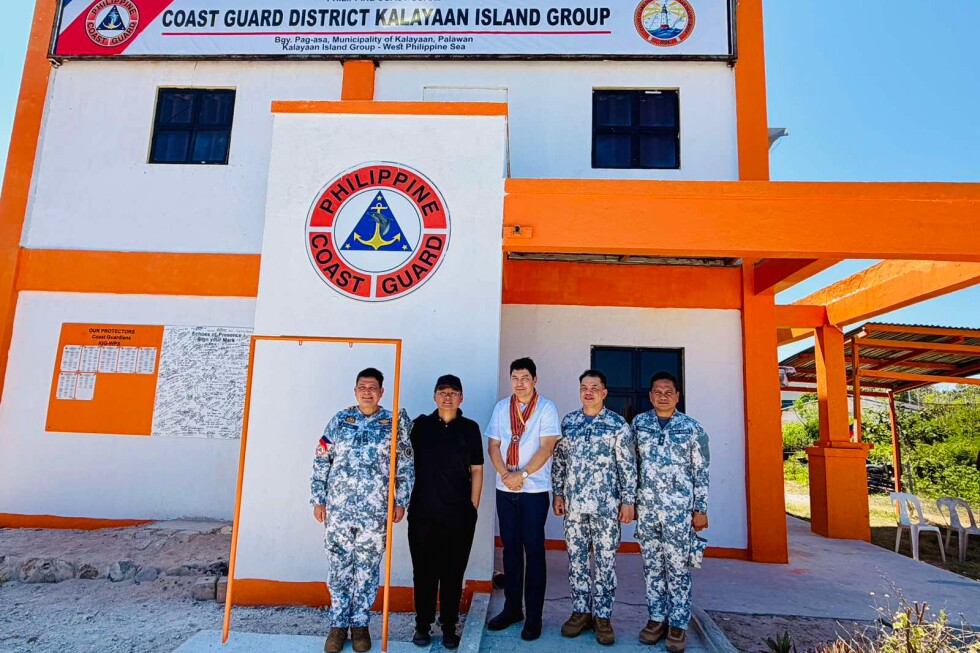
MANILA, Philippines – In a high-stakes move that underscores its longstanding territorial claims in the contested South China Sea, the Philippines formally inaugurated a new coast guard district command on Thursday on Thitu Island, a Spratly chain outpost held by Filipino forces and communities for decades but claimed by multiple parties including Beijing. The launch was timed to coincide with the Philippines’ national Day of Valor, a holiday honoring wartime sacrifice, and framed by Philippine officials as a permanent assertion of national sovereignty in a region where Chinese maritime assets maintain constant, close presence.
China has not yet issued an immediate official response to the opening of the new base. Thitu, known to Filipinos as Pag-asa (meaning “hope” in Tagalog), is also claimed by Vietnam and Taiwan, and Chinese coast guard vessels and state-linked maritime militia ships regularly conduct patrols in the waters surrounding the island. While past encounters between Chinese and Filipino maritime forces have largely remained low-level, the regional security environment has grown increasingly tense in recent years amid overlapping territorial claims.
China asserts sweeping jurisdiction over nearly the entire South China Sea, a critical global maritime trade route that carries trillions of dollars in annual commerce. However, a landmark 2016 international arbitration ruling, issued under the United Nations Convention on the Law of the Sea, fully invalidated Beijing’s expansive claims. Beijing refused to participate in the arbitration process, has rejected the ruling’s outcome, and continues to disregard it in its maritime operations.
Top Philippine officials including Transport Secretary Giovanni Lopez, Senator Erwin Tulfo, and Philippine Coast Guard Commandant Admiral Ronnie Gil Gavan traveled to Thitu for the brief inauguration ceremony. In remarks at the event, Lopez emphasized that the new command marks a permanent commitment to defending Philippine maritime interests, protecting the livelihoods of Filipino fishermen, and upholding national sovereignty. A commemorative marker inside the new coast guard building describes the outpost as the “vanguard and steadfast sentinel of our sovereignty, sovereign rights and maritime jurisdiction.”
The new district command will be headed by a commodore, staffed by a dedicated contingent of personnel, and supported by patrol vessels and aircraft to carry out a range of missions: maritime law enforcement, regional surveillance, environmental protection, and search and rescue operations. Philippine coast guard officials also announced plans to construct smaller auxiliary outposts on other smaller outcrops occupied by the Philippines in the Spratlys.
The tadpole-shaped Thitu Island, ringed by white sand beaches, is home to roughly 400 Filipino civilian villagers. It is one of nine Spratly features occupied by Philippine forces since the 1970s, when Manila offered incentives like free rice to encourage fishing families to relocate to the island as a way to solidify its territorial claim. Today, the 37-hectare outpost has been upgraded with modern infrastructure including internet and cellular service, more reliable power and water systems, a newly paved airstrip, a coastal wharf, an elementary school, a community gymnasium, and a typhoon evacuation center. Even with these improvements, the settlement remains a small, modest frontier outpost when compared to China’s heavily developed nearby facility on Subi Reef, located just 24 kilometers (15 miles) southeast of Thitu. Over the past decade, Beijing has transformed seven formerly submerged disputed reefs into full-fledged man-made island bases with military infrastructure, including a functional runway at Subi.
For the civilian community on Thitu, the arrival of the permanent coast guard command has delivered a significant boost to morale. “Everyday, our villagers see Chinese coast guard and militia ships all around the island,” said Rene Albayda, vice mayor of the island municipality that the Philippines recognizes as its most remote offshore township, administered under Palawan province. Speaking to the Associated Press, Albayda framed the new base as a critical step toward greater security for the island’s permanent residents.