BUENOS AIRES, Argentina — Argentina’s lower congressional chamber has given final approval to a hotly contested amendment to the country’s landmark 2010 Glacier Law, opening the door to expanded mining activity in sensitive glacial regions and sparking fierce pushback from environmental activists and water protection advocates. The original 2010 legislation, widely hailed as a pioneering global conservation measure, imposed a total ban on mining and mineral exploration across all glacial zones, designating these frozen landscapes as critical national water reserves.
The approved reform shifts regulatory authority: the power to map and define which glacial areas will receive protected status is transferred from the national Argentine Institute for Snow, Ice and Environmental Sciences (Ianigla) to individual provincial governments. President Javier Milei, a prominent supporter of the overhaul, framed the change as a step toward decentralized resource governance, saying it empowers provincial leaders to leverage their own natural assets and permits mining activity only in areas that do not require environmental protection.
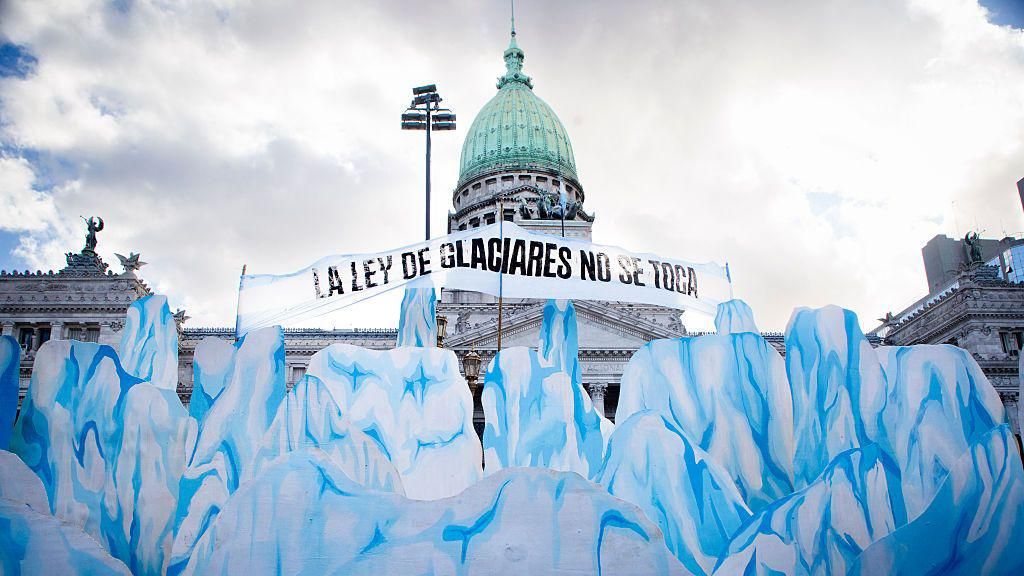
The bill cleared the Argentine Senate in February 2026, leaving lower house approval as the final procedural barrier. Its passage has deepened political and social divides across the country, with opponents organizing mass public demonstrations outside congressional buildings. Protesters carried signs reading “La Ley de Glaciares no se toca” — “Hands off the Glacier Law” — to demand the legislation be withdrawn.
Opponents warn the amendment puts Argentina’s most essential freshwater supply at existential risk. “Without water, we cannot even begin to plan for growth or development,” opposition Congresswoman Natalia de la Sota argued. Supporters of the reform, however, reject claims that the change weakens glacial protections. Backbench Congresswoman Nancy Picón Martínez, a proponent of the bill, said the mining industry has been unfairly demonized in public debate, insisting “this law protects glaciers, no matter how much some people want us to believe otherwise.”
Under the terms of the new framework, existing glaciers and periglacial environments — frozen landscapes that may not be permanently covered in ice but remain frozen for a large part of the year — will retain protected status under Ianigla’s national inventory until provincial governments formally prove these areas do not function as strategic water reserves.
Argentina is home to more than 16,900 glaciers, which feed 36 river basins spanning 12 provinces that supply freshwater to nearly seven million people. Meltwater from these glacial systems plays a critical role in buffering the impact of droughts, a growing threat across Argentina’s semi-arid northern and central regions driven by accelerating climate change. In provinces like Mendoza, glacial meltwater is often the only reliable water source for communities and agricultural production during extended dry periods.
Governors of five mineral-rich provinces — Catamarca, Jujuy, Salta, Mendoza and San Juan — united in support of the amendment, arguing the 2010 law blocked efforts to drive inclusive, sustainable economic growth for both provincial and national economies without compromising resources for future generations.
Leading environmental organizations have sharply condemned the reform, pushing back on the core argument that only a subset of glacial and periglacial areas qualify as strategic water reserves. “The primary function of all glaciers and the entire periglacial environment is to act as a freshwater reservoir,” explained Agostina Rossi Serra, a biologist with Greenpeace Argentina. “Periglacial environments hold water within their structure, and their gradual melt feeds the rivers and streams that sustain our country. A large portion of the regions pushing hardest for this amendment are arid and semi-arid areas where water is already an extremely scarce resource.”