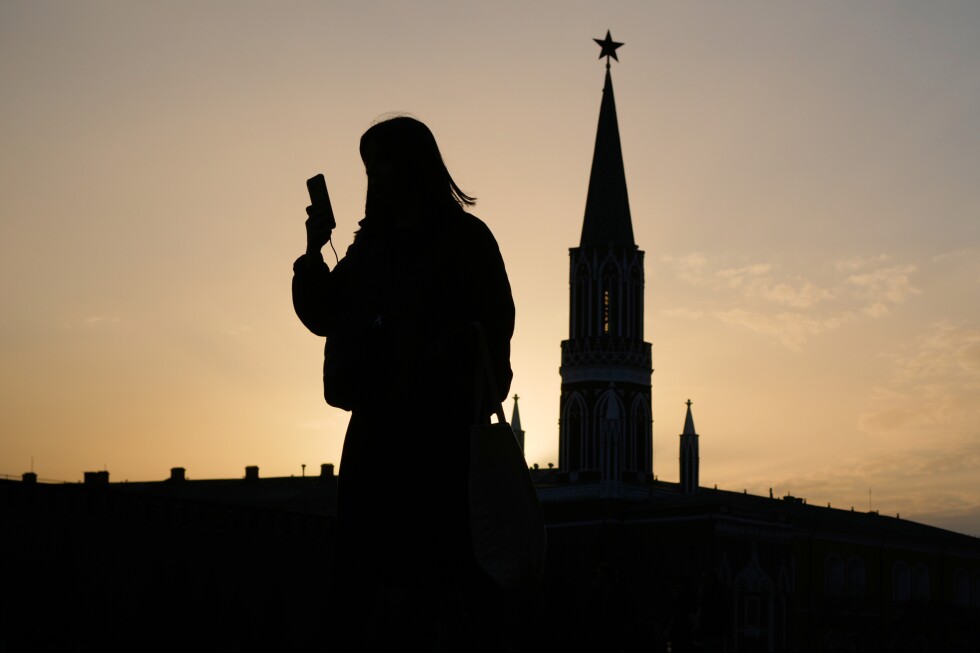
On a bright spring weekend in central Moscow, dozens of residents gathered in an orderly line outside the presidential administration building, with uniformed police stationed nearby keeping close watch over the demonstration. They had come to submit formal complaints against the Russian government’s rapidly intensifying internet restrictions — a sweeping regime that has included repeated cellphone internet shutdowns, blocks on the country’s most widely used messaging apps, and severed access to thousands of independent websites and digital services. This gathering marks the latest visible eruption of public anger over policies that have upended daily life for ordinary Russians, damaged commercial operations, and even drawn criticism from longstanding supporters of the Kremlin.
For years, the Kremlin has pursued a long-term goal of placing the entire Russian internet under full state control, with the ultimate aim of potentially isolating it from the global web. Authorities have already blocked tens of thousands of websites, social media platforms and messaging services that refuse to comply with domestic content and surveillance rules. Most Russian internet users have adapted by relying on virtual private networks (VPNs) to bypass these blocks, but the government has increasingly cracked down on VPN tools as well. Last year, the restrictions escalated to an unprecedented level: authorities began ordering widespread shutdowns of cellphone internet access, and in some cases fixed-line broadband, leaving only a small set of pre-approved government sites and services accessible via official “white lists”.
Kremlin officials have justified the extreme measures by claiming they are necessary to disrupt the navigation of Ukrainian drones that carry out strikes on Russian territory amid Moscow’s four-year full-scale invasion of Ukraine. However, the shutdowns have hit remote regions that have never experienced a Ukrainian drone attack, leaving ordinary residents and business owners reeling from the widespread disruption.
The regime has targeted Russia’s two most popular messaging apps, WhatsApp and Telegram, with restrictions growing progressively stricter: first voice and video calls were blocked, then sending messages became functionally impossible without a VPN connection. In place of these widely used private platforms, the state has pushed its own domestic alternative called MAX, which security analysts and users widely suspect functions as a state surveillance tool. Last week, Digital and Communications Minister Maksut Shadayev confirmed his department had been ordered to further crack down on remaining VPN access, and while unconfirmed media reports have revealed the ministry has drafted a slate of harsh new anti-VPN regulations, the department has declined to respond to requests for comment from the Associated Press.
Sarkis Darbinyan, a digital rights lawyer and co-founder of RKS Global, a digital rights advocacy group, told the AP that the end goal of the Russian government is to corral all domestic internet users into a state-controlled “digital ghetto” made up only of Kremlin-approved Russian platforms. “The internet is no longer this universal digital good,” Darbinyan noted. The crackdown has not only restricted access to independent information: it has thrown daily digital life into chaos, making it impossible to order ride-hailing services or food deliveries, complete electronic payments for goods and services, and maintain contact with friends and family abroad or inside Russia.
In recent weeks, discontent has spread beyond ordinary users to reach the highest echelons of Russia’s business and industry elite, with growing numbers of prominent leaders voicing public concern and urging the Kremlin to adopt a more moderate approach. Alexander Shokhin, head of the Russian Union of Industrialists and Entrepreneurs and a former 1990s government minister who has been a member of the ruling United Russia party since the 2000s, raised the issue directly with President Vladimir Putin during a recent industry forum. He told the gathering that widespread cellphone internet shutdowns “made life difficult for both businesses and citizens”, adding: “Given the high level of mobile technology penetration in our lives, we hope that a systemic, balanced solution will be found.” Putin, who appeared on stage alongside Shokhin, spoke immediately after his address but declined to make any comment on the internet crackdown.
A similar call for moderation came from top executives at two of Russia’s four major cellphone carriers during a recent telecommunications conference, according to Russian state news agency Interfax. Sergei Anokhin of Beeline and Khachatur Pombukhchan of Megafon proposed that instead of blanket internet shutdowns, authorities could allow carriers to identify and restrict only suspicious individual users, a targeted approach that “would make life significantly easier for people, for clients”, Pombukhchan said.
Even prominent IT industry figures have openly pushed back against the policies. Leading Russian tech entrepreneur Natalya Kasperskaya recently publicly blamed the federal communications regulator Roskomnadzor’s aggressive anti-VPN crackdown for a brief, widespread outage of banking and other essential digital services last weekend. “There’s no technical way to block VPNs without disrupting the entire internet,” she wrote in a Telegram post, adding a sharp warning: “So, comrades, take screenshots of interesting websites, withdraw as much cash as possible, and get ready to listen to radio reports about foreign enemies who have blocked our once-beloved RuNet.” Roskomnadzor denied any role in the outage, and Kasperskaya later issued a formal apology for her claim, but she doubled down on her call for open dialogue between authorities and the domestic IT sector, stressing that “technical decisions sometimes cause downright shock and a desire to at least get an explanation.”
Even a foreign leader has openly criticized the policy. During a televised April 1 meeting with Putin, Armenian Prime Minister Nikol Pashinyan made a thinly veiled jab at the Kremlin’s restrictions, noting that “in Armenia, our social media, for example, is 100% free. There are no restrictions whatsoever.” Footage of the exchange showed an unsmiling Putin staring at Pashinyan with eyebrows slightly raised, offering no response.
Across Russia, from Moscow in the west to Vladivostok in the Far East, opposition activists have taken cautious steps to organize pushback against the internet crackdown since late February. Well aware that any unauthorized public demonstration is met with harsh suppression, and that government critics are routinely jailed on spurious charges, activists have followed strict protest laws to apply for official authorization for their gatherings. In the vast majority of cases, permission has been denied, and dozens of activists have already been arrested on a range of charges. A small number of small, authorized pickets have managed to go forward in a handful of cities, while in other regions, activists have posted flyers and banners on public walls and notice boards denouncing the restrictions.
Leading opposition politician and Kremlin critic Boris Nadezhdin, who has emerged as a prominent voice of the anti-crackdown movement, says that the measures have “infuriated a huge number of people”, echoing the widespread public frustration. Nadezhdin, his supporters, and other activist groups have applied for permission to hold small rallies in dozens of Russian cities on April 12, the annual Cosmonautics Day holiday that marks Yuri Gagarin’s 1961 mission as the first human in space. Nadezhdin explained the strategic choice of date with a subtle smile: “We’re filing for authorization (and saying) we’re marking Cosmonautics Day. Our slogans will be (about the fact that) cosmonautics is impossible without science, technology and progress, and progress, science and technology development is impossible without connectivity, without communication, without the internet.”
Nadezhdin says he is determined to ramp up public pressure on the Kremlin despite the ongoing crackdown, noting that public frustration over the restrictions is “enormous”, and that ordinary Russians are willing to participate in authorized, safe demonstrations to voice their discontent. Moscow-based opposition politician Yulia Galyamina echoed that assessment in a video recorded near the April demonstration outside the presidential administration, where she and other protesters submitted their complaints. She said the discontent over the internet crackdown “is truly widespread”, adding: “The more there is public outcry over the blocking of the internet, Telegram in particular, and depriving us of the possibility to communicate with each other, interact, express our political position, the bigger the effect will be.”