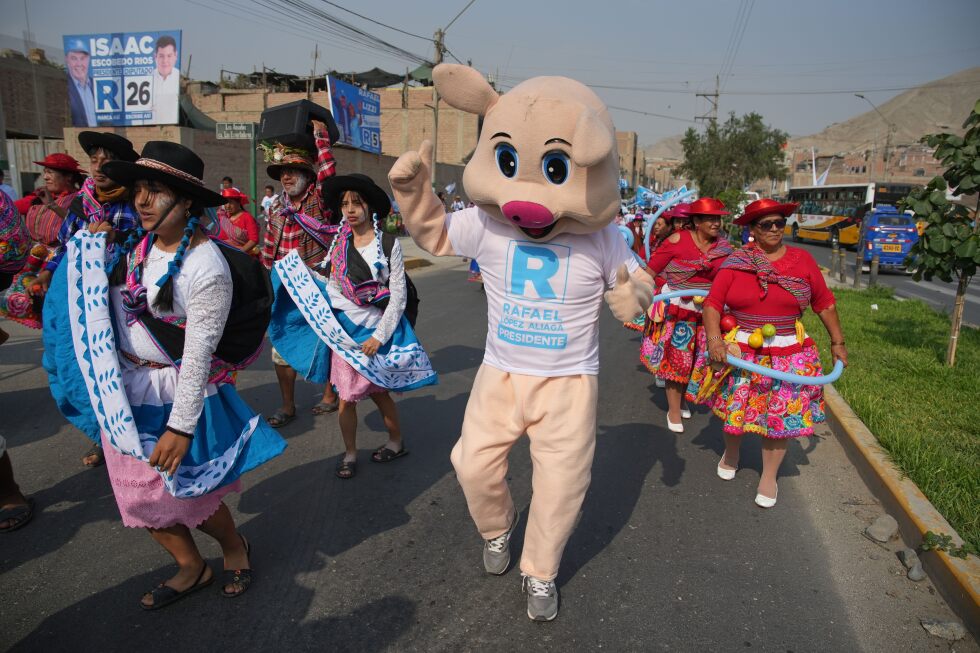
On Sunday, Peru will hold a landmark general election that will select the Andean nation’s ninth president in just 10 years, alongside the launch of a new bicameral legislative system — all against a backdrop of soaring violent crime, deep-rooted public corruption, and widespread voter cynicism that has left much of the population skeptical of change. Thirty-five candidates are competing for the nation’s top office, an unprecedented field in Peru’s electoral history that ranges from a longtime political scion and a former capital mayor to a popular comedian, reflecting deep fragmentation in the electorate that analysts say all but guarantees a June runoff.
Voting is compulsory for Peruvian citizens between the ages of 18 and 70, with more than 27 million registered voters nationwide. Around 1.2 million of those eligible to vote are currently living abroad, with the largest concentrations of overseas voters located in the United States and Argentina. To win the presidency outright, a candidate must secure a 50% majority of the vote; given the split field, no candidate is expected to hit that threshold, pushing the race to a second round.
For most Peruvian voters, the single most pressing issue driving this election is the unchecked surge in violent crime that has upended daily life across the country. Official government data shows homicides have doubled over the past decade, while extortion cases have jumped fivefold. In 2025 alone, more than 200 public transportation drivers were killed in targeted attacks, leaving ordinary residents afraid to leave their homes. A 2025 national survey from Peru’s National Institute of Statistics and Informatics found that 84% of urban respondents worried they would become a crime victim within the next year.
Juan Gómez, a 53-year-old construction worker supporting five children in Lima, summed up the pervasive frustration with public insecurity and political failure. “You can’t trust anyone anymore, nothing’s going to change,” Gómez said. “(Criminals) come on motorcycles, put a gun to your head… you look around and there’s no police officer. What are you going to do? You just let them rob you.” Raúl Zevallos, a 63-year-old retiree, echoed those fears, noting the constant risk of violence that comes with routine travel. “You get on the bus, and you have to sit far from the driver; you don’t know if you’ll make it home alive,” Zevallos said. “Criminals drive by on motorcycles, shoot, kill the driver, and you could die, too.”
In response to widespread public anger over crime, most candidates have rolled out hardline policy proposals aimed at demonstrating they will tackle the crisis. Planks of these platforms include constructing massive new maximum-security megaprisons, restricting prisoner access to food unless they work, and reinstating the death penalty for serious violent offenses.
The most high-profile candidate in the race is Keiko Fujimori, a conservative former congresswoman and daughter of late Peruvian President Alberto Fujimori, who is making her fourth bid for the presidency. Fujimori has campaigned on an “iron fist” anti-crime agenda, promising to make prisoners work to earn their meals and allow judges presiding over criminal cases to remain anonymous to protect them from gang retaliation. But her platform faces scrutiny: her political party supported recent legislative changes that legal experts argue have weakened criminal prosecutions, including eliminating preliminary detention for certain offenses and raising the legal bar for seizing assets connected to criminal activity.
Another leading conservative contender is Rafael López Aliaga, the former mayor of Lima, who has proposed building new large-scale prisons in Peru’s remote Amazon region, also backing anonymous judges and calling for the expulsion of undocumented immigrants living in the country. The race also includes outsider candidates, most notably Carlos Álvarez, a comedian who has pivoted to politics and has promised to invite policy experts from El Salvador, Denmark, and Singapore to help craft a new national security strategy for Peru.
Beyond the presidential race, Sunday’s election will mark the return of a bicameral Congress to Peru for the first time in more than 30 years, a change enacted via 2024 constitutional amendment by sitting lawmakers despite 80% of voters rejecting the proposal in a 2018 public referendum. Under the new structure, the 60-seat Senate will hold substantial new powers: the president will no longer have the authority to dissolve the Senate, and the chamber will have the power to remove the president from office through impeachment with just 40 votes, a lower threshold than the 87 votes required under the previous unicameral system. Political analysts note that the lower impeachment threshold was a direct response to the frequent turnover of presidents over the past decade that left Peru with nine leaders in 10 years, but warn the new structure concentrates too much power in a small chamber.
“They’ve concentrated too much power in a 60-people chamber,” said Alejandro Boyco, a researcher at the Institute of Peruvian Studies. “They are not going to be immune to being corrupt.” The new Senate will also be responsible for appointing and disciplining top government officials, including the national Ombudsman, Constitutional Court justices, and members of the Central Bank’s board of directors, in addition to reviewing and amending legislation passed by the lower congressional chamber.