The ongoing military conflict between the United States, Israel and Iran has escalated dramatically in recent weeks, after US President Donald Trump issued an ultimatum demanding Tehran reach an acceptable negotiated settlement by Tuesday night, or face widespread targeting of key civilian infrastructure across the country. In stark, incendiary rhetoric, Trump publicly threatened to bomb Iranian infrastructure “back to the Stone Ages”, specifying that bridges and power plants would be primary targets. In a social media post published Tuesday, he went further, warning that an entire civilization would be lost if no agreement was reached by his self-imposed deadline.
Weeks of coordinated airstrikes carried out by US and Israeli forces have already left a trail of destruction across Iran, with a growing share of damage concentrated on critical infrastructure that supports the daily lives of ordinary Iranian citizens. Fact-checking and verification team BBC Verify has independently confirmed that in the 14 days leading up to this report, strikes have hit at least two major steel production facilities, three highway bridges, and a key pharmaceutical manufacturing plant. The escalation has drawn sharp condemnation from senior Democratic lawmakers in the US Congress and top United Nations officials, who have repeatedly warned that the deliberate targeting of civilian infrastructure could violate international law and qualify as war crimes. Trump rejected these concerns outright during a White House press briefing on Monday, dismissing all criticism of the airstrike campaign.
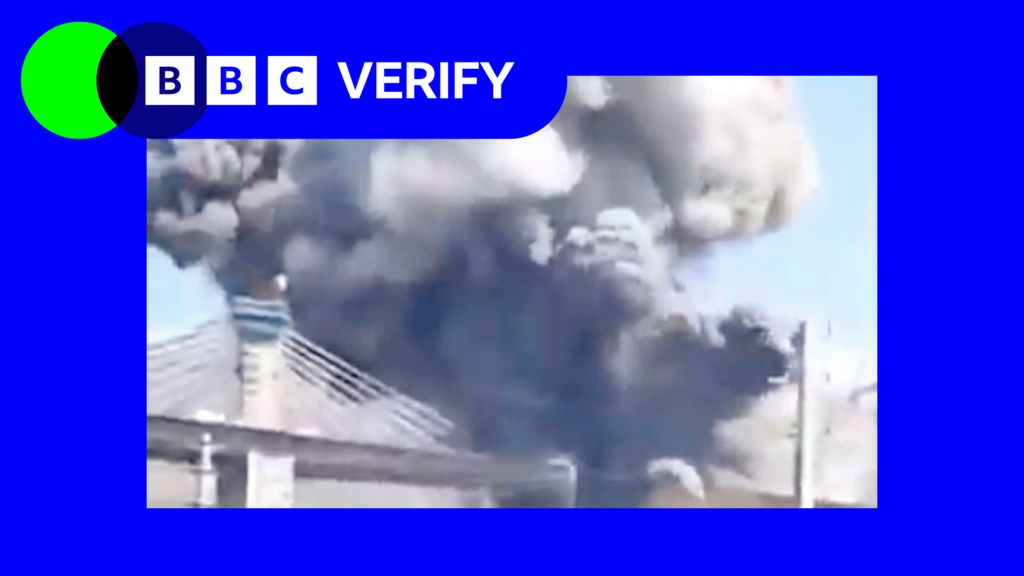
One of the deadliest recent attacks took place last Thursday, when US warplanes struck an under-construction bridge in the central Iranian city of Karaj. Local Iranian authorities confirmed the strike killed at least 13 civilians, with multiple additional people injured. Footage verified by BBC Verify shows two separate impact craters on the structure, which now has a large gaping hole in its central span, with construction cranes still standing on either side of the destroyed section. President Trump later republished verified footage of the strike to his social media platform, writing that Iran’s “biggest bridge comes tumbling down, never to be used again” and teasing that far more strikes would follow in coming days.
Iran’s critical steel production sector, a cornerstone of the country’s non-oil economy, has been among the hardest hit by the campaign. On March 27, verified footage captured thick plumes of smoke rising from the Isfahan Mobarakeh Steel Company, Iran’s largest single steel producer, forcing an immediate full suspension of all operations. Industry data linked to the company shows the facility exported roughly $860 million worth of steel between March 2025 and January 2026. Satellite imagery also confirms extensive damage at Khuzestan Steel Company, Iran’s second-largest steel manufacturer, with local officials estimating repairs could take up to 12 full months to complete.
Israeli Prime Minister Benjamin Netanyahu has claimed the coordinated strikes have disabled approximately 70% of Iran’s total steel production capacity. Arman Mahmoudian, a research fellow at the University of South Florida’s Global and National Security Institute, warned the damage will have severe, long-lasting ripple effects across Iran’s entire economy. “Steel is a cornerstone of Iran’s non-oil economic capacity,” Mahmoudian explained. “If Israeli strikes have indeed dismantled around 70% of Iran’s steel production capacity, this would place nearly 20 million tons of output at risk, potentially affecting around 3–3.5% of Iran’s GDP.”
The strikes have also expanded into Iran’s pharmaceutical sector, raising alarm about the future of the country’s public health system. On March 31, an Israel Defense Forces (IDF) spokesperson confirmed the military carried out a strike on the Tofigh Daru Research & Engineering Company, one of Iran’s largest domestic producers of anesthetics and life-saving cancer medications. The IDF claimed the facility was transferring chemical substances, including fentanyl, for use in chemical weapons research and development, but the BBC has not been able to independently verify this allegation. While pharmaceutical production makes up a small share of Iran’s overall GDP, Mahmoudian noted that targeting the sector directly undermines civilian access to critical medication and threatens the domestic medical independence Iran has built over decades. Iranian state media has previously claimed more than 90% of all pharmaceuticals used in the country are produced domestically, a figure BBC Verify has not been able to confirm.
In addition to industrial and medical infrastructure, educational and religious sites have also suffered extensive damage in recent strikes, verified imagery and footage confirms. On Saturday, photos show debris scattered across the campus of Tehran’s Shahid Beheshti University, with entire sections of a main campus building destroyed following a reported airstrike. Images also confirm damage to buildings at Tehran’s Sharif University of Technology after strikes targeted the capital on Monday. In the central city of Zanjan, a strike levelled large portions of the city’s Husseinya Mosque, destroying an on-site clinic and public library and killing two civilians, local officials confirmed.
On Tuesday, the IDF announced it had bombed 10 key segments of Iran’s national railway network. Verified footage from Aminabad village in central Iran shows a major railway bridge collapsed after the attack, while a separate verified video from the Iranian Red Crescent shows paramedics evacuating an injured civilian from a railway corridor near Karaj, though the exact cause of their injuries has not been confirmed. A railway worker based in Tehran who spoke to the BBC on condition of anonymity expressed widespread frustration among civilian workers over the attacks. “I’m really angry,” the worker said. “Everything is falling apart.” Ahead of Tuesday’s railway strikes, the IDF issued a Farsi-language warning to Iranian civilians on social media, advising them to avoid all travel and stay away from trains and railway corridors, citing risks to civilian life.
The latest wave of strikes follows a broader pattern of attacks on civilian infrastructure since the US-Israeli bombing campaign began in late February. Last month, BBC Verify revealed that a UNESCO World Heritage Site, multiple schools, and a civilian hospital were among the sites damaged in earlier bombing runs.
The targeting of civilian sites has sparked intense legal debate over whether the campaign violates international humanitarian law. Professor Rachel VanLandingham, a former US military lawyer, told BBC Verify that under international law, strikes on civilian sites are only permitted in rare, limited circumstances where they provide a clear, direct military advantage. She emphasized that any military action cannot cause excessive harm to civilian civilians compared to the expected military gain.
Independent conflict monitoring organization Acled published new data this week showing that civilian casualties have remained clustered around areas close to US-Israeli strikes on military, security, and state-linked sites, rather than spreading to widespread indiscriminate bombardment across residential neighborhoods. The organization confirmed 40 dual-use facilities, which produce both civilian and military goods, have been hit since the campaign began on February 28.
Despite that finding, top UN officials have repeatedly raised alarms over the campaign. UN spokesperson Stephane Dujarric reaffirmed Monday that any attack that causes excessive incidental harm to civilian life and infrastructure is prohibited under international law. UN High Commissioner for Human Rights Volker Turk stated Tuesday that deliberately targeting civilians and civilian infrastructure constitutes a war crime, and all those responsible for violations will be held accountable.
Sir Geoffrey Nice, a former prosecutor at the International Criminal Tribunal for the former Yugoslavia in The Hague, told the BBC’s *World at One* programme that deliberate attacks on critical civilian infrastructure such as power plants and water facilities would almost certainly qualify as disproportionate under international law. “The civilian population in any war is entitled to be properly protected and if you interfere with the basic means of life… you are at grave risk of causing completely disproportionate damage, ultimately including by starvation and disease,” Nice said.
Addressing the mounting criticism on Monday, Trump doubled down on his position, saying he was “not worried about” allegations that his threats and strikes amount to war crimes. “You know the war crime? The war crime is allowing Iran to have a nuclear weapon,” he added.