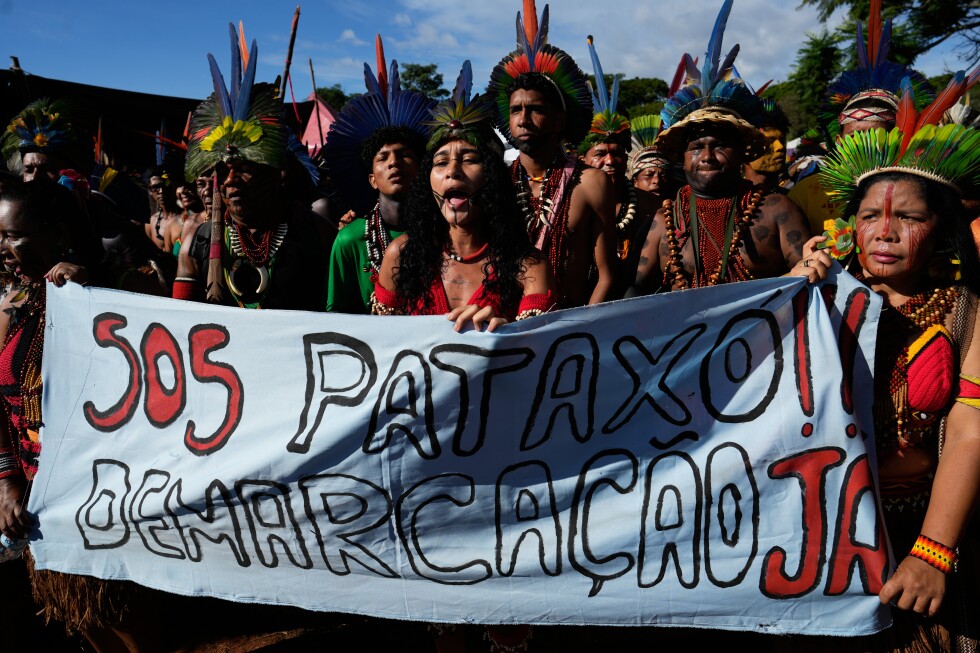
In the heart of Brazil’s capital Brasilia, thousands of Indigenous representatives from 200 distinct communities across the nation gathered this Tuesday for the 22nd iteration of the Free Land Encampment, the country’s largest annual Indigenous mobilization. Marching along the Esplanade of the Ministries toward Three Powers Square — the central district housing Brazil’s presidential palace, Congress, and Supreme Court — demonstrators came together to push back against the encroachment of corporate agribusiness, logging, and mining projects on their constitutionally protected ancestral territories.
Organized under this year’s theme “Our future is not for sale, and the answer is us,” the gathering coincides with a rising tide of land-related violence and tension across Brazil, including ongoing violent disputes targeting the Pataxo people in Bahia state and widespread unrest in the Amazon basin over the past several months. An estimated 7,000 attendees began arriving in Brasilia over the weekend, setting up camp in an open-air cultural space and holding preliminary assemblies to align their shared demands ahead of the main march. When Indigenous leaders asked the assembled crowd whether they were satisfied with the federal government’s progress on demarcating Indigenous land, and with the actions of Congress and the Supreme Court, every question drew a resounding chorus of “no.”
The march also places direct pressure on President Luiz Inácio Lula da Silva, a leftist leader who campaigned on a platform of strengthening Indigenous land rights and environmental protection after four years of rollbacks under his predecessor, but has drawn sharp criticism for moving forward with oil exploration and other resource extraction projects that contradict those core promises. With Lula widely expected to run for re-election this October, Indigenous leaders say they are demanding a seat at the table for policy decisions that shape the future of their communities.
“Congress, the Supreme Court, and the president make decisions about our lives without ever hearing our voices,” explained Alessandra Korap, a Munduruku Indigenous leader and 2023 Goldman Environmental Prize winner, as she joined the march. “They often consult one or a handful of Indigenous people and claim we all agree to a new waterway, a railroad, or a mining project. When we stand united like this, no one can speak for us — we are here to deliver our own message.”
The mobilization follows a string of recent actions across the Amazon that have yielded mixed results for Indigenous communities. In February, thousands of protesters including Korap held 33 days of demonstrations outside a Cargill facility in Para state, successfully pushing Lula to revoke a decree that would have allowed private concessions for Amazonian waterways. Just weeks earlier, however, a federal court approved licensing for a massive Canadian-led gold mining project operated by Belo Sun in Para, prompting months of continuous Indigenous-led protests in the state capital of Altamira.
As demonstrators marched on Tuesday, dressed in traditional headdresses and cultural body paint and chanting unified calls for land sovereignty, movement leaders emphasized that even with incremental gains under the Lula administration, Indigenous rights remain under growing threat from agribusiness, mining, and energy interests that dominate national politics. Dinamam Tuxá, executive coordinator of the Articulation of Indigenous Peoples of Brazil, noted that Brazil’s current political and economic context demands sustained, unified action from Indigenous communities. “Lawmakers have already advanced multiple bills that would weaken constitutional protections for our lands and reinterpret long-standing land rights to open more territories to extraction,” Tuxá explained. “With global demand for oil, gas, and critical minerals rising, these economic interests are putting unprecedented pressure on our territories.”
The contradiction at the heart of Lula’s policy agenda remains a central point of tension for the movement. Lula was invited to attend the Free Land Encampment, but had not confirmed his attendance as of Monday afternoon. While members of his administration, including Indigenous Peoples Minister Eloy Terena, have confirmed they will participate in policy hearings during the week-long gathering, Lula has continued to argue that economic development and environmental conservation can coexist, even as he approves new extraction projects opposed by Indigenous and environmental groups.
Recent judicial action has added new urgency to the movement’s demands. In February, Supreme Court Justice Flávio Dino ordered Congress to pass formal legislation regulating mining activity on Indigenous territories within two years. In his ruling, Dino acknowledged that illegal mining is already widespread on Indigenous lands, carried out with pervasive violence and disregard for environmental protections, and affirmed that the Cinta Larga people, whose territory spans the Amazonian states of Mato Grosso and Rondonia, retain the right to conduct mining on their own land if they comply with environmental rules and secure broad community approval. Under current Brazilian law, all mining and mineral exploration on Indigenous territory requires congressional approval in addition to community consultation.
But legal and environmental advocates warn that a Congress dominated by agribusiness and pro-extraction lawmakers will almost certainly draft legislation that undermines Indigenous sovereignty. Renata Vieira, a lawyer with the non-profit Instituto Socioambiental, called the push to open Indigenous territories to formal mining one of the most severe threats facing Indigenous communities in modern Brazil. “Any legislation coming out of this current Congress will be deeply harmful to Indigenous rights,” Vieira said.
Beyond the immediate fight for Indigenous sovereignty, the protection of Indigenous territories is widely recognized by climate scientists as one of the most effective strategies to curb Amazon deforestation. The Amazon, the world’s largest tropical rainforest, acts as a critical global carbon sink that regulates global climate patterns, and researchers warn that continued large-scale forest loss could accelerate dangerous levels of global warming. Data from 2022 collected by MapBiomas, a network of non-profit land-use tracking organizations, underscores the impact of Indigenous stewardship: over 30 years, Indigenous territories lost just 1% of their native vegetation, compared to a 20% loss on private land across Brazil.