Global financial markets swung sharply on Tuesday, as fresh US-Israeli strikes near Iran’s critical Kharg Island oil export terminal triggered volatility just hours before a looming deadline set by US President Donald Trump for Tehran to reopen the Strait of Hormuz. The escalating Middle East tensions have injected deep uncertainty into trading rooms across the world, leaving investors bracing for the possibility of a full-scale attack that could cripple global energy supplies.
Oil prices recorded immediate gains following the strike reports: the May contract for West Texas Intermediate, the US crude benchmark, climbed 2.7 percent to settle at $115.44 a barrel, while June Brent North Sea crude rose 0.5 percent to $110.30 a barrel. While prices climbed even higher in the immediate aftermath of the strike news, they partially pulled back after confirmations emerged that the targeted sites were military facilities rather than key energy export infrastructure, easing some of the most extreme market jitters for the moment.
Equity markets across major global economies moved firmly into negative territory. All three major US stock indices opened lower and remained down through morning trading, with the Dow Jones Industrial Average dropping 0.6 percent to 46,391.07, the S&P 500 falling 0.5 percent to 6,577.13, and the Nasdaq Composite slipping 0.6 percent to 21,867.83. European mid-afternoon trading followed the downward trend, with London’s FTSE 100 falling 0.4 percent, Paris’ CAC 40 edging 0.1 percent lower, and Frankfurt’s DAX dropping 0.4 percent. By contrast, the US dollar saw little volatility against most major global currencies, holding steady through the trading session.
The root of the current market tension dates back to late February, when Iran blocked commercial passage through the Strait of Hormuz— a waterway that carries roughly one-fifth of the world’s daily global oil trade. The disruption has already pushed global energy prices sharply higher, and policymakers around the world are now bracing for a potential second inflation surge tied to the escalating conflict.
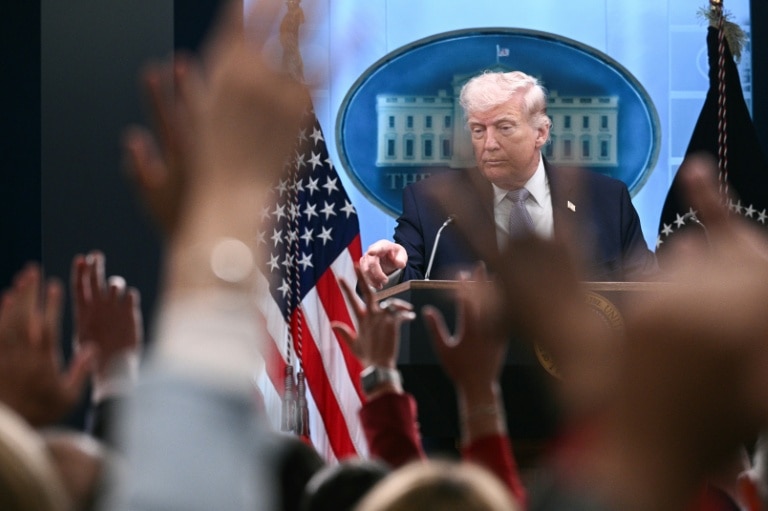
President Trump ramped up rhetoric ahead of his self-imposed midnight GMT deadline, warning Tehran that any failure to reopen the strait would result in what he called the “complete demolition” of Iran’s critical national infrastructure. He doubled down on the threat on Tuesday, stating that “a whole civilization will die” if Iran rejects US war demands, though he added that he “hopes” such drastic action will not be necessary. Iran has shown no indication of backing down: the country’s Revolutionary Guard has issued a counter-warning that it will destroy all major energy installations across the Persian Gulf if any US attack crosses Tehran’s stated “red line.”
Market analysts note that trading activity is being driven by conflicting emotions: cautious optimism that a full-scale attack can be avoided is running parallel to deep anxiety that conflict will break out. “Ultimately no one knows what the president will do next, and this is causing tensions to remain high in financial markets,” explained Kathleen Brooks, research director at XTB. Patrick J. O’Hare, an analyst at Briefing.com, summed up the market mood, noting “Today is a hand-wringing day if there ever was one.”
The rising energy costs have already started to show up in economic data. On Tuesday, the Philippines reported that annual inflation jumped to 4.1 percent in March, exceeding analyst forecasts and hitting the highest level in nearly two years. Last week, US economic data showed that service sector growth cooled in March, as businesses adjusted their outlooks to account for higher energy prices and potential new supply chain disruptions.
Against the backdrop of Middle East tension, there was one bright spot in global markets: shares of Samsung Electronics rallied roughly one percent after the tech giant projected that its first-quarter net profit would soar 755 percent year-over-year to an all-time record of $38 billion, driven by booming demand for advanced semiconductors that power artificial intelligence systems.
Among major Asian benchmark indices, Tokyo’s Nikkei 225 closed flat at 53,429.56, while Shanghai’s Composite Index gained 0.3 percent to close at 3,890.16. Hong Kong’s Hang Seng Index was closed for a public holiday on Tuesday.