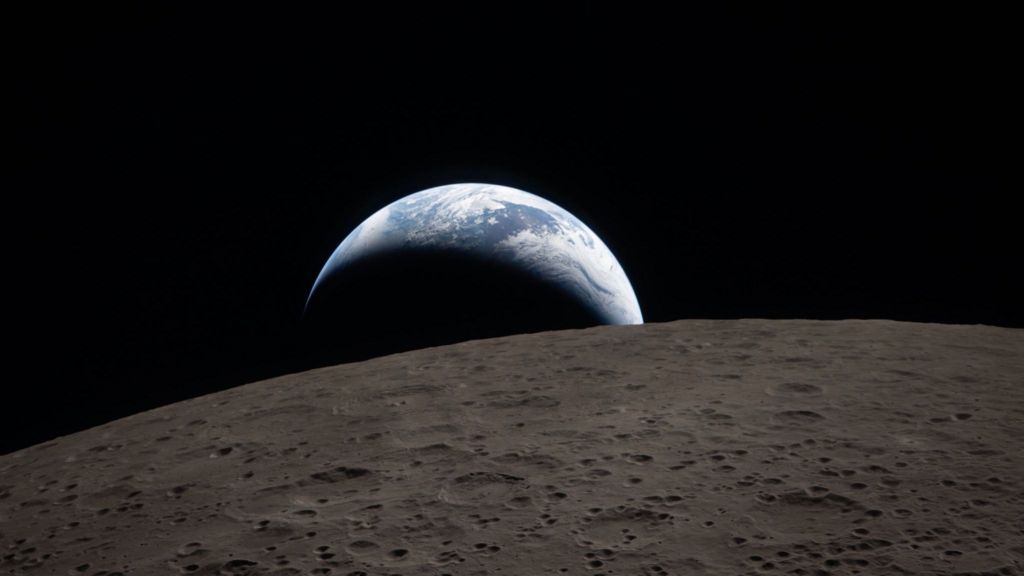
In a landmark moment for modern human space exploration, NASA has publicly released the first never-before-seen photographs captured by the Artemis II crew during their groundbreaking flight past the Moon, offering the public an intimate, unprecedented view of our closest celestial neighbor and home planet from a human vantage point not seen since the final Apollo mission more than 50 years ago.
Among the released images, one frame that has already drawn global attention captures what NASA describes as a quiet, stunning Earthset: our blue home planet peeking gently over the rugged, crater-pocked horizon of the Moon, a perspective that has only ever been witnessed by a handful of humans in history. A second photograph showcases a rare, spectacular solar eclipse, a sight only accessible to a crew orbiting the Moon — the lunar body perfectly aligned between the spacecraft and the Sun, completely blocking the star’s bright disk to create a singular astronomical view. A third image, nicknamed by NASA “Ready for a close up”, offers a crisp, detailed look at the Moon’s battered, ancient surface, highlighting the geological features that scientists continue to study to unlock the solar system’s history.
The images were captured during the mission’s six-hour lunar flyby maneuver, a phase of the journey that included a period of planned radio silence when the Orion capsule passed behind the far side of the Moon, cutting off contact with ground control on Earth. According to NASA’s official timestamp, the iconic Earthset photograph was shot through one of Orion’s observation windows at 18:41 Eastern Daylight Time (23:41 BST) this past Monday.
In its detailed official description of the frame, NASA explained that the shadowed portion of Earth in the image is in the grip of nighttime, while the sunlit hemisphere clearly shows swirling cloud systems stretching across Australia and the Oceania region. In the immediate foreground of the photograph sits Ohm crater, a well-preserved complex impact crater marked by distinct terraced edges and a relatively flat floor split by sharp, raised central peaks. NASA added that these central peaks form when the asteroid or comet impact that creates the crater temporarily liquefies the lunar surface, which then rebounds upward to form the raised central rock formations after the initial impact.
The agency has not yet confirmed which of the four Artemis II crew members took the photographs, as the mission is currently on its return trajectory toward Earth, with splashdown planned in the coming days. The Artemis II mission is the first crewed test flight for NASA’s Artemis program, which aims to land the first woman and first person of color on the lunar surface later this decade, establish a long-term sustainable lunar outpost, and prepare for future human missions to Mars. These first hand-held photographs from the mission are already being celebrated as a reminder of the power of human space exploration to connect people across the globe to the wider universe.