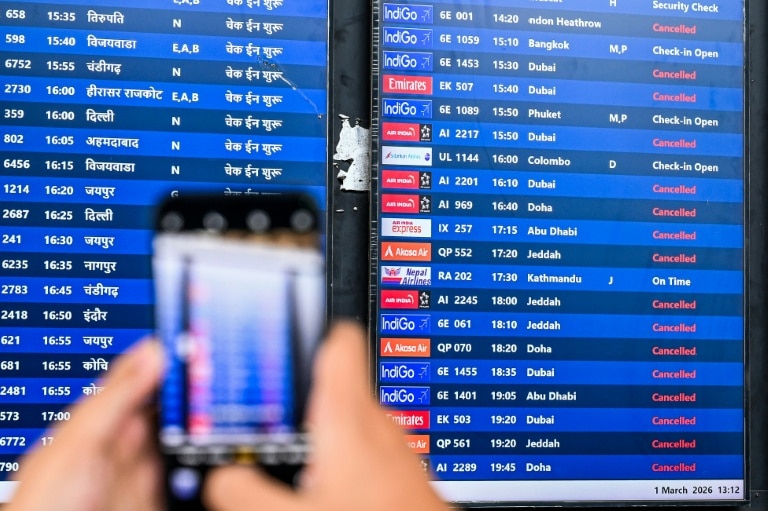
International governments and airlines have launched coordinated evacuation operations to rescue tens of thousands of travelers stranded across the Middle East following unprecedented airspace closures triggered by regional military conflicts. The crisis emerged after Israel-US strikes on Iran prompted widespread aviation shutdowns, creating what aviation analysts describe as one of the most significant air travel disruptions in recent history.
According to data from aviation analytics firm Cirium, a staggering 12,903 flights were canceled between Saturday and Monday—representing 40% of all scheduled departures. The cancellations have directly impacted an estimated one million passengers, with Dubai International Airport, the world’s second-busiest aviation hub, experiencing near-total operational suspension during the peak of the closures.
European nations have spearheaded evacuation efforts, with the Czech Republic, Slovakia, and Romania executing emergency airlifts that returned hundreds of citizens via specially chartered flights. France, facing one of the largest contingents with approximately 400,000 nationals in the region, initiated repatriation flights under direct presidential oversight. Germany organized charter flights from Oman to evacuate some of the 30,000 stranded Germans, while British authorities arranged similar operations from Oman and Jordan.
The United States confirmed it has facilitated the return of over 9,000 citizens since Saturday through charter flights from Jordan, Saudi Arabia, and the United Arab Emirates. Meanwhile, Russian evacuation teams retrieved nationals who had fled to Azerbaijan from Iran, along with dozens stranded in Egypt.
Commercial airlines have joined government efforts, with Indian carriers IndiGo, Air India Express, and Akasa Air announcing special evacuation flights. British Airways scheduled a repatriation flight from Oman for Thursday, though numerous carriers including Air France, LOT, Norwegian, SAS, and Finnair have suspended Middle Eastern operations indefinitely, with some cancellations extending through month’s end.
While Dubai and Abu Dhabi airports resumed limited operations Monday, significant airspace restrictions remain over Iraq, Israel, Kuwait, Libya, and Qatar—where authorities reported blocking an attack on its major aviation hub. Israel announced plans for gradual airspace reopening beginning Wednesday night, initially permitting only repatriation flights for returning nationals.