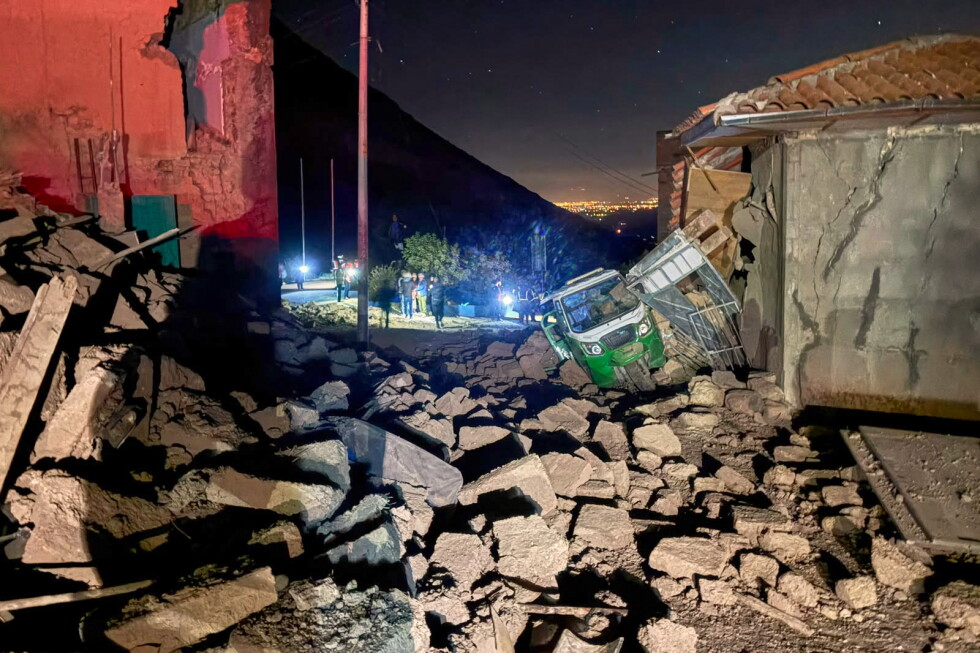
A destructive 5.5-magnitude earthquake has rocked the Andean highlands of central Peru, leaving at least five people dead and triggering widespread displacement and infrastructure damage, Peruvian national authorities confirmed Sunday. Over 20 residents were treated for quake-related injuries, and roughly 300 people have been forced to leave their damaged or destroyed homes in the aftermath of the disaster.
According to data from the U.S. Geological Survey (USGS), the seismic event hit at 9:24 p.m. local time Saturday. Its epicenter was positioned just 2 kilometers (1.24 miles) west-southwest of Sicaya, a small city in Peru’s Huancayo province, and the quake originated at a relatively shallow depth of 10 kilometers (6.21 miles) below the Earth’s surface.
In an official update, Peru’s National Civil Defense Institute stated that the full scope of the disaster remains unclear, as the total number of people unaccounted for has not yet been confirmed. Multiple structures across the affected region have either completely collapsed or sustained critical structural damage, among them a historic local church and adjacent convent.
Luis Vásquez, director of the regional civil defense office, explained to reporters that the widespread heavy damage can be partially attributed to common building practices in the Andean region. Many local homes and structures are constructed with traditional rustic adobe, a material that offers far less resistance to seismic shaking than modern engineered building materials, amplifying the disaster’s impact.
Peru sits along the Pacific Ocean’s geologically active “Ring of Fire,” a zone where constant tectonic plate movement makes major and minor earthquakes a frequent hazard for the country’s population. The 2007 Pisco region earthquake, which measured magnitude 7.9, killed close to 600 people and stands as one of the deadliest seismic events to hit the South American nation in recent decades.
Footage aired by local Peruvian media outlets has captured the acute distress of residents in one of the hardest-hit communities, the low-lying agricultural zone of Chongo Bajo. Locals can be seen gathered outside their heavily damaged homes, huddled together under blankets to stay warm after being forced to evacuate, with some livestock also reported trapped under collapsed rubble.
Hermenegilda Guamalato, a displaced resident, shared her experience with local radio after relocating to neighboring Huayucachi province to find emergency shelter. “My home has been destroyed,” she explained, adding that she was now searching for safe, stable accommodation alongside her three children.
Response teams continue to assess the full extent of casualties and damage across the affected region as of Sunday, with emergency shelter and basic supplies being mobilized for displaced residents.