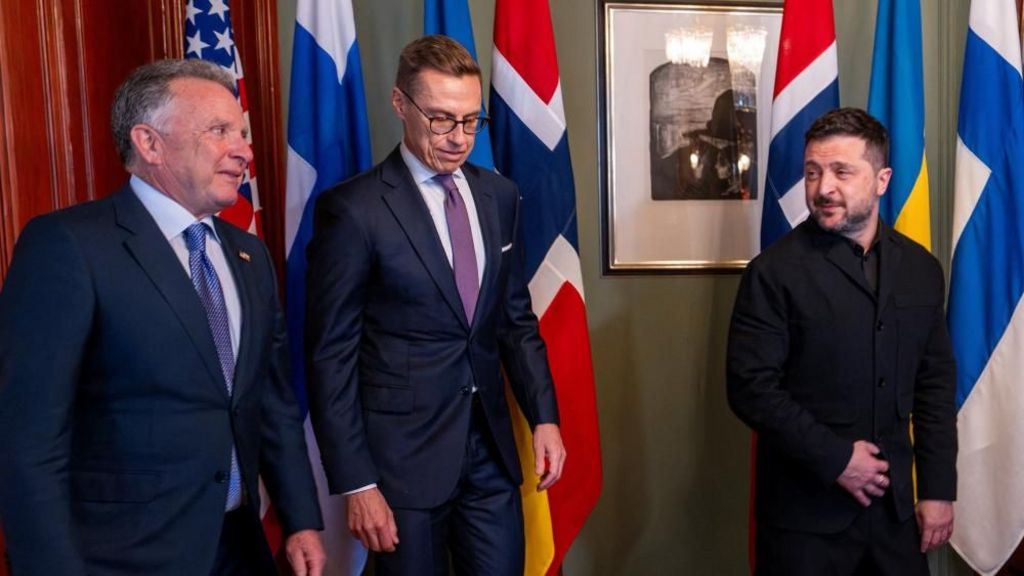
High-stake negotiations hosted in Oslo this week have marked a partial breakthrough in strained relations between Kyiv and Washington, with Ukrainian President Volodymyr Zelensky confirming that U.S. intelligence sharing for early warnings of Russian missile and drone attacks is now functioning effectively. The resolution of this friction point came during closed-door talks between Zelensky and Donald Trump’s special envoy Steve Witkoff, clearing the way for the next phase of Western-backed peace efforts that will move to St. Petersburg when Witkoff meets Russian leadership on Wednesday.
The meeting in the Norwegian capital followed weeks of growing tensions between the two allies, after Kyiv publicly accused Washington of holding back critical intelligence that could protect Ukrainian civilians from deadly airstrikes. That claim was immediately dismissed as “scandalous” by U.S. Secretary of State Marco Rubio, who has pushed back on suggestions the Trump administration is deliberately withholding military support. A parallel dispute has also emerged over SpaceX’s Starlink satellite internet service, which Ukrainian military forces rely on for drone operations against Russian targets. Zelensky told reporters after the Oslo talks he remained hopeful for a positive resolution to recent reported speed restrictions on the platform, a issue that a bipartisan group of U.S. senators has already called for an urgent investigation into.
Finnish President Alexander Stubb, one of the co-hosts of the multilateral talks alongside Norwegian Prime Minister Jonas Gahr Støre, announced that participants had made “genuine progress” on drafting a set of peace proposals, though he declined to share specific details and cautioned that a negotiated end to the three-year conflict will require significant patience. Støre also emphasized a core European demand: that European nations must be included at every stage of any peace talks, a position that comes amid growing concern across the continent over inconsistent signals from the Trump administration on its commitment to Ukraine’s security.
Witkoff did not appear at the joint press conference following Tuesday’s discussions, and the focus now turns to Moscow’s response to the drafted framework. Russian President Vladimir Putin has not yet issued a public comment on the latest developments, but Foreign Minister Sergei Lavrov has already signaled the Kremlin’s opening stance: while it will hear out Witkoff’s proposals, it will not make any political concessions. Moscow currently retains control of roughly 20 percent of Ukraine’s internationally recognized territory, three years after Putin launched a full-scale invasion of the country in 2022.
On the same day the Oslo talks were held, Russian forces continued their regular airstrike campaign, killing at least 10 civilians across Ukraine: four in and around Kyiv, four in the eastern Donetsk region, and two in the central city of Dnipro. The deadly attacks underscored the ongoing urgency of early warning intelligence that Zelensky highlighted, noting that timely alerts allow civilians to take shelter before incoming ballistic missiles strike.
The Oslo meeting was not the first round of backchannel talks between U.S. and Ukrainian representatives in recent weeks. Earlier this month, a Ukrainian delegation led by intelligence chief Rustem Umerov and lawmaker Davyd Arakhamia met Witkoff and Trump’s son-in-law Jared Kushner in Miami. That meeting ended abruptly after the delegation learned Trump would lift U.S. sanctions on Russian diesel exports, allowing Moscow to ship more than 300,000 tons of diesel to the U.S. and global markets. Zelensky reacted to the decision by calling it a “happy birthday present” for Putin.
Recent weeks have seen a sharp downturn in public U.S.-Ukraine relations, with Trump repeatedly stating that it is time for Ukraine to negotiate an end to the war and even suggesting that Ukraine should replace its current leadership. Speaking to reporters at the White House after the Oslo talks, Trump reaffirmed his position that Kyiv should reach an agreement, saying Russia is also willing to finalize a deal and that the war must end. Ahead of upcoming U.S. midterm elections, Trump has also blamed Ukrainian strikes on Russian oil refineries for rising U.S. fuel prices, a point echoed by Vice President JD Vance in comments this week that have alarmed European leaders.
Vance said Monday that he does not consider Ukraine a formal U.S. ally, noted it is not a NATO member and should not join the alliance, and said Washington and Kyiv hold divergent interests on multiple issues, including strikes on Russian energy infrastructure. German Chancellor Friedrich Merz echoed widespread European anxiety this week, saying there are “mixed pictures and messages” coming from Washington on the war. Merz told Bloomberg TV that Europe remains committed to supporting Ukraine despite the heavy budgetary burden, and is working to convince the U.S. administration that the conflict must be resolved jointly with European partners.
On the issue of U.S. military support, unconfirmed reports ahead of the Oslo talks suggested that the transfer of additional U.S.-made Patriot interceptor missiles – the only weapon system Ukraine currently has that can effectively shoot down Russian ballistic missiles – has not yet been approved by the Trump administration. Rubio, who is currently on an official visit to India, acknowledged that the new interceptors have not yet arrived in Ukraine but denied that Kyiv has been intentionally denied any requested military support. Zelensky added that he held a constructive discussion with Rubio ahead of the Oslo meeting on the need for early warning intelligence, additional Patriots, and a resolution to the Starlink restrictions.