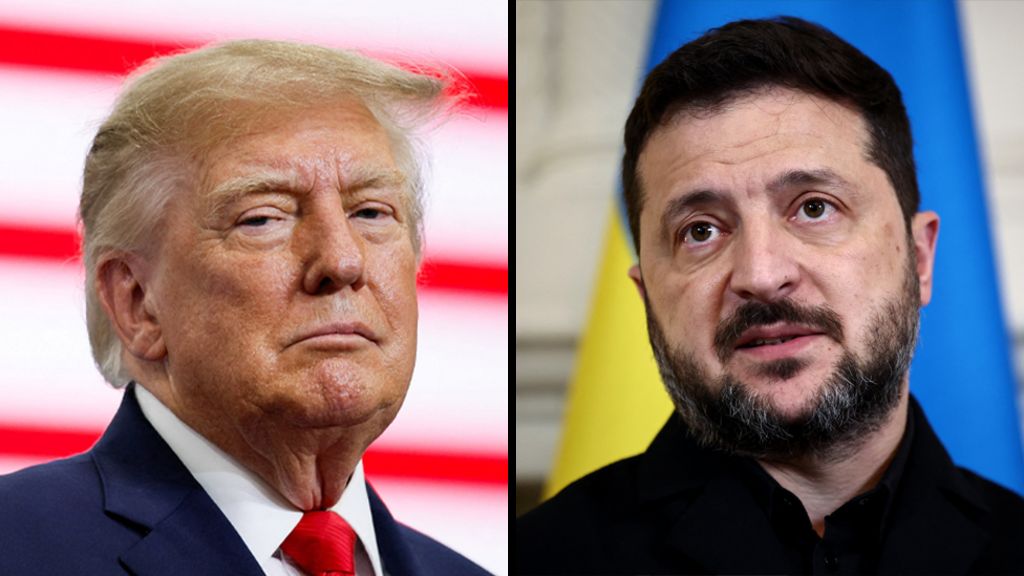
A warm opening hug between former U.S. President Donald Trump’s special envoy Steve Witkoff and Ukrainian President Volodymyr Zelensky in Oslo this week did little to mask the growing rift at the highest levels of U.S.-Ukrainian relations, as a series of controversial policy shifts from the Trump administration have left Kyiv questioning Washington’s commitment to its war against Russian invasion.
The meeting, held in the Norwegian capital, comes after ten days of escalating public tension between Trump and Zelensky that has laid bare the fractious and unpredictable nature of their relationship. The two leaders have never enjoyed close ties, but recent exchanges have revealed a rupture deeper than any seen in years. Last week, Trump publicly attacked Zelensky in an interview with Newsmax, calling the Ukrainian leader “not a good guy” for the U.S. to work with. This week, he doubled down, dismissing Zelensky’s criticism of the U.S.-Russia diesel deal by saying “Zelensky doesn’t know what he’s talking about.”
These harsh words are characteristic of Trump’s blunt, inconsistent approach to diplomacy, observers note. For instance, just four months after lambasting Israeli Prime Minister Benjamin Netanyahu in June 2025, calling him a leader with poor judgment, Trump publicly endorsed him ahead of Israel’s elections. “Trump can always do another U-turn,” explained Ian Bond of the Centre for European Reform, “But this does look bad.”
For his part, Zelensky has historically maintained a cautious public tone regarding his most unreliable yet critical partner, but this month his frustration has boiled over. Speaking to a visiting U.S. congressional delegation, Zelensky referenced “decisions on the American side that are hard to explain between friends” and openly voiced fears that Washington has made a political decision to slow down military support to Ukraine. Responding directly to Trump’s recent claim that he is the main barrier to a negotiated end to the war, Zelensky wrote on Telegram: “We have welcomed literally EVERY attempt by our partners to end this war with dignity.”
This is not the first time U.S.-Ukraine relations have hit a crisis point. After a high-profile public altercation between the two leaders in the Oval Office in February 2025, when Trump accused Zelensky of “gambling with World War III,” Washington temporarily suspended military aid and restricted intelligence sharing. That crisis was resolved in a week, and when the Trump administration later decided to end direct U.S. financing for military assistance to Ukraine, it established a mechanism for European nations to purchase U.S.-made military equipment on Kyiv’s behalf.
Today, however, the strains are being felt on the front lines of Ukraine’s air defense. One critical exception to the European funding model has been U.S.-made Patriot air defense missiles, which are badly needed by Kyiv to counter Russian ballistic missile attacks. Amid a global shortage of Patriot interceptors, supplies to Ukraine have slowed to a trickle. Citing an unnamed senior Ukrainian official, The Washington Post reported that only a handful of interceptors remain in Kyiv’s stockpile, and the Trump administration has delayed approval for U.S. allies to transfer their own Patriot stocks to Ukraine.
The most consequential policy shift that has angered Kyiv came earlier this month, when Trump announced a new deal with Russian President Vladimir Putin to open U.S. markets to Russian diesel exports. While experts have questioned whether the deal will actually lower U.S. gasoline prices ahead of congressional midterm elections – widely seen as the primary political motivation for the agreement – it sent a clear signal that Washington is willing to prioritize its own political and economic interests over Ukraine’s concerns, particularly in the wake of Ukraine’s long-range strikes on Russian oil infrastructure. For Kyiv, the deal was a sharp rebuke.
Things got worse last Friday, when Trump waived a new round of sweeping sanctions on Russia that had been passed in the Graham Act – legislation named after late South Carolina Senator Lindsey Graham, a prominent and longtime supporter of Ukraine. Trump justified the move by arguing the sanctions would derail his efforts to broker peace between Russia and Ukraine, but Kyiv and its supporters see it as further evidence that the White House is aligning with the Kremlin. “What the Trump administration is doing is providing carrots to the Russians and sticks applied to the Ukrainians,” former U.S. Ambassador to Ukraine William Taylor told the BBC, adding “It’s inexplicable and saddening.” Senior Russian envoy Kirill Dmitriev echoed that reading, calling the move “an important and truly historic moment,” a development that aligns with Moscow’s vision of closer U.S.-Russia ties promoted after the 2025 Trump-Putin summit in Anchorage.
Further eroding trust are unconfirmed allegations that the Trump administration has restricted intelligence sharing with Kyiv and limited Ukraine’s access to Elon Musk’s Starlink satellite internet service, both critical tools for Ukraine’s defense against Russian drone and missile attacks. Zelensky told NBC News that for three days amid a wave of Russian ballistic attacks, Ukraine received no advance warning from U.S. satellite intelligence. On October 12, five Russian S-400 missiles hit central Kyiv before air raid sirens or mobile alerts could be activated, according to local reports. U.S. Secretary of State Marco Rubio has denied any intentional pause in intelligence sharing, blaming the gap on a temporary “software problem.”
Similar confusion surrounds Starlink access. Ukrainian officials reported last week that connection speeds have been throttled, leaving military terminals unable to maintain the stable high-speed connections needed to intercept fast-moving Russian jet-powered drones, which have launched an escalating wave of attacks on Ukrainian cities in recent months. Reuters reported that the order to restrict access originated at the White House, but Rubio has denied that any such order was issued. Even so, the repeated emergence of these allegations points to a deep and ongoing breakdown of trust between the two sides.
This long-running tension has deep roots. For more than a decade, Trump has harbored mistrust toward Ukraine, stemming from his debunked belief that Ukrainian officials interfered in the 2016 U.S. election to prevent him from winning, including the false claim that the Democratic National Committee stored a server on Ukrainian territory. When Zelensky took office in 2019, he resisted Trump’s demands to open investigations into both the 2016 election claims and then-candidate Joe Biden, a refusal that came as Trump was withholding $391 million in congressionally approved military aid to Ukraine – a scandal that ultimately led to Trump’s first impeachment.
While it remains unclear whether this historical resentment is shaping current U.S. policy, there is no question that the already volatile U.S.-Ukraine relationship has entered another period of severe strain. Following the Oslo talks, Witkoff is set to carry a new set of Ukrainian proposals to St. Petersburg for talks with Putin, leaving the international community waiting for Moscow’s next move. Norwegian Prime Minister Jonas Gahr Støre, who hosted the talks, said the meeting had helped “to straighten out a few things,” and struck a diplomatic tone, saying “There’s nothing to gain from… digging into what was said yesterday or a week ago.”
Zelensky struck an optimistic note after the talks, telling reporters he had a productive conversation with Secretary Rubio, that the early warning intelligence issue had already been resolved, and that he expected positive progress on both Patriot missile supplies and Starlink access. “I think we will have good results too,” he said. Even so, behind Zelensky’s carefully calibrated upbeat tone, it is clear that Volodymyr Zelensky and Donald Trump are once again at odds, with the future of critical U.S. support for Ukraine hanging in the balance.