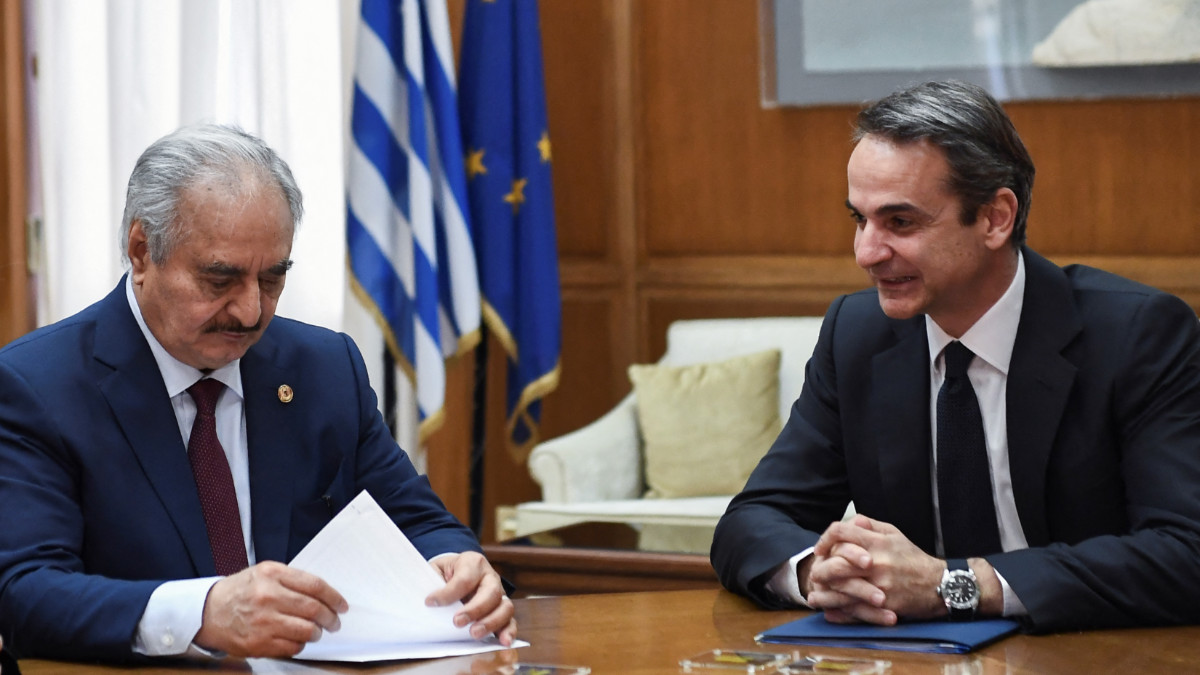
Weeks before Libya’s east-based House of Representatives approved a divisive maritime boundaries agreement with Turkey, Athens launched intensive diplomatic outreach to its key regional partners – Cairo, Jerusalem, and Abu Dhabi – in a last-ditch effort to block the deal, multiple senior regional officials confirmed to Middle East Eye. Despite Greece’s lobbying, the Benghazi-based parliament voted to ratify the accord on Tuesday, a development that underscores both Turkey’s growing regional influence and a sweeping geopolitical reordering across the Middle East that has undermined Greece’s coordinated effort to counter Ankara. \n\nThe ratification cements Turkey’s outsized role in Libyan politics and confirms a cross-factional Libyan consensus backing Ankara’s expansive claims to Eastern Mediterranean maritime territory, analysts note. “Turkey has entrenched its position in Libya so deeply that any future Libyan leader would struggle to reverse course and strike a deal favorable to Greece,” explained Constantinos Filis, director of the Athens-based Institute of Global Affairs, in an interview with Middle East Eye. “There is now a unified Libyan position that aligns with Turkey’s interests, which is a major strategic shift from just a few years ago.”\n\nFar from being just a bilateral setback for Greece or a routine diplomatic win for Turkey, the accord lays bare how rapidly regional alliances are realigning as the United States reduces its security footprint in the Middle East and new tensions linked to the ongoing Israel-Iran standoff have reshaped national priorities across the region. For Greece, the failure of its closest regional partners to block the deal exposes a gap between its expectations and shifting regional interests, a reality rooted in the ongoing geopolitical reconfiguration of the Middle East.\n\nOver the past decade, the Eastern Mediterranean has emerged as a flashpoint for competing Greek and Turkish claims, a rivalry that predates the 2011 collapse of the Muammar Gaddafi regime that split Libya into rival administrations based in Tripoli and Benghazi. The two NATO allies even came close to open conflict in 1996 over a remote uninhabited Aegean islet, with the United States historically stepping in to de-escalate tensions between its two alliance partners. Today, however, that dynamic has shifted dramatically: Washington has reduced its engagement in Middle Eastern security affairs, and NATO itself is grappling with internal divisions amplified by the war in Ukraine, while Turkey has built a robust domestic defense industry that has reduced its reliance on Western military suppliers. \n\nAgainst this backdrop, Turkey’s regional influence has expanded steadily: it backs a sympathetic government in Syria, and an increasing number of Gulf states now view Ankara as a critical security partner as U.S. influence wanes. Tom Barrack, the U.S. ambassador to Turkey and special envoy for Syria and Iraq, acknowledged this shift in comments Tuesday, noting that the decades-long U.S. “oil for security” framework for Gulf relations is currently in a period of transition.\n\nA senior Libyan source with knowledge of internal negotiations told Middle East Eye that the ratification of the maritime deal is part of a broader, U.S.-backed plan to unify Libya under a single national government, an initiative that Washington has agreed to advance in coordination with Ankara. The source added that the U.S. wants Turkey to broker a power-sharing agreement between the rival Benghazi and Tripoli administrations, a development corroborated by this week’s visit to Tripoli by the head of Turkish intelligence, Ibrahim Kalın.\n\nFor its part, Greece has worked aggressively to build a counter-coalition of regional partners to push back against Turkey’s expanding maritime claims, which Athens says violate Greek sovereign rights over large territorial zones, including around the populous island of Crete, home to more than 600,000 Greek citizens. Greece has deepened its longstanding warm ties with Egypt: when Turkey first signed a maritime demarcation deal with the Tripoli-based government in 2019, Athens responded by signing its own agreement with Cairo to codify its competing claims. Greece has also moved closer to the United Arab Emirates: Greek Prime Minister Kyriakos Mitsotakis was among the first foreign leaders to visit Abu Dhabi amid heightened 2020 tensions between the U.S. and Iran, and when Greek-Turkish tensions spiked that same year, the UAE dispatched military aircraft to Crete in a show of support.\n\nMost significantly, Greece has forged a close strategic alliance with Israel, which is itself locked in a regional power struggle with Turkey that plays out across conflict zones from Syria to the Horn of Africa. In August, Athens finalized a $3.5 billion defense deal with Israel – the largest arms sale in Israeli history – a move that cemented the growing military partnership between the two countries. \n\nThe ratification of the Turkish deal by eastern Libya’s parliament is a particularly stinging defeat for Greece because eastern Libya has long been backed by Egypt, the UAE, and Israel – the same three countries that Athens counts as its core regional partners. The territory is controlled by military commander Khalifa Haftar, who for years was seen as a bitter rival of the Turkey-backed Tripoli government, making his failure to block the agreement all the more notable for Athens. Greece had lobbied Cairo heavily in recent months to pressure Haftar to reject the deal, and just five days before the vote, an Egyptian diplomatic delegation traveled to Athens for high-level talks on how to prevent ratification.\n\nIn a striking turn of events, even Khalifa Haftar’s son and likely successor, Saddam Haftar, has recently moved closer to Ankara, despite Turkey’s past intervention to block his father’s attempt to capture Tripoli during Libya’s civil war. Multiple sources confirmed to Middle East Eye that amid pressure from the UAE, Saddam Haftar traveled to Athens for talks earlier this summer, even as he deepened his rapprochement with Turkish officials. \n\n“It was unrealistic for Greece to expect Egypt and the UAE to prioritize Greek interests over their own evolving regional priorities,” Filis noted. “Their positions have shifted dramatically in recent years, and it was unwise to assume they would align with Athens on this issue at the cost of their own improved relations with Turkey.”\n\nJust a few years ago, both Egypt and the UAE were openly at odds with Turkey: Cairo and Abu Dhabi backed the Haftar-led campaign in eastern Libya during the civil war, while Turkey supported the Tripoli government. Today, however, both states have taken significant steps to normalize relations with Ankara. Egyptian officials have repeatedly emphasized to Middle East Eye that Cairo’s rapprochement with Turkey is not directed at Greece, and Egyptian Foreign Minister Badr Abdelatty reaffirmed this position in a call with his Greek counterpart on Tuesday, stressing the ongoing shared interests between Athens and Cairo. \n\nEven so, regional analysts note that Egypt and Turkey now find themselves aligned on more regional issues than they compete on, even if both continue to hold competing maritime interests in the Eastern Mediterranean. “Egypt does not want to see the Eastern Mediterranean dominated by Turkey, but it has bigger fish to fry,” one senior Arab official told Middle East Eye. Both Cairo and Ankara are deeply wary of expanding Israeli territorial ambitions in the wake of the October 7, 2023 attacks by Hamas and the subsequent Israeli military campaign in Gaza, which has resulted in widespread civilian casualties and the occupation of additional territory in Syria and Lebanon. The two countries also share aligned interests in the Red Sea region: both support Somalia’s territorial integrity and oppose Israel’s recognition of the breakaway Somaliland republic, and both back Sudan’s transitional government against the Rapid Support Forces, a paramilitary group that Israeli Prime Minister Benjamin Netanyahu has openly acknowledged is sympathetic to Jerusalem. In Libya itself, Egypt has major economic interests at stake, including plans to construct a $1 billion oil pipeline from Tobruk in eastern Libya to the Egyptian port of Alexandria, creating an incentive for Cairo to maintain stable relations with all Libyan factions, regardless of their alignment with Turkey.\n\nThe UAE, while still holding competing interests with Turkey in some regions including Sudan, has also worked to resolve its differences with Ankara in recent years. A notable example of this thaw came in 2022, when Abu Dhabi purchased a fleet of Turkish-made Bayraktar TB2 drones, a major signal of improved bilateral relations. \n\nThe most striking development came just this week, when Israeli Prime Minister Benjamin Netanyahu released a map labeling much of the Eastern Mediterranean as “friendly territory” for Israel, the UAE, and Greece – only days after eastern Libya’s parliament approved the Turkish maritime deal. A Libyan source confirmed to Middle East Eye that Saddam Haftar met with Netanyahu in the UAE back in September, aligning with previous reporting. One senior European official told Middle East Eye that Israel may actually view the expansion of Turkey’s maritime claims as a net positive for its own strategic interests, as it pushes Greece even deeper into Israel’s orbit.\n\nUltimately, the failure of Greece’s regional allies to mobilize against the ratification of the Turkish-Libyan maritime deal is a clear marker of how dramatically the geopolitical landscape of the Middle East has shifted in recent years, as old rivalries give way to new alignments shaped by shifting U.S. engagement and evolving regional security priorities.
Why Greece’s alliances failed to prevent eastern Libya’s maritime deal with Turkey