In the wake of an unexpected, uncoordinated announcement from former U.S. President Donald Trump ordering substantial cuts to the annual U.S.-South Korea Ulchi Freedom Shield military exercises, South Korea finds itself grappling with growing public anxiety and deepening questions about the long-term reliability of its decades-long security alliance with Washington.
The drama unfolded just hours before the 11-day drills — a routine defense training event designed to boost combined readiness against evolving North Korean threats — were set to kick off Monday. In a social media post that caught South Korean officials completely off guard, Trump justified his order by pointing to what he claimed was a positive personal relationship with North Korean leader Kim Jong Un, and retaliated against South Korea for its refusal to join the U.S. in military action against Iran. Trump added that he viewed the exercises as unnecessarily costly and argued they sent a needlessly hostile message to Pyongyang, which he claimed had remained respectful and non-threatening during his tenure.
This abrupt move, which bypassed all prior consultations with South Korean leadership, has reignited long-simmering doubts about U.S. commitment to the alliance, a partnership first forged amid the chaos of the 1950-1953 Korean War. For many South Koreans, this latest development compounds a steady erosion of trust that has already been fueled by Trump-era trade tariffs and a 2023 immigration raid in Georgia that detained hundreds of South Korean workers. A recent joint survey from South Korea’s JoongAng Ilbo newspaper and the Seoul-based East Asia Institute underscores this shifting sentiment: for the first time since polling began in 2017, more South Korean respondents (46.4%) labeled the U.S. an untrustworthy partner than a trustworthy one (45.4%).
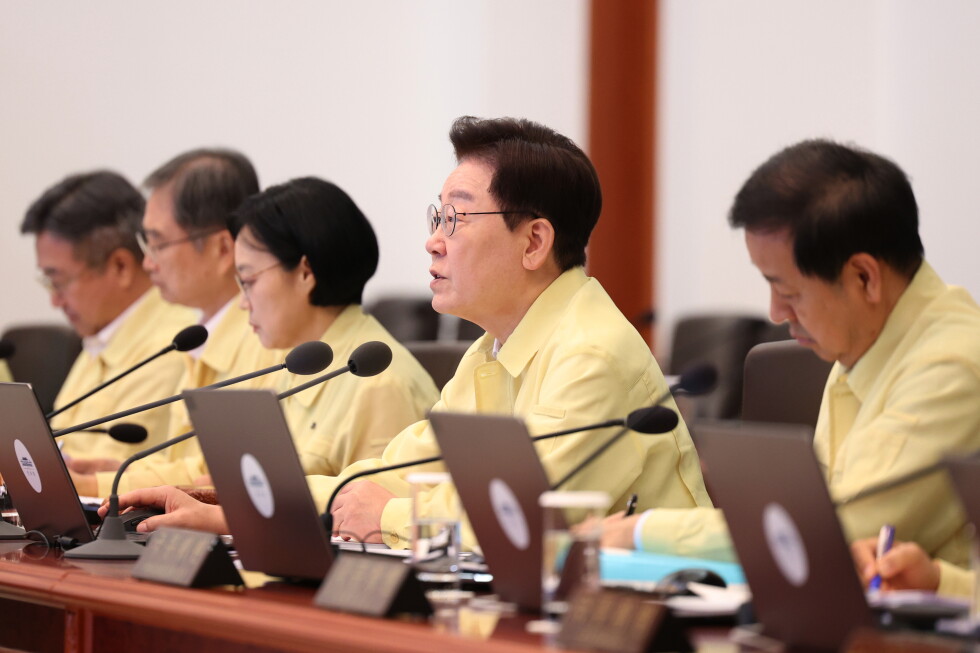
On Tuesday, South Korean President Lee Jae Myung addressed the growing unrest during a regular Cabinet meeting, emphasizing that a robust alliance with the U.S. remains the core foundation of the country’s national security. Lee, a liberal leader who has long pushed for greater South Korean self-reliance in defense, noted that “national security will be further strengthened when the alliance is solid,” adding that building South Korea’s own independent military capabilities will only boost its value and standing as a U.S. ally.
Prior to Trump’s announcement, both South Korean and U.S. military officials had confirmed the 2025 drills would match the scale of previous years, incorporating tactical lessons from modern conflicts — including North Korea’s battlefield deployments alongside Russia in the Ukraine war — and reiterated that the exercises are strictly defensive in nature. Even after Trump’s order, it remains unclear which segments of the 11-day training will be scaled back.
North Korea has already responded sharply to the drills, with its Foreign Ministry accusing Seoul and Washington of planning more aggressive provocative actions and vowing to counter the exercises with a new, upgraded level of nuclear deterrent.
For its part, the Lee administration has sought a cautious path forward. On Monday, Lee’s presidential office expressed hope that the friendly rapport between Trump and Kim would open the door to meaningful denuclearization dialogue and lasting peace on the Korean Peninsula. This stance, however, has drawn fierce backlash from South Korea’s main conservative opposition party, the People Power Party. Party spokesperson Park Chung-kwon argued that the country’s entire security framework is being shaken to its core, noting that South Korea relies on the U.S. nuclear umbrella to defend itself against nuclear-armed North Korea, hosting roughly 28,500 U.S. troops on its territory to uphold that security commitment.
Experts note that Kim Jong Un has shown little inclination to return to nuclear talks with the U.S. after high-profile 2019 negotiations collapsed. In the years since the talks fell apart, Kim has expanded North Korea’s nuclear arsenal, deepened his diplomatic and military alignment with Russia amid its war in Ukraine, and has shown no interest in reengaging without major U.S. concessions.
Analysts like Leif-Eric Easley, a professor of international studies at Seoul’s Ewha University, frame Trump’s approach to alliances as transactional: “Trump thinks of an alliance as an investment that should pay regular dividends, or a rainy-day fund he can withdraw from when another project isn’t going well.” Easley added that South Korean leaders have come to expect constant renegotiation of ties with the Trump administration that links economic and security issues, forcing Seoul to respond cautiously to the unexpected shift.
Leading South Korean media have echoed public anxiety, with major daily Hankook Ilbo noting in a Tuesday editorial that Trump’s order “reveals the stark reality of a faltering Korea-U.S. alliance, fueling public anxiety.” The paper added, “It’s absurd that the U.S. appears to treat North Korea more respectfully than its ally South Korea.”
In a clarification following Trump’s announcement, Lee’s office confirmed that South Korea and the U.S. are currently in close discussions over Seoul’s practical and military contributions to upholding freedom of navigation in the Strait of Hormuz, a key global energy chokepoint, a topic that ties back to Trump’s reference to Iran.