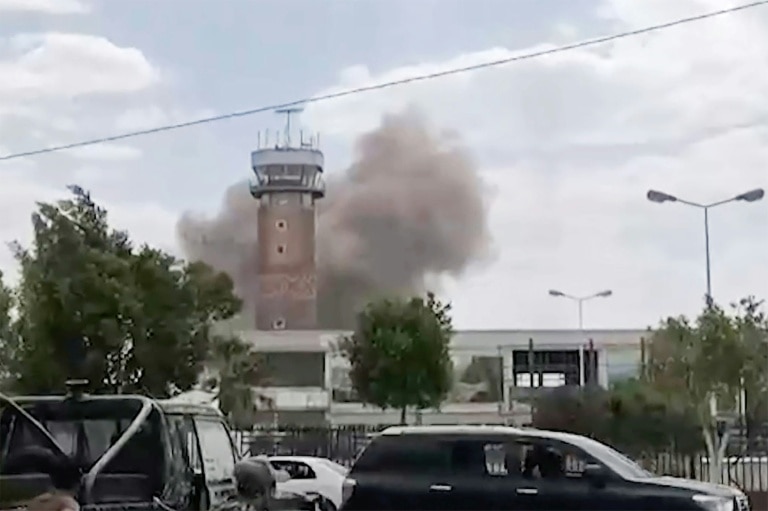
Decades of simmering conflict in Yemen reignited dramatically on Monday, after the internationally recognized Yemeni government confirmed it carried out an airstrike targeting runways at Sanaa International Airport, the most intense escalation of hostilities between government forces and Houthi rebels in more than two years.
The government justified the strike by stating it aimed to block an Iranian aircraft from landing in the Houthi-held capital. The action came after diplomatic efforts failed to persuade a Houthi delegation returning from Tehran—where they had attended the funeral of former Iranian supreme leader Ayatollah Ali Khamenei—to switch to a Yemenia national airline flight instead. Yemeni Defense Ministry officials clarified that the airstrike specifically targeted airport infrastructure in response to what it called a Houthi violation of Yemeni territorial sovereignty by allowing the Iranian plane to enter without prior coalition clearance.
Under longstanding restrictions imposed since 2011, all aircraft entering Yemeni airspace require advance approval from the Saudi-led coalition that backs the Yemeni government, a rule the coalition says it enforces at the official government’s request. By arranging a direct flight from Tehran to Sanaa without securing that clearance, Houthi forces openly challenged the existing arrangement, prompting the military response. Immediately after the strike, the Yemeni government ordered all of the country’s airports to close indefinitely effective Monday.
Houthi officials have placed full blame for the attack on Saudi Arabia, the Yemeni government’s primary military backer, and warned of imminent retaliation. “This aggression will not go unanswered or unpunished,” said Houthi military spokesperson Yahya Saree, adding that the strike formally “ends the de-escalation phase” that has held since 2022. The Houthi foreign ministry went further, declaring the attack marked “the end of the phase of de-escalation and the ceasefire and declares the start of war.” Houthi state broadcaster al-Masirah reported that the Iranian plane had already landed safely before the strike, carrying returning Yemeni medical patients and the Houthi delegation. Tensions had already been building through October, with Houthi officials accusing Saudi Arabia of an earlier strike on an Iranian plane traveling to Sanaa earlier this month, a provocation that already drew threats of retaliation against Saudi civilian and military infrastructure at the time.
Rashad al-Alimi, head of Yemen’s Presidential Leadership Council, sought to temper expectations of a rapid expansion of fighting, saying he had “ordered that the scope of the confrontation not be expanded in a manner that would achieve Iran’s objective of dragging Yemen and its people into wars.”
The strike comes at a moment of already elevated regional friction, as the United States and Iran have exchanged a series of tit-for-tat attacks across the Gulf that have stoked fears of broader regional conflict. The UN, which brokered the 2022 truce that paused large-scale fighting between Yemeni government and Houthi forces, has moved quickly to urge de-escalation. UN Special Envoy for Yemen Hans Grundberg confirmed his office has reached out to military leadership on both sides, saying “We are urging them to de-escalate and refrain from any actions that would risk a new cycle of violence in Yemen.”
Analysts warn the latest escalation puts the fragile two-year truce at severe risk of total collapse. “If this cycle of action and retaliation continues, it could effectively mark the collapse of the April 2022 ceasefire framework and signal a return to a much more intense phase of the conflict,” said Mohammed al-Basha, a Yemen-based risk analyst with the U.S.-based Basha Report. Al-Basha noted that “The coming days will likely show whether both sides are prepared to move back toward sustained military escalation and ground war,” adding that the next steps involving the Iranian plane that prompted the strike will likely shape the trajectory of hostilities going forward.
The Yemeni civil war, which began when Houthi forces seized Sanaa and much of northern Yemen in 2014, has killed more than hundreds of thousands of Yemenis through direct fighting, hunger and preventable disease, creating what the UN calls the world’s worst humanitarian crisis. Before Monday’s strike, large-scale fighting had remained largely frozen across frontlines for more than two years, creating a fragile calm that allowed limited humanitarian access and incremental confidence-building talks between rival factions.