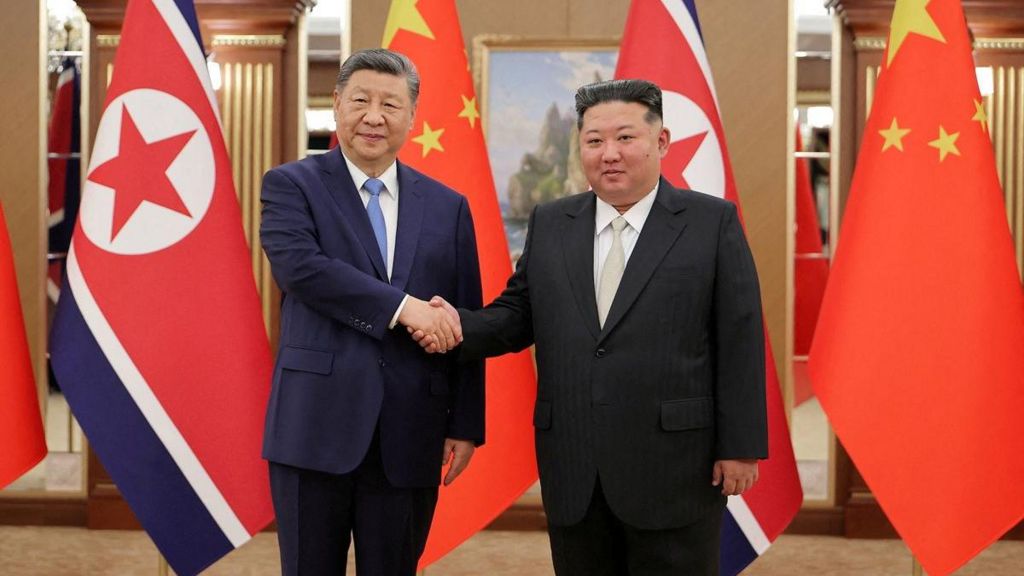
After a seven-year gap since his last official trip to North Korea, Chinese President Xi Jinping has concluded a high-profile two-day state visit to Pyongyang, an encounter that has underscored the complex, long-standing alliance between the two neighboring socialist nations amid evolving global power shifts.
North Korean leader Kim Jong Un extended an exceptionally warm welcome to Xi following his arrival on Monday, rolling out the ceremonial red carpet and staging elaborate acrobatic performances to honor the visiting head of state. While no binding, concrete policy agreements were announced publicly after the closed-door talks, both leaders emphasized the symbolic weight of the meeting, according to reports from North Korea’s state-run news outlet KCNA. Kim framed Xi’s selection of Pyongyang as his first state visit of the year as clear evidence of the “utmost importance” Beijing places on the bilateral relationship.
The visit comes at a moment of growing strategic repositioning for Beijing: as North Korea has deepened its diplomatic and military ties with Moscow in recent years, China has moved to reassert its influence over its strategically critical, often unpredictable neighbor. Analysts note the trip allows Xi to reinforce a core message for Pyongyang: that China remains North Korea’s primary political and economic benefactor, a lifeline that has sustained the country through decades of harsh international sanctions imposed over its nuclear weapons program. For Kim, hosting a major global leader like Xi just weeks after Xi held separate summits with U.S. President Donald Trump and Russian President Vladimir Putin serves as a high-profile demonstration that North Korea maintains influential international partnerships despite its continued isolation over its nuclear program.
In remarks carried by China’s state news agency Xinhua during an official state banquet on Monday evening, Xi emphasized the deep geographic and historical bonds between the two nations, noting that “China and North Korea are linked by mountains and rivers and share a common destiny.” Kim echoed the sentiment, affirming that North Korea will continue to prioritize its friendship with Beijing and reaffirming Pyongyang’s unwavering support for China’s One China principle. Against a backdrop of widespread global geopolitical upheaval, Kim stressed that the visit serves as a reminder of the enduring strength of the two countries’ friendship. Xi added that the two leaders reached “important consensus” on advancing high-level diplomatic exchanges and expanding people-to-people connections to align with shifting global trends.
The 2026 visit also marks a notable milestone: this year celebrates the 65th anniversary of the China-North Korea defense pact, the only active mutual defense agreement China holds with any nation globally. Beyond diplomatic rhetoric, the trip also included symbolic gestures honoring the shared history of the two countries. On Tuesday, Xi and Kim traveled to Pyongyang’s Friendship Tower, a monument honoring Chinese soldiers who fought alongside North Korean forces during the Korean War. They also visited the country’s top leadership training academy, where the two leaders planted a fir tree to represent what both sides described as an evergreen, enduring friendship between the two nations. Throughout his stay, Xi was hosted at Pyongyang’s exclusive Kumsusan State Guest House, a purpose-built facility completed in 2019 ahead of Xi’s last visit to the capital that has since hosted other visiting global leaders including Russian President Vladimir Putin and Belarusian President Alexander Lukashenko.
Notably absent from all official state media readouts of the talks was any public discussion of North Korea’s nuclear program and the longstanding goal of Korean Peninsula denuclearization — an omission that observers say was entirely expected. In recent years, China has significantly softened its public calls for denuclearization, rarely raising the issue in official joint statements with North Korean leadership.
Xi was accompanied by a high-powered delegation of top Chinese officials, including his closest political advisor Cai Qi, Defense Minister Dong Jun, Foreign Minister Wang Yi, and Commerce Minister Wang Wentao, signaling the high priority Beijing placed on the engagement.
Despite the lavish displays of shared friendship and solidarity, underlying strategic and ideological differences between the two countries remain visible in the official readouts of the visit. In his public remarks, Xi referenced working together to open “a brighter future for the socialist cause of both countries” — a nod to a longstanding point of friction between Beijing and Pyongyang. For decades, China has encouraged North Korea to adopt Beijing’s own model of socialist development: maintaining rigid one-party rule while opening its markets to foreign trade and investment. Sydney Seiler, Korea Chair at the Center for Strategic and International Studies, noted on social platform X that key details in Chinese official reports suggest Xi may hold frustration over Pyongyang’s rejection of this path. “North Korea still refuses to learn from China’s developmental experience,” Seiler wrote, pointing to the complete absence of any reference to economic reform in Kim’s public remarks during the visit.