Global equity markets kicked off Wednesday with stark divergence across regions, capping a prior session that saw U.S. benchmarks notch all-time records powered by the red-hot artificial intelligence boom.
The most notable milestone of the day came from Asian trading, where Japan’s Nikkei 225 index crossed the 68,000 threshold for the first time in history, closing up 2.5% at 68,402.13. The historic rally was led by semiconductor sector stocks that sit at the core of AI supply chains: Tokyo Electron, a leading manufacturer of chip production equipment, soared 13.4%, while Advantest, a specialist in chip testing gear, added 5.1% to its value. Other Asian markets delivered mixed results: Australia’s S&P/ASX 200 gained 0.7% to 8,785.70, Taiwan’s Taiex climbed 2%, and China’s Shanghai Composite eked out a 0.2% rise to 4,083.97. By contrast, Hong Kong’s Hang Seng index dropped 1.6% to 25,633.21, India’s Sensex fell 0.9%, and South Korean markets remained closed for a public holiday.
When European markets opened for trading on Wednesday, the momentum from Japan’s AI-fueled rally failed to lift regional shares, with all major benchmarks opening in negative territory. Germany’s DAX index slid 0.8% to 24,930.74, Paris’ CAC 40 fell 0.4% to 8,173.51, and London’s FTSE 100 shed 0.3% to 10,340.00. U.S. index futures also pointed to a mild pullback at the opening, with S&P 500 futures down 0.1% and Dow Jones Industrial Average futures off 0.2% ahead of the New York opening bell.
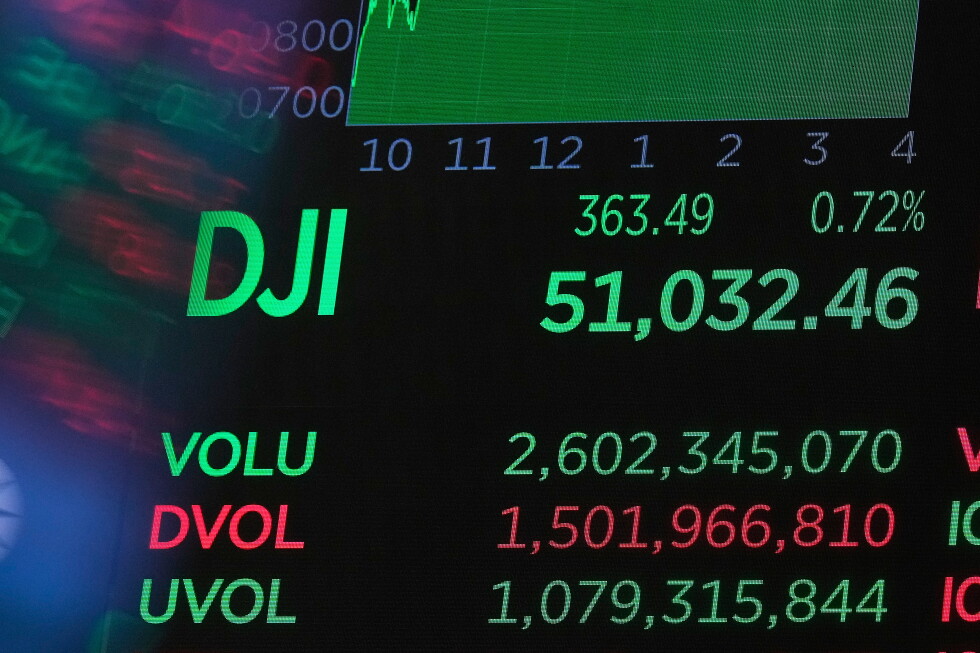
The mixed regional performance follows a record-setting session on Wall Street Tuesday, when the ongoing AI boom pushed all three major U.S. indexes to new all-time highs. The S&P 500 notched its ninth consecutive weekly gain — its longest winning streak since 2023 — edging up 0.1% to 7,609.78, while the Dow added 0.4% to 51,307.79 and the Nasdaq composite climbed less than 0.1% to 27,093.90.
AI-linked stocks continued to drive gains for Wall Street, with multiple players posting spectacular single-day jumps. Hewlett Packard Enterprise saw its stock surge 19.5% after reporting quarterly profits that far outpaced analyst projections, with the company attributing the beat to booming customer demand for AI infrastructure. Marvell Technology, another chip and AI infrastructure firm, leaped 32.5% — its best single-day performance since its 2000 IPO — after Nvidia CEO Jensen Huang suggested during a Taiwan conference that Marvell could become the next trillion-dollar corporation. That milestone has already been reached by a growing number of AI-focused firms, including most recently Micron Technology, and Nvidia itself, which now boasts a market valuation above $5 trillion even as its stock slipped 0.7% on Tuesday.
The nine-week winning streak for U.S. equities has left some market observers noting an unusual dynamic in investor behavior. “One thing that stands out in today’s market is how little investors seem willing to pay for protection despite a world overflowing with potential shocks,” Stephen Innes, managing director at SPI Asset Management, wrote in a Wednesday market commentary. Many analysts have also warned that a near-term pullback may be on the horizon after the extended run of gains.
A stronger-than-expected U.S. labor market report has added to mixed signals for investors: new data released this week showed U.S. employers posted far more open jobs at the end of April than economists had forecast, signaling ongoing resilience in the world’s largest economy. Market sentiment has also been supported by hopes for a diplomatic deal between the U.S. and Iran to reopen the Strait of Hormuz, a critical global oil chokepoint. A resolution would restore unimpeded oil flow from the Persian Gulf and ease upward pressure on energy prices.
Despite those hopes, oil prices resumed their upward climb on Wednesday, with international benchmark Brent crude rising $2.63 to $98.63 per barrel, and U.S. benchmark West Texas Intermediate crude adding $2.79 to hit $96.55 per barrel — a jump of more than $2 per barrel for both benchmarks.
In currency markets, the U.S. dollar saw mild movement against major global currencies. After hitting an intraday high of 160.44 yen, the dollar slipped to 159.86 yen, down slightly from 159.92 yen at Tuesday’s close. The euro also edged fractionally lower, falling to $1.1631 from $1.1632 in the prior session.