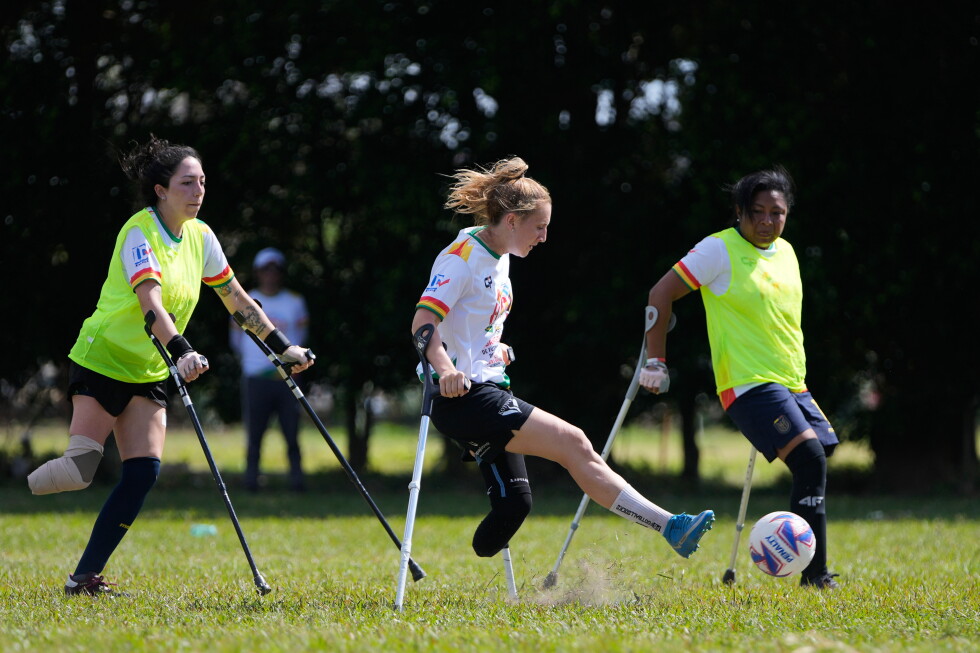
As global football fans turned their attention to the final stretch of the 2026 FIFA World Cup this week, a groundbreaking moment for women’s adaptive sports unfolded on a sunlit pitch in Santa Cruz, Bolivia. From afar, the athletes sprinting across the grass, executing sharp corner kicks, and weaving past defending players looked like any elite group training for a top-tier international tournament. A closer look revealed their extraordinary resilience: goalkeepers dove to stop shots using only one arm, while outfield players propelled themselves down the field with crutches, their prosthetic limbs left on the sidelines per tournament rules.
This five-day gathering marked the first regional training camp for female amputee football players across South America, all working toward a spot on their national rosters for the 2027 Women’s Amputee Football World Cup set to be hosted in Poland. Thirty-five women from 10 Latin American nations — including Argentina, Bolivia, Brazil, Ecuador, and Colombia — gathered in Bolivia’s lowland eastern hub to hone their skills, wraping up the camp with a series of friendly exhibition matches on Friday. The majority of participants lost their limbs to complications from infections or life-altering traumatic injuries, a shared experience that forged an immediate sense of community on and off the pitch.
Organized by the World Amputee Football Federation, the global governing body for the sport, in partnership with local Bolivian authorities and regional nonprofits, the camp brought in elite coaching expertise from across the globe, including seasoned players from the U.S. Women’s National Amputee Soccer Team. Under the official rules of seven-a-side amputee football, all participants must remove prosthetic limbs before kickoff. Athletes rely on crutches to move across the pitch, but are prohibited from using crutches to make contact with the ball, putting a premium on balance, coordination, and quick adaptive thinking. Over five days, coaches covered everything from fundamental crutch movement and core stability to advanced passing tactics and game strategy.
For 21-year-old U.S. national team player Amie Donathan, who was born with a single leg, the camp represented far more than just training. “The life of amputees can sometimes be hard, but we adapt really fast,” Donathan explained. “The way I feel about this camp, honestly, can’t be described.”
Men’s international amputee football has a decades-long history, with the first international matches taking place in the 1980s, and a World Cup tournament staged every four years. The sport has seen steady growth across regions affected by conflict and landmines, including Gaza and Rwanda, where it has become a source of healing and community for survivors. For women, however, the discipline has only recently begun to gain formal recognition and support. The first ever Women’s Amputee Football World Cup was held just last year in Colombia, where the host nation claimed the historic inaugural title. The 2027 edition in Poland will only be the second women’s world cup in the sport’s history, with organizers still finalizing details on the host city and exact match dates.
Lidia Mayser, president of Santa Cruz’s regional sports council, which is currently working to establish Bolivia’s first national women’s amputee football federation and qualify a team for the 2027 tournament, emphasized the transformative impact of the event. “It’s so that women with amputations can realize their dream through sports, through soccer,” Mayser said.
That transformation is already evident for participants like Filomena Luna, a 50-year-old mother of six who lost her leg at age 11 after an infection worsened when her family first sought treatment from a traditional healer instead of a medical professional. Luna never imagined she would be able to play competitive soccer, but the camp has helped her find belonging and joy she never expected. “This practicing and training has helped me improve tremendously,” Luna said. “Soccer is an escape for me.”