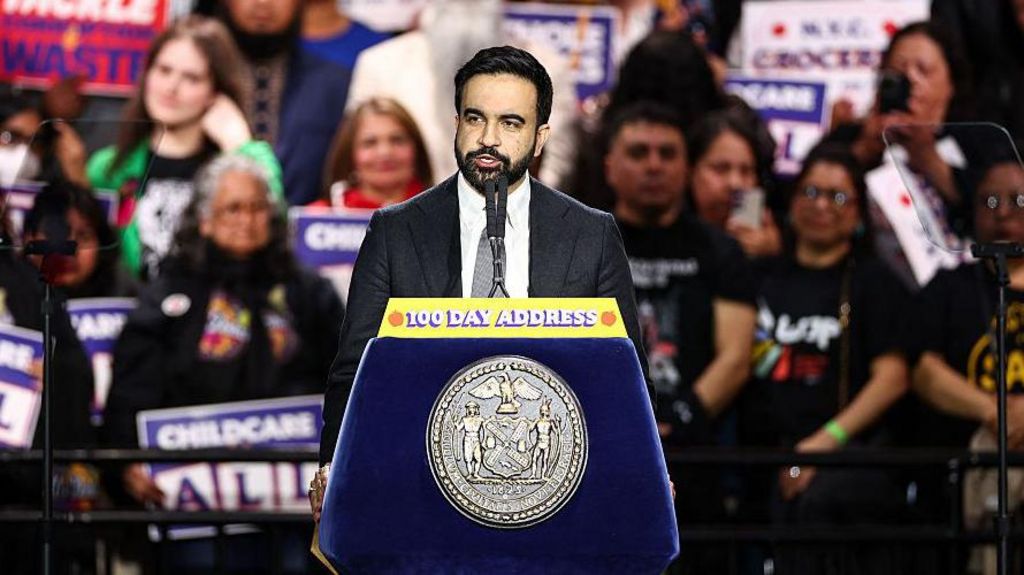
On a packed Sunday afternoon at Queens’ historic Knockdown Center, thousands of supporters gathered to hear New York City’s youngest mayor in more than a century deliver his highly anticipated first 100-day address, marking a milestone for the progressive leader who shook up city politics last election cycle.
Zohran Mamdani, the self-identified democratic socialist who took office earlier this year, used the rally to highlight early progress on his policy agenda, drawing cheers from crowds holding signs reading “Pothole Politics” and “Childcare for All.” “Nothing is too big for New York City to take on,” Mamdani told the assembled crowd. “And over the past 14 weeks, we have proved that there is no task too small either.”
Among the wins Mamdani touted were 100,000 repaired city potholes and a commitment to secure $1.2 billion in funding to expand access to free childcare. But even as he celebrated early progress, the address laid bare the gap between his ambitious campaign pledges and the realities of governing a complex, cash-strapped major American city, with many top-priority policy goals still far from completion.
Political analysts note that Mamdani’s strategic focus on easily popularized wins early in his term is a deliberate governing choice. Justin de Benedictis-Kessner, a public policy professor at Harvard University’s Kennedy School of Government, explained: “He’s picking some of the stuff that he thinks he can most easily build support with, trying to find issues that have a broad base of support behind them instead of picking potentially divisive issues to start with.”
One of the most unexpected developments of Mamdani’s first 100 days has been a dramatic thaw in his once-bitter rivalry with Republican President Donald Trump. In the months leading up to the election, the two traded relentless public insults: Trump dismissed Mamdani as a “communist,” while the New York mayor repeatedly vowed to never back down from the White House. But since Mamdani took office, the relationship has shifted dramatically toward unexpected cordiality.
After multiple closed-door meetings, Trump publicly praised Mamdani and said he would be “cheering” for the New York mayor’s success. The pair discussed New York’s crippling housing and cost of living crisis during a widely publicized photo op, where both leaders appeared smiling and relaxed. Lincoln Mitchell, a global affairs expert at Columbia University’s School of International and Public Affairs, noted that Trump has at times seemed “mesmerised” by the young progressive mayor.
Crucially, Mamdani has managed to navigate a careful middle path with the Trump White House, avoiding conflict while sticking to his core policy priorities. “What he’s managed to do is thread the needle of not getting Trump’s direct ire, and at the same time, not giving in to him,” Mitchell explained. This detente has already yielded tangible benefits for New York: Trump has followed through on his earlier threat to withhold federal funding from the city, which is already operating with a significant budget deficit, and has not launched a hardline immigration crackdown in New York similar to the one that sparked widespread conflict between federal and local leaders in Minneapolis earlier this year.
On the policy front, one of Mamdani’s most prominent campaign promises was delivering universal free childcare to all New Yorkers, a cornerstone of his plan to tackle the city’s affordability crisis. While full universal childcare is not yet a reality, Mamdani has secured $1.2 billion to launch a phased rollout, with 2,000 free childcare spots for two-year-olds in low-income neighborhoods including Canarsie, Brownsville and Ozone Park set to open by fall 2026. The plan calls for expanding to 12,000 spots by fall 2027, with full universal coverage targeted within four years. New York Governor Kathy Hochul has already committed to fully funding the program’s first two years, though long-term funding beyond that timeline remains unconfirmed.
Mamdani’s first 100 days have not been without controversy. Just weeks into his term, New York City was hit by two of the most severe snowstorms to hit the area in recent decades, with the first storm dropping 13.5 inches of snow on the Bronx in late January, and a second blizzard dumping nearly 20 inches of snow on Central Park in late February. The mayor faced widespread criticism after at least 18 people died during the first storm and the subsequent cold snap, particularly over slow response efforts to unhoused New Yorkers living on the street.
Mamdani moved quickly to adjust his approach ahead of the second storm, activating emergency measures that included opening vacant hotel rooms for temporary shelter, placing 1,400 unhoused people in city shelters, and deploying 150 additional outreach workers to conduct street checks. The mayor also noted that more than 23 million pounds of snow were processed and melted at eight dedicated city melting sites, with thousands of sanitation workers working around the clock to clear major roads and residential streets.
During Sunday’s rally, Mamdani announced a new affordability initiative that will launch before the end of his first term: a city-owned public grocery store in East Harlem’s historic La Marqueta, a public market first established by legendary mayor Fiorello LaGuardia in 1936. The mayor plans to open five of these public grocery stores across the city in coming years, with the first location expected to cost $30 million, according to reporting from the New York Times. New York City already offers subsidized rent and operational cost coverage for private grocery vendors to expand access to affordable food in underserved neighborhoods, but this marks the city’s first experiment with fully public grocery operations in modern history.
Despite these early steps forward, many of Mamdani’s most ambitious campaign pledges remain stalled, held up by political constraints, budget limitations and the complexities of New York’s system of shared governance. “Anybody who thought he would wave a wand and get his big-picture promises done quickly, of course, that was never going to happen,” Mitchell said.
The city’s affordability crisis remains unaddressed on the rental front, for example: a March 2026 report from real estate firm the Corcoran Group found that median rent had risen to $5,000 a month in Manhattan and $4,150 in Brooklyn, hitting new record highs. Mamdani campaigned on a promise to freeze rent hikes for the roughly 2 million New Yorkers living in rent-stabilized apartments. While the mayor does not have the authority to set rent policy directly, he has appointed six of the nine members of the city’s Rent Guidelines Board, which will vote on rent adjustment this June after holding public hearings with landlords, tenants and stakeholder groups. Analysts expect the final outcome to be a compromise rather than a full rent freeze, given competing political pressures.
“Everything is trade-offs in politics and in governing,” de Benedictis-Kessner said, noting that after engaging with stakeholder groups, the final policy is likely to look “slightly different” than what Mamdani’s most enthusiastic supporters imagined during the campaign.
Other key pledges have also moved slower than expected. Mamdani’s plan for a new standalone Department of Community Safety, which would deploy social workers instead of police to respond to non-criminal emergencies, has so far only materialized as a small two-person office within the mayor’s existing staff, rather than the $1.1 billion standalone agency he proposed during the campaign. His plan to make all city buses free and speed up bus routes has also been limited to small pilot programs, with citywide rollout still pending.
Mamdani’s signature plan to fund his expansive policy agenda – raising an estimated $9 billion through higher taxes on the city’s wealthiest residents and an increase in the corporate tax rate from 7.25% to 11.5% – is currently blocked at the state level. Governor Hochul, who is running for re-election this year, has already indicated she opposes tax increases, meaning the mayor cannot move forward with his revenue plan without her administration’s support. “That’s going to be the challenge,” Mitchell said. “Because if she doesn’t [raise taxes], he’s really limited in what he can do.”