For the first time in eight years, a sports team from North Korea is set to cross the border into neighboring South Korea this weekend, marking a rare moment of people-to-people exchange between the two divided nations at a time of high geopolitical tension.
Naegohyang Women’s FC, the top-flight women’s football champion from Pyongyang, will arrive in South Korea on Sunday ahead of their Asian Champions League semi-final clash against South Korea’s Suwon FC Women, scheduled for Wednesday at Suwon Sports Complex, just 30 kilometers south of the capital Seoul. This landmark trip comes against a decades-long backdrop of fractured inter-Korean relations: the two Koreas have remained technically at war since the 1950-1953 Korean War ended in an armistice rather than a permanent peace treaty, and ties have nosedived since 2019 when US-North Korean nuclear negotiations collapsed, leading Pyongyang to formally declare itself an irreversible nuclear-armed state.
This is not the first time sports has served as a diplomatic icebreaker between the two nations. Back in 2018, North Korea’s participation in the Pyeongchang Winter Olympics hosted by the South triggered a brief thaw in relations, with Pyongyang sending athletes, a high-profile delegation, and a popular all-female cheering squad. The two sides even made history by fielding a unified women’s ice hockey team for the Games. But after the 2019 breakdown of nuclear talks, cooperation has stalled, making this trip all the more unusual.
To pull off the unprecedented visit, organizers and South Korean authorities have navigated a complex web of logistics, legal constraints, and security protocols. A 39-person delegation, including 27 players and 12 coaching and administrative staff, will travel to South Korea via air from Beijing. Both squads will stay at the same hotel in Suwon, but local media reports confirm their dining areas and movement routes will be strictly separated, making unplanned interactions between players from the two sides unlikely. The match will be held at the 12,000-capacity Suwon Sports Complex, with no North Korean fans able to cross the border due to long-standing travel restrictions.
South Korean law adds another layer of complexity to the event. Under South Korea’s National Security Act, public display of the North Korean flag or playing of the North Korean national anthem is generally considered illegal, and separate inter-Korean exchange regulations require South Korean citizens to obtain government approval before any contact with North Koreans. However, South Korean officials confirmed the entire visit has been pre-approved by the Unification Ministry, meaning informal exchanges such as simple greetings between players and fans will not be treated as a criminal offense. Additionally, as the Asian Champions League is a club-level competition, no national symbols or anthems will be featured during the match, eliminating a potential legal flashpoint.
For North Korea, this match carries more than just athletic significance, analysts say. “Under Kim Jong Un, sports are viewed not simply as entertainment, but as a measure of national capability,” explained Lim Eul-chul, a North Korea studies expert at South Korea’s Kyungnam University. Lim added that Pyongyang is likely aiming to demonstrate what it frames as its overwhelming sporting superiority over the South, using the high-profile match as a platform to project strength to its rival.
North Korea has long been a powerhouse in women’s football, particularly at the youth level, where the country has claimed multiple FIFA World Cup titles in recent years. Founded in 2012 and based in Pyongyang, Naegohyang is one of the country’s fastest-rising women’s football sides. The club claimed the North Korean national league title in the 2021-2022 season after upsetting traditional powerhouse April 25 Sports Club, and already holds a 3-0 victory over Suwon FC from their group stage meeting in the 2023 Champions League.
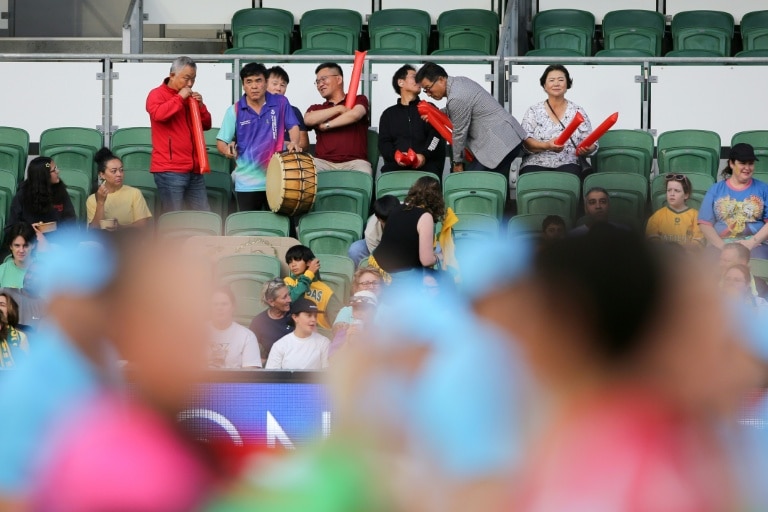
Despite ongoing tensions, South Korean authorities and civic groups are framing the match as an opportunity for constructive exchange. The Unification Ministry has allocated 300 million won (approximately $200,000) to support South Korean civic groups organizing cheering for both teams, covering ticket costs, supplies, and banners. Organizers expect around 2,500 spectators to attend the match. While civic groups will have broad discretion over their chants, the government has issued soft guidelines to avoid provocative content given the special nature of the event.
Civic organizers emphasized the unique value of the cross-border exchange. “We see it as a rare and meaningful exchange between young South and North Koreans,” said Hong Sang-young, secretary general of the Korean Sharing Movement, a prominent inter-Korean exchange NGO. “Political slogans or messages could cause misunderstandings, so we intend to focus on football itself and on supporting young people from both Koreas sharing the same space.”