In the parched semi-autonomous region of Puntland, northern Somalia, 70-year-old pastoralist Abdi Ahmed Farah guards a rapidly dwindling stock of food that keeps his family of 23 alive. Three years of failed consecutive rains have turned his once-thriving herd of 680 goats into a pile of carcasses littered outside his makeshift tent, leaving just 110 emaciated animals barely clinging to life. Already trapped in debt from purchasing overpriced water, Farah’s family now survives on a single daily meal of rice mixed with sugar and oil. Three weeks after his youngest child was born, his wife produces barely a drop of breast milk to feed the newborn.
“I have considered abandoning my family because I cannot provide for them,” Farah said, his voice heavy with desperation that echoes across millions of Somali households as the country faces what experts warn could be the worst drought in its recorded history. One of the world’s most climate-vulnerable nations, Somalia is now grappling with a climate-driven catastrophe that has dried up major rivers, withered entire harvests, and pushed a third of its population to the brink of starvation.
The crisis has been severely compounded by cascading external pressures: deep cuts to international humanitarian aid, most sharply from the United States, Somalia’s former largest donor, and skyrocketing commodity prices spurred by ongoing tensions in the Middle East. Somalia relies on imports for 70% of its food supply and purchases nearly all of its fuel from the region, leaving its already fragile economy extremely exposed to global market shocks. Data from the United Nations Food and Agriculture Organization shows production of the country’s staple crops—maize and sorghum—during the key October-to-December rainy season fell to the lowest level on record this year.
Humanitarian agencies now warn that nearly 500,000 children across Somalia are at risk of severe acute malnutrition, the deadliest form of hunger, a toll higher than that recorded during the catastrophic droughts of 2011 and 2022, according to UNICEF. “2026 is the worst year on record for Somalia in terms of drought,” said Hameed Nuru, country director for the U.N. World Food Programme (WFP) in Somalia. “Children have started dying.”
Official joint estimates from the Somali government and the United Nations put the number of people facing crisis-level hunger at 6.5 million, a 25% jump since the start of the year that equals one-third of the entire national population. While aid organizations are stretching already thin resources to respond and the Somali diaspora has been sending critical funds to family members back home, humanitarian workers warn the support being mobilized is nowhere near enough to meet the scale of need.
“This drought is not just another cycle of dry season. It’s a repeated climate shock with shrinking humanitarian support,” explained Mohamed Assair, a senior manager for Save the Children in Puntland.
In Usgure, the small Puntland village where Farah and his family have taken shelter for 10 days after fleeing their depleted grazing lands, the local economy that relies entirely on pastoralist activity has completely collapsed. Almost a dozen rotting goat carcasses lie within meters of Farah’s tent, and even when herders manage to hold onto livestock, emaciated animals cannot be sold or traded for staple grains like they once could. “There is no market for my goats because they are so thin. Previously we would trade them for rice, but now we can’t,” Farah said.
Community leader Abshir Hirsi Ali, who heads the 700-family village, says local shops have shuttered and food reserves have run dry. A brief, unseasonable shower that recently passed through the region left behind pools of contaminated rainwater, but desperate families with no other source of drinking water had no choice but to consume it. “Some families were so desperate they drank it … now there is a high number of people with fever,” Ali said. Save the Children occasionally delivers free water to the village, but private water vendors have quadrupled their prices amid scarcity. The cost of a 50-kilogram bag of flour has jumped by a third to $40, out of reach for most displaced and local households.
For 47-year-old mother of 11 Muhubo Tahir Omar, the drought has erased even the possibility of education for her children. Like other families, she sold all her goats one by one to cover school fees, but when the money ran out, teachers abandoned the village school. Her last remaining goat is now also sick, leaving her with no assets to fall back on. “I’m not only afraid for my family but the future of the whole village,” she said.
Decades of ongoing conflict in Somalia have already displaced millions of people across the country, and the drought has pushed an additional 200,000 people from their homes this year alone, per U.N. estimates. Many families cross hundreds of kilometers of harsh, arid terrain with almost no food or water to reach the nearest aid distribution sites, a journey that often proves fatal. “People are on the move … and when people move, people die,” said Kevin Mackey, country director for the humanitarian organization World Vision. Mackey recently met with a group of displaced people who walked for nine consecutive days across open desert to reach aid in the southern Somali town of Dollow.
In a displacement camp outside Shahda village, Puntland, 20-year-old mother of four Shukri—who only provided her first name for safety—says she once managed to scrape together one meal a day for her children from aid handouts. Now, there is no food at all, and clean water remains almost impossible to access. “The children got diarrhea from dirty water and malnourishment worsened,” she said. “I know a few people who have died.”
Thousands of displaced people flock to Mogadishu, Somalia’s capital, in search of better access to aid, but food scarcity plagues even the capital city. Forty-five-year-old mother of seven Fadumo fled to Mogadishu from Lower Shabelle, a region already besieged by violence from the al-Qaida-linked militant group al-Shabab. “The water sources we depended on for farming, including the river, dried up,” Fadumo said. “Conflict made our situation even worse, forcing us to flee.”
The catastrophic 2022 drought in Somalia killed an estimated 36,000 people, per U.N. data, and today, the level of emergency aid that was rushed to the country during that crisis has all but evaporated. Total international aid funding to Somalia dropped to just $531 million in 2025, down from $2.38 billion in 2022, a collapse driven largely by deep cuts from the United States, which was previously the country’s largest donor.
“Unless there is a sudden and substantial response from donors, the outlook is deeply concerning. A drought of similar severity in 2022 received a response five times greater than what we are seeing,” said Antoine Grand, head of the International Committee of the Red Cross in Somalia. WFP originally planned to deliver food aid to 2 million vulnerable Somalis this year, but crippling funding gaps mean the organization has only been able to reach 300,000 people to date.
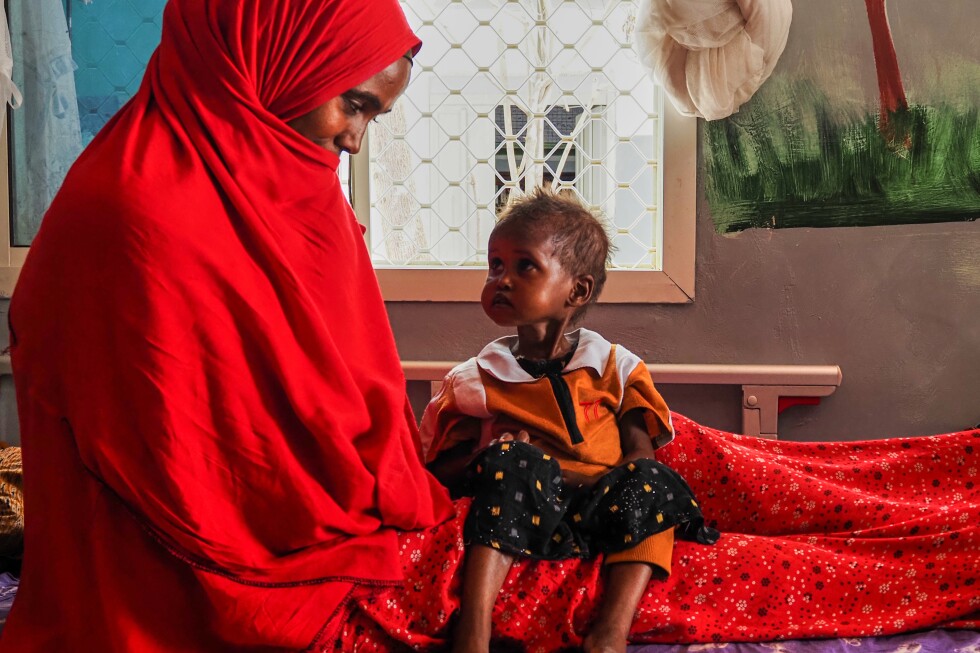
At a severe acute malnutrition treatment center run out of the main hospital in Qardho, Puntland, life-saving therapeutic milk for malnourished children is now rarely in stock, forcing nurses to rely on unfortified cow’s milk as a homemade alternative, according to center director Shamis Abdirahman. The center currently treats around 15 children a month, but staff expect cases to surge dramatically as more displaced families arrive from drought-stricken rural areas.
Four-year-old Farhia, who weighs just 7.5 kilograms—less than 17 pounds—with sunken eyes and visible bones under her skin, is one of the children currently receiving care. Her family fled to Qardho after all of their goats died back in their home village. “I don’t know what to hope for, or see how we can get back to what we had,” said Farhia’s mother, Najma.