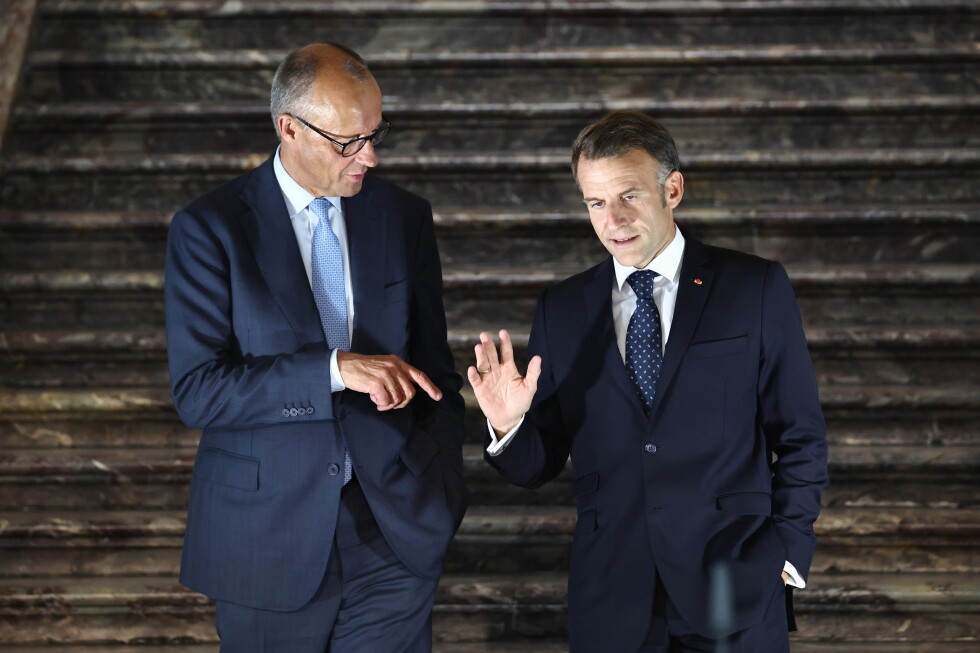
COLOGNE, GERMANY — In a landmark shift for European defense cooperation, the leaders of Germany and France announced Friday that German conventional military forces will take part in a French-led nuclear deterrence exercise before the end of 2025, marking the first time Berlin has agreed to join such a partnership amid widespread uncertainty over long-term U.S. security commitments to the continent.
Speaking alongside French President Emmanuel Macron following bilateral talks at Germany’s Norvenich Air Base near Cologne, German Chancellor Friedrich Merz confirmed the historic move, breaking with decades of refusal by previous German administrations to pursue formal nuclear cooperation with Paris. Merz emphasized that the new partnership is designed to complement, rather than replace, Germany’s long-standing commitments to NATO’s existing nuclear sharing arrangement, where the U.S. stations tactical nuclear weapons on German soil, with German fighter jets certified to deploy the weapons in the event of a large-scale conflict.
“The world we live in today requires new answers,” Merz told reporters, noting that Germany will contribute only conventional military assets to the upcoming exercise for now. “We are proceeding step by step. It may be that this will result in a new doctrine for European deterrence, but it is far too early to draw that conclusion today.”
For his part, Macron framed the expanded cooperation as a critical boost to European collective security, arguing that diversified, advanced deterrence capabilities create essential strategic uncertainty for potential adversaries. He said Germany will take a “vanguard role” in European deterrence efforts, adding that structured, visible cooperation on nuclear preparedness confuses potential opponents far more than a diffuse, uncoordinated approach.
Macron outlined that the partnership will include sharing specialized military practices, joint training initiatives, capacity-building exchanges, and closer trust-building among military personnel and technical experts, though he declined to disclose specific operational details, noting that “Complete and absolute transparency is not necessarily the most effective strategy when dealing with adversaries on European soil.” He also confirmed that Germany will not be required to provide financing for France’s nuclear deterrence infrastructure as part of the agreement.
The announcement comes on the heels of a symbolic preliminary joint exercise held Thursday, where French Rafale jets — the platform designed to deliver France’s nuclear weapons — and German Eurofighter fighters carried out a joint in-flight refueling drill to mark the launch of the new cooperation framework.
The initiative traces back to an announcement Macron made in early March, where he unveiled plans to expand France’s national nuclear arsenal and formally invited European partners to deepen cooperation on nuclear deterrence. The proposal emerged against a backdrop of growing unease across Europe over the long-term reliability of U.S. defense guarantees for the continent.
France has been the only nuclear-armed member of the 27-nation European Union since the United Kingdom left the bloc in 2020, and a broad coalition of European nations have already signaled interest in joining the initiative, including the UK, Poland, the Netherlands, Belgium, Greece, Sweden, Denmark, and Norway. Germany’s participation is seen as a major boost for the program, as Berlin is currently implementing a €100 billion rearmament plan aimed at building Europe’s most powerful conventional military force by 2039.
Friday’s agreement also marks a key step toward repairing and reinvigorating bilateral Franco-German defense ties, which suffered a setback in June when the two countries’ ambitious $100 billion joint next-generation fighter jet program collapsed. That initiative was intended to replace the existing Rafale and Eurofighter fleets used by France, Germany, and Spain by 2040.
Both leaders are moving quickly to lock in progress on the new partnership in the coming months, as Macron approaches the end of his second and final presidential term, with growing uncertainty over whether his successor will maintain the same level of commitment to deepening European integration and defense cooperation. The report was contributed by Claudia Ciobanu from Warsaw, Poland, and Samuel Petrequin from Paris.