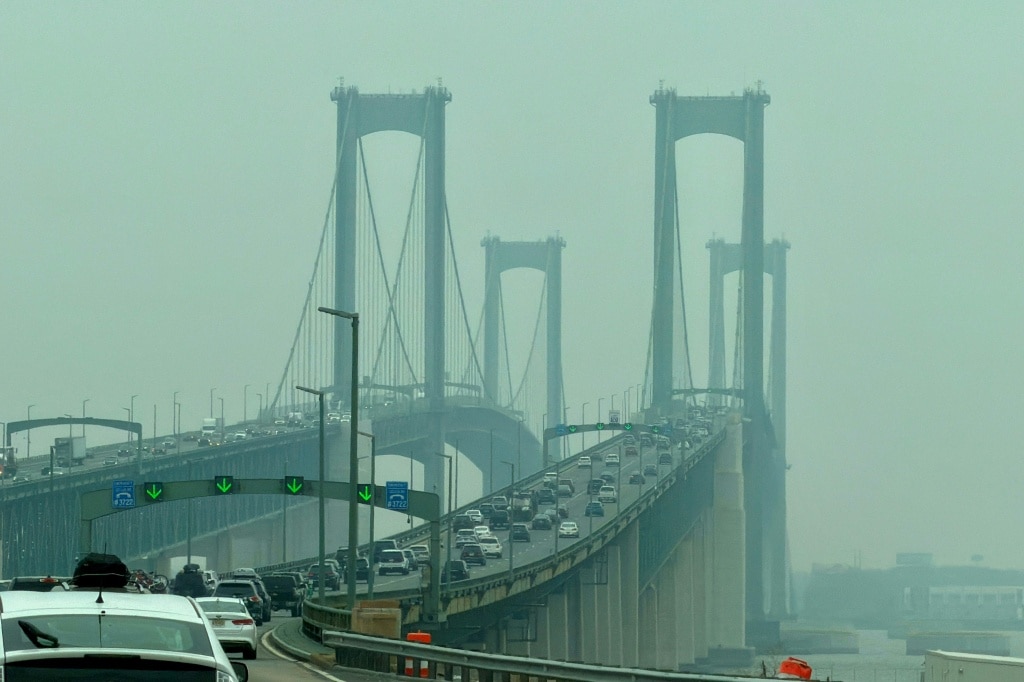
A thick, acrid blanket of wildfire smoke drifted south from raging Canadian blazes to engulf much of the eastern United States on Saturday, creating dangerous air quality conditions across major population centers and casting uncertainty over the 2026 FIFA World Cup final scheduled for Sunday at an open-air New Jersey stadium located just across the Hudson River from New York City.
As of Saturday morning, official data from the Canadian Wildland Fire Information System confirmed that more than 950 active wildfires were still burning uncontrolled across vast swathes of Canadian territory. The persistent wind patterns pushed plumes of toxic smoke across the U.S.-Canada border, triggering public health alerts from New England down to the Mid-Atlantic and into parts of the Midwest. By midday Saturday, global air quality tracker IQAir recorded that New York City had topped its list of the world’s most polluted major cities, with neighboring Toronto and Washington, D.C. ranking just behind the U.S. megacity.
At MetLife Stadium, the venue for the highly anticipated final between Argentina and Spain, tournament officials confirmed they are closely monitoring the evolving air quality situation. Andrew Giuliani, executive director of the White House World Cup task force, shared the update during a press briefing Saturday. Across the river in New York City, the iconic skyline was completely obscured by dense grey haze, and most people venturing outdoors wore protective face masks to avoid inhaling the toxic fumes.
Public officials across the region have issued urgent advisories urging residents to limit outdoor activity. New York City Mayor Zohran Mamdani called on locals to stay indoors and avoid unnecessary travel, warning that incoming weather systems bring both a potential end to the haze and new hazards. “Thunderstorms are expected to bring damaging winds strong enough to down trees and power lines, along with heavy rainfall that could cause flash flooding,” Mamdani posted on the social platform X. The U.S. National Weather Service echoed that warning, noting that the smoky conditions would persist across the region through Saturday afternoon, with the heavy storm system only expected to clear the area by evening.
In Washington, D.C., the Department of Homeland Security and Emergency Management warned that air quality levels remained “unhealthy for at-risk groups” including children, the elderly and people with preexisting respiratory conditions, urging residents in the capital to cut down on extended time outdoors.
Meteorologists noted that the incoming Saturday evening storms could deliver a partial reprieve: the heavy rainfall is expected to pull much of the suspended smoke particles out of the atmosphere, clearing the haze in time for Sunday’s match. But the same storm system carries significant risks of flash flooding and dangerous wind gusts that have already prompted flash flood warnings across the Northeast.
The crisis has already sparked political controversy, with U.S. President Donald Trump placing full blame on Canadian authorities for the cross-border pollution. Trump accused Canada of “willful negligence” for “not properly maintaining” its forested lands, and threatened to impose new additional tariffs on Canadian imports in response to the crisis.
Climate policy and public health advocates, however, have emphasized a broader root cause: repeated transboundary wildfire smoke events across North America are directly linked to human-caused climate change, which has created hotter, drier conditions across the Canadian boreal forest that increase the frequency and severity of extreme wildfire seasons.