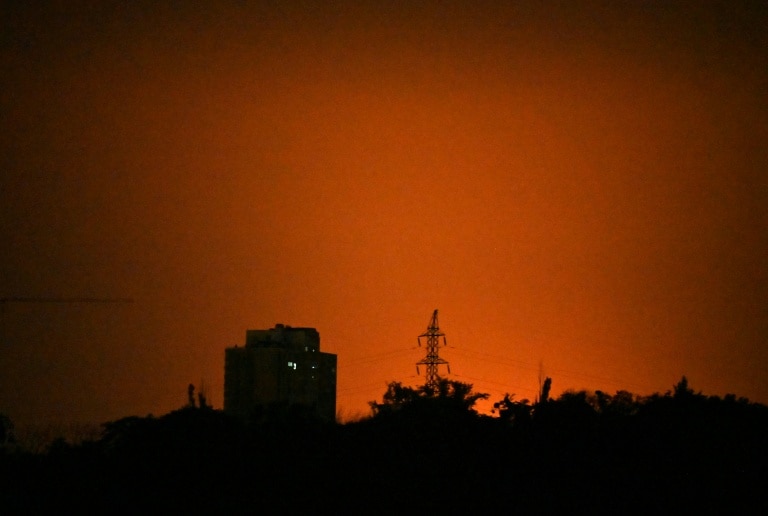
Escalating cross-border attacks have plunged the Russia-Ukraine war into a dangerous new phase, with Russian ballistic missiles striking multiple civilian targets across Ukraine’s capital Kyiv overnight in retaliation for a major Ukrainian drone assault on Russian logistics infrastructure. The July 19 bombardment, which comes as Ukraine grapples with rare domestic political upheaval in its fifth year of full-scale invasion, has left conflicting casualty figures and widespread damage across the capital.
Moments after Ukraine’s Air Force pushed an emergency alert to residents via the messaging platform Telegram warning of incoming ballistic threats, AFP correspondents on the ground in Kyiv heard multiple loud explosions. One blast was powerful enough to trigger car alarms across the city’s central district, witnesses confirmed. Initial casualty reports have been inconsistent: Kyiv’s military administration announced one fatality in a Telegram update, while Mayor Vitali Klitschko reported seven injuries with no confirmed deaths, and Ukraine’s state emergency service put the number of wounded at just two.
Local authorities confirmed that the overnight strikes ignited multiple fires and damaged structures across five of Kyiv’s districts. In the Solomianskyi district, an apartment building was directly hit, and a nearby supermarket caught fire. A residential home burned in the Sviatoshynsky district, while strikes were also confirmed at a shopping and entertainment complex in Dniprovsky district, a second apartment building in the central Shevchenkivsky district, and an unused non-residential structure. This latest wave of attacks is part of Russia’s nearly daily campaign of missile and drone strikes against Ukrainian cities that has continued uninterrupted since the full-scale invasion began in February 2022.
The retaliatory Russian strike came one day after Ukraine launched a large-scale drone attack on e-commerce warehouses in Russia’s Moscow and Tambov regions. Ukrainian officials confirmed the attack, which killed eight people and sparked massive infernos across the two logistics hubs. In a post on X, Ukrainian President Volodymyr Zelensky stated that the strike was a direct response to repeated Russian attacks on Ukrainian civilian infrastructure, adding that the targeted warehouses were being used to store sanctioned components for Russian drone manufacturing and navigation systems.
In simultaneous attacks across Ukraine on Saturday, Russian strikes killed five people and injured nearly 20 more in regions spanning the country’s southeastern frontline. Over recent months, Kyiv has stepped up long-range strikes on Russian territory, a campaign it frames as “long-range sanctions” intended to punish Moscow for its years of bombardment of Ukrainian civilian areas. The campaign has primarily targeted Russian oil infrastructure, contributing to widespread fuel shortages in one of the world’s largest oil-producing nations. Moscow has meanwhile reported a sharp rise in incoming drone attacks: Russian capital mayor Sergei Sobyanin confirmed that more than 370 drones were launched toward the Moscow region overnight in the recent attack, adding that nearly 1,900 incoming Ukrainian drones were intercepted in the week between July 11 and 18.
Beyond the escalating cross-border fighting, Ukraine is facing unprecedented domestic political unrest amid a sudden military leadership shakeup. For the third consecutive day on Saturday, thousands of protestors gathered in major Ukrainian cities to oppose Zelensky’s dismissal of popular Defense Minister Mykhailo Fedorov. The tech-focused minister, who had pushed aggressive reforms to digitize and modernize Ukraine’s war-weary military, was removed in a surprise cabinet reshuffle at a moment when Ukrainian forces had been gaining incremental momentum on the frontline, triggering a rare public backlash against Zelensky’s administration.
The reshuffle has also fuelled widespread media speculation that army chief General Oleksandr Syrsky could be next to be replaced, as Zelensky held two consecutive days of closed-door meetings with top military commanders over the weekend. During his six months in office, Fedorov repeatedly clashed with the 60-year-old Syrsky over his modernization and digitization agenda for the Ukrainian military, which has been strained by more than four and a half years of continuous high-intensity combat.