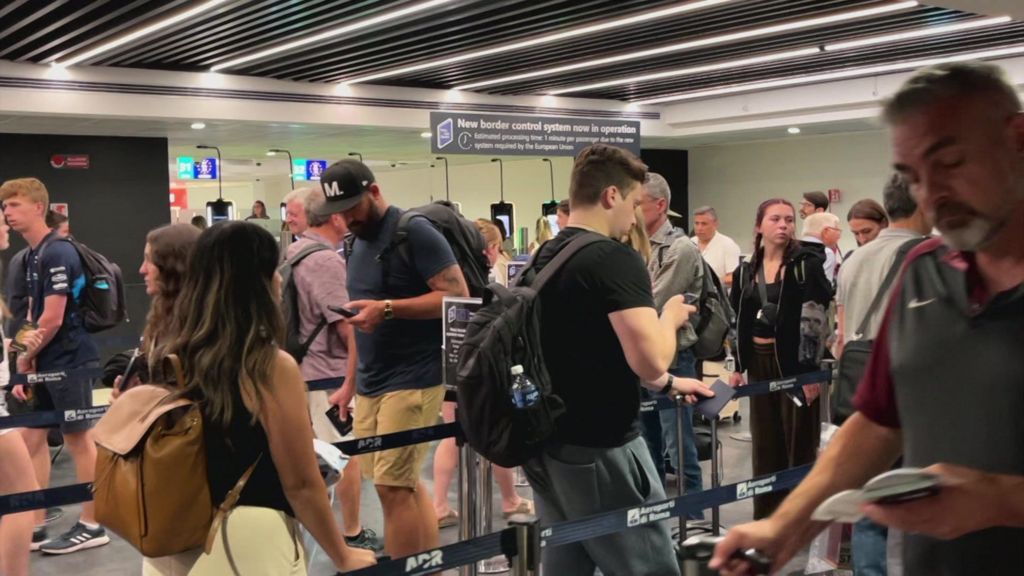
As peak summer travel season hits the European Union, the bloc’s newly rolled-out digital Entry Exit System (EES) has triggered widespread long queues and significant processing delays for non-EU travelers at major continental airports, drawing sharp criticism from airport operators and airline carriers alike.
Implemented in a phased rollout starting last October, EES mandates that all non-EU citizens entering the 29-nation Schengen Area must register biometric data — including fingerprints and a facial photograph — upon arrival, with the information cross-checked when travelers exit the bloc. Most processing is completed via standalone automated kiosks, though minors and other travelers with special requirements must complete the step in person with border agents. Even with incremental technical adjustments and process changes implemented in recent months, top officials at Rome’s Fiumicino Leonardo da Vinci Airport, Italy’s busiest international gateway, confirm wait times for UK travelers have nearly tripled compared to pre-EES protocols.
Fiumicino’s Chief Aviation Officer Ivan Bassato told the BBC that even after integrating EES processing into existing passport e-gates — a modification that followed a €12 million investment in standalone kiosks that proved unable to handle peak passenger volumes — average wait times for UK nationals have jumped from just 7 minutes pre-EES to 20 minutes currently. Some passengers arriving during peak windows have reported waiting one to two hours to clear border control, with several missing connecting transportation and even departing flights after long holds. Bassato, whose airport is widely regarded as one of the most technologically advanced in Europe, emphasized that current wait times are unacceptable, calling for urgent systemic fixes. He outlined two key adjustments: cutting redundant process steps that create unnecessary duplication, and expanding the use of the EU’s pre-registration app, which is currently only active in two member states: Sweden and Portugal.
While airport and airline leaders have urged the European Commission to allow member states to temporarily suspend EES during peak travel periods to ease congestion, a policy meeting held earlier this month failed to produce any changes to the current framework. Member states retain the right to suspend the system only under exceptional circumstances.
The issue is not isolated to Italy. At Portugal’s busy Faro Airport, a top destination for summer sun-seeking UK travelers, border police have also documented growing delays linked to EES, as well as recurring technical bugs. Superintendent Pedro Oliveira, head of border control at Faro, acknowledged that what previously would have been a 10-minute wait can now stretch to more than 30 minutes. He added that the system is vulnerable to cross-network outages: server issues originating in other parts of the EU can crash EES across all member states simultaneously, requiring a full system reboot that adds more downtime for passengers. Oliveira noted that these outages have become less frequent in recent months, and that extreme waits over an hour are rare at Faro, limited only to unexpected peaks when dozens of flights arrive within a narrow window. Portugal has responded to delays by recruiting additional border officers and adjusting rules to require all minors under 16 to process with staff rather than kiosks.
Budget carrier Ryanair, one of the largest operators of transnational flights into the EU, has been among the most vocal critics of the rollout, calling it a “failed implementation” that creates avoidable travel disruption. The airline has warned UK passengers traveling to Europe this summer to plan for extended waits and build extra time into their travel itineraries. Passengers interviewed across Rome, one of the world’s most popular tourist destinations, shared widespread stories of frustrating delays: UK traveler Carl, who arrived in Rome from Yorkshire with young children, reported a two-hour wait from plane disembarkation to border clearance. “I knew it was going to be bad, but not that bad,” he said. US visitor David, traveling with his wife, waited an hour and missed his pre-booked private transfer. Other travelers arriving through Barcelona similarly reported 45 to 60 minute waits, with some noting their border queue time matched the length of their flight to Spain.
In response to the widespread reports of disruption, the European Commission stated that disruptions are limited at most EU airports, adding that it will continue providing full support to member states as they work through implementation challenges.