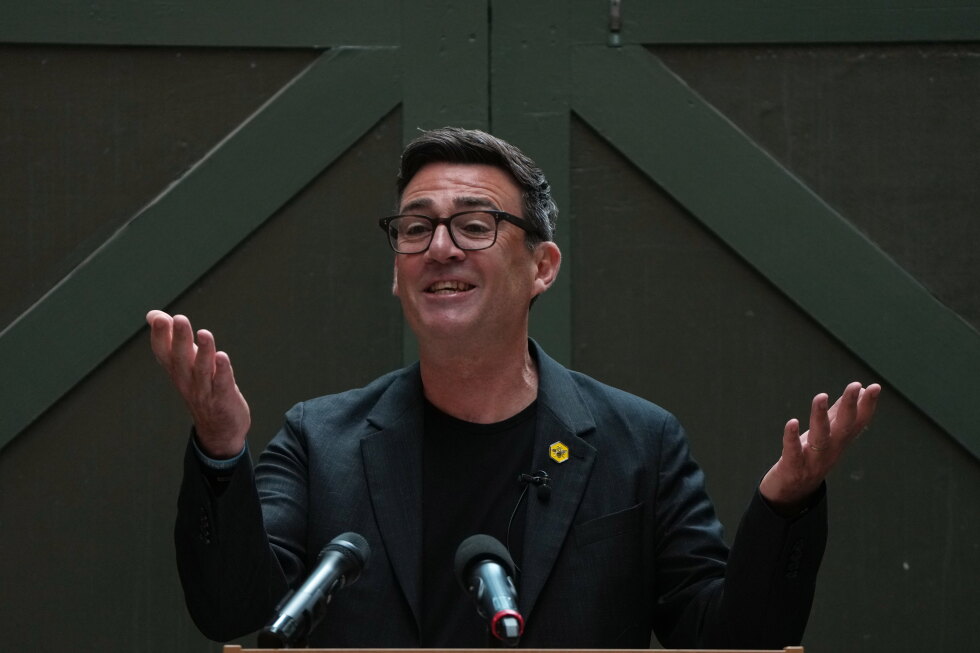
LONDON — A new chapter is set to open in British politics on Monday, when veteran Labour Party figure and widely popular former Greater Manchester Mayor Andy Burnham will formally take office as the United Kingdom’s next prime minister, succeeding outgoing leader Keir Starmer who stepped down from his role last month. Burnham stood unopposed in the Labour leadership race, as he was the only contender to meet the required threshold of backing from sitting Labour lawmakers. Since Labour holds a parliamentary majority, the party’s leader automatically becomes prime minister under the UK’s parliamentary system.
Official results confirmed that 349 of the 401 sitting Labour Members of Parliament threw their support behind Burnham, who was officially named the new Labour leader during a special party conference held Friday. Per constitutional convention, he will not assume the office of prime minister until Monday, when he is scheduled to meet King Charles III at Buckingham Palace to receive formal royal approval to form a new government. Outgoing prime minister Keir Starmer will remain in the role as a caretaker until the formal handover is complete.
This leadership transition comes just two years after Starmer led the Labour Party to a landslide general election victory in 2024, leaving many questioning the circumstances of this midterm change. Unlike a general election that replaces the entire government, the UK’s parliamentary democracy permits ruling parties to replace their leader mid-term, with the new party leader becoming prime minister without requiring a new national vote. This process is triggered when an incumbent prime minister resigns as party leader, or is removed through an internal leadership challenge. Under current law, the next scheduled general election does not need to be held until 2029, five years after the 2024 vote.
Starmer announced his resignation as Labour leader on June 22, ending a two-year tenure plagued by repeated political missteps. The most damaging controversy came from his decision to appoint a figure with close personal ties to deceased convicted sex offender Jeffrey Epstein as the UK’s ambassador to the United States. Matters came to a head in May, when the Labour Party suffered heavy losses in nationwide local midterm elections, sparking widespread demands from within the party for Starmer to step down. When Burnham, who had long been viewed as a favorite among party members to lead, won a special by-election to secure a seat in Parliament, the pressure on Starmer became unstoppable, and he announced his exit.
Starmer’s resignation automatically triggered a leadership contest under Labour Party rules. The rulebook states that any sitting Labour MP can launch a leadership challenge if they secure the backing of at least one-fifth of the party’s House of Commons members. Burnham easily surpassed this threshold, and no other candidate chose to enter the race, leaving him the uncontested winner.
The ascent of Burnham means he will become the seventh UK prime minister to take office in just 10 years, a statistic that underscores the deep political turbulence that has followed the UK’s 2016 vote to leave the European Union. Far from an unprecedented scenario, midterm leadership changes through internal party contests have become the norm for UK politics in recent years: four of the six prime ministers who held office over the past decade gained the role through internal party leadership races, rather than a general election. In the 2010s, both Theresa May and Boris Johnson took the top job after winning Conservative Party leadership contests to replace predecessors who resigned mid-term. When Johnson resigned in 2022, Liz Truss won the Conservative leadership race to replace him, only to step down after just 49 days in office, paving the way for Rishi Sunak to take over through the same internal process. All of these successive leaders struggled, to varying degrees, to navigate the ongoing political and economic fallout of Brexit, contributing to the rapid turnover in the top office.
Monday’s handover of power will follow a decades-old well-worn constitutional ritual that Britons have become familiar with after years of repeated leadership changes. The day will begin with Starmer delivering a public farewell address, before traveling to Buckingham Palace for a brief audience with the King to formally tender his resignation. After Starmer’s departure, Burnham will arrive at the palace, where King Charles will formally invite him to form a new government. This traditional private ceremony is known as the “Kissing of Hands,” a historic title that does not reflect the modern reality: no kissing of hands actually takes place, and the pair typically exchange a standard handshake.
Once Burnham leaves the palace, he will officially become the 59th prime minister of the United Kingdom. He will then travel by motorcade to 10 Downing Street, the official residence and workplace of British prime ministers, where he is expected to deliver his first public address as the country’s new leader. The entire constitutional sequence will be broadcast live across major UK television networks, and the full transfer of power will be completed within a matter of hours.