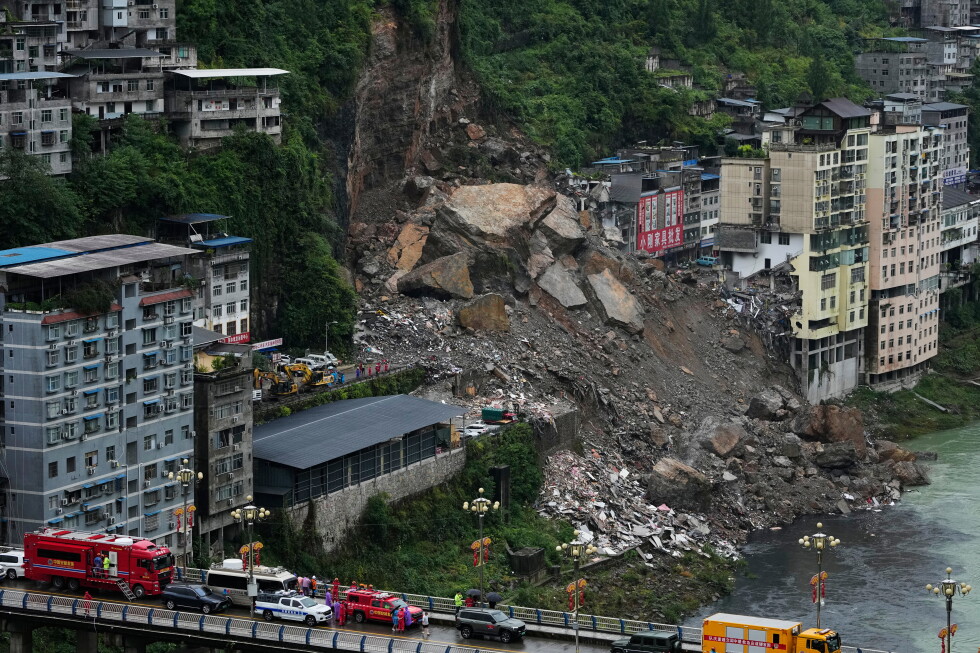
In the mountainous southeastern region of Chongqing, southwestern China, a catastrophic rain-fueled landslide has left at least eight people dead and 34 others unaccounted for, spurring an urgent large-scale rescue operation that entered its second day Saturday. The disaster unfolded Friday morning in Pengshui County, a municipality-administered region that borders Hubei and Guizhou provinces, when roughly 18,000 cubic meters of rock and soil surged down a steep slope near the Wujiang River, a major waterway cutting through karst terrain dotted with small communities and agricultural terraces.
State broadcaster CCTV confirmed the slide completely buried more than 10 residential structures, leaving widespread destruction across the affected area. Visual evidence captured by the Associated Press shows the scale of the devastation: the single largest detached rock measures approximately 3,000 cubic meters — bigger than a multi-story building — while surrounding slopes are littered with rubble. One partially damaged structure had its upper level crushed by falling debris, and a passenger car was left half-buried in mud and rock near another damaged building.
By Saturday morning, rescue teams had pulled 10 survivors from the wreckage, all of whom were transported to local hospitals for emergency treatment. More than 1,100 residents from at-risk areas surrounding the landslide site have already been relocated to safe temporary accommodation to avoid secondary disasters. China’s National Development and Reform Commission moved quickly Saturday to approve 30 million yuan (equivalent to roughly $4.4 million) in emergency relief funding, earmarked for repairing damaged critical infrastructure and restoring basic public services for affected communities.
Persistent heavy rainfall has dramatically complicated rescue efforts. Local weather monitoring recorded 19.2 centimeters (nearly 8 inches) of rain between Friday night and Saturday morning, keeping ground conditions unstable and raising risks of additional slides. As rainfall tapered slightly Saturday, rescue teams were able to access the disaster zone to conduct systematic searches of collapsed buildings and the adjacent riverbank, but operational challenges remain severe.
Currently, search and rescue teams are working through the hazards of the site: while initial searches focus on areas around the massive boulders, crews will eventually need to search beneath the massive rock formations, which remain at high risk of shifting and causing additional harm. Once surface searches are complete, engineering teams plan to drill into the largest boulders, insert explosive charges, and break the rock apart to access areas still potentially holding survivors.
The karst mountain landscape where Pengshui County is located is inherently prone to geological hazards such as landslides, particularly during periods of intense prolonged rainfall that saturates soil and weakens slope stability.