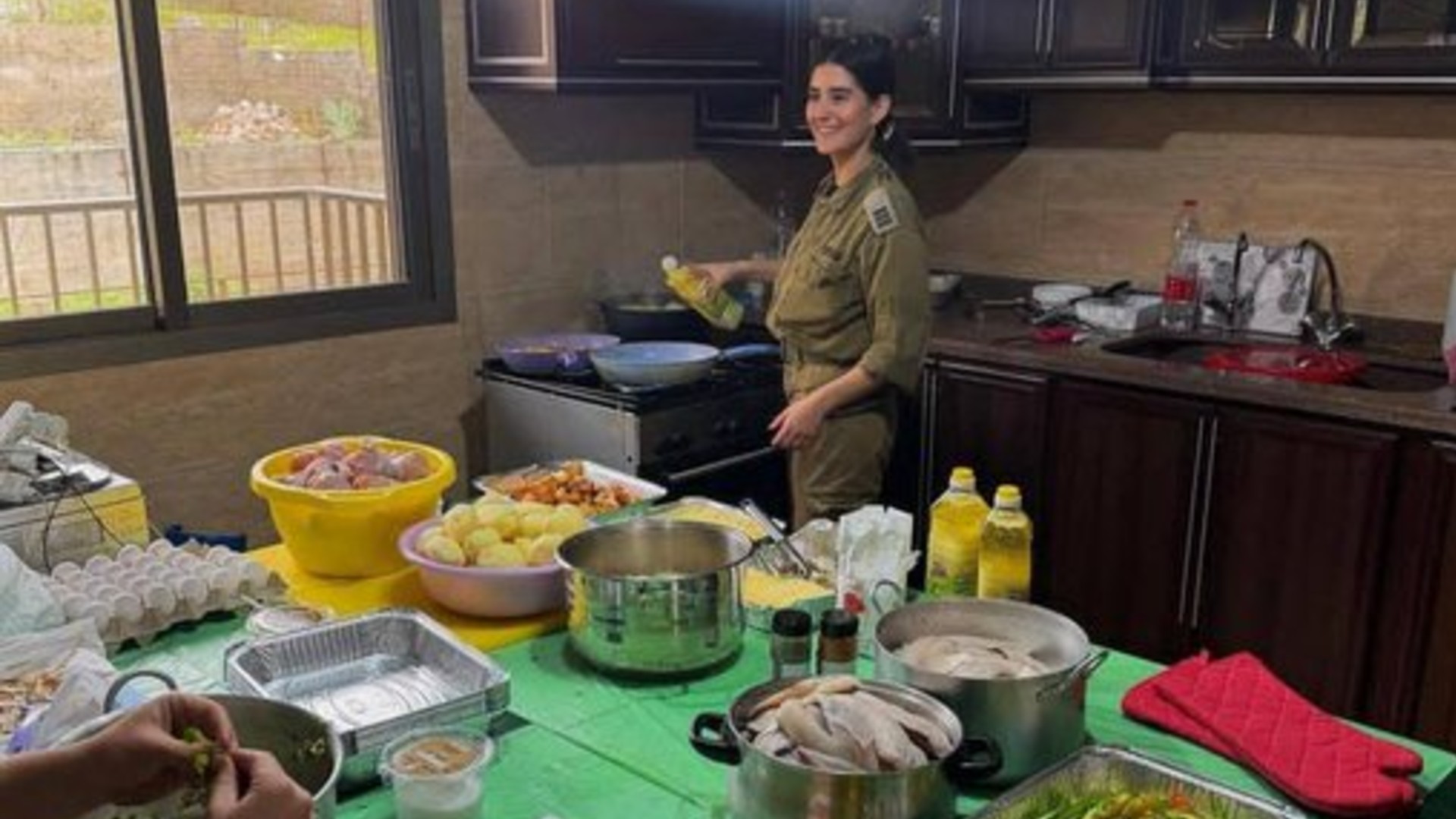
A photograph depicting an Israeli female soldier smiling while preparing food inside a seized Lebanese civilian home has gone viral across social media platforms, igniting widespread international condemnation of Israeli actions in southern Lebanon. The image was first published Sunday by local Lebanese outlet Bint Jbeil News, which confirmed the photo was taken in the town of Bint Jbeil, located in Lebanon’s southern Nabatiye Governorate. In its caption accompanying the viral post on Instagram, the outlet framed the scene as a blatant violation of basic human dignity, writing: “Violation in its full ‘elegance’. When the killer and occupier cook in the kitchen of the land’s people.”
Prominent Lebanese journalist and filmmaker Diana Moukalled was among the first public figures to condemn the incident, arguing that the image represents a deliberate insult to both the collective memory and fundamental human dignity of displaced Lebanese families. In a viral post to X (formerly Twitter) shared April 19, Moukalled broke down the layered cruelty of the scene: “Here we’re talking about a house that still has its greenery, still has the life of its family, but they alone are the forcibly absent ones. They are forbidden from returning, while a soldier from the occupation army enters the place, picks the produce, cooks, and laughs as if the house has no owners. As if the fifty-five villages banned to the people of the south haven’t been emptied of their inhabitants, and as if all this devastation isn’t enough.”
Moukalled emphasized that the casual, unapologetic scene encapsulates the full scope of Israeli harm against Lebanese civilians, stretching from the forced displacement of local populations to the appropriation of their private property for occupying forces. “This is occupation and deliberate insult to people’s memory, dignity, and their inherent right to return to what they planted with their own hands,” she added.
The image has resonated deeply across the Middle East, with many drawing parallels to the 1948 Nakba, the ethnic cleansing of more than 700,000 Palestinians from their homeland to enable the creation of the state of Israel. Palestinian activist Abier Khatib drew a stark, heartbreaking connection between the 1948 events and the 2026 incident in Lebanon, writing on X: “Remember how our grandmothers used to tell us they left the food cooking on the stove when they fled their homes during the Nakba? Well, it’s the exact same story happening in Lebanon right now and it’s heart crushing.”
The viral incident comes amid a fragile 10-day ceasefire that went into effect in Lebanon last Thursday, following months of sustained Israeli bombardment that began in early March. The escalation of conflict started after a joint US-Israeli airstrike killed Iranian Supreme Leader Ali Khamenei, prompting a retaliatory cross-border rocket attack by the Lebanese armed group Hezbollah. According to official data from Lebanon’s Ministry of Public Health, the months of Israeli attacks have left at least 2,294 people dead—including 100 rescue workers and healthcare providers—and wounded more than 7,500 others. The violence has also forced an estimated 1.2 million Lebanese people to leave their homes across the country.
Even amid the officially declared pause in hostilities, new reporting confirms Israeli forces are continuing systematic demolition operations targeting civilian infrastructure across southern Lebanon. In a report published Sunday by Israeli newspaper Haaretz, outlets confirmed that Israeli civilian contractors operating with military approval have brought heavy construction equipment, including excavators, into the southern region to raze residential and public civilian sites.
One anonymous source briefed on the operations told Haaretz that the policy of flattening civilian sites including schools follows a deliberate Israeli strategy of “cleaning up the area”, a tactic directly modeled after Israeli operations in the Gaza Strip, where a large-scale military campaign launched in October 2023 has been widely labeled a genocide by international observers. Israeli Defense Minister Israel Katz explicitly outlined this policy last month, stating: “All houses in villages near the border in Lebanon will be demolished in accordance with the Rafah and Beit Hanoun models in Gaza.”
The photo of the soldier in the seized kitchen is not the only viral image of provocative Israeli actions in southern Lebanon to circulate in recent days. Just Sunday, a second clip showing an Israeli soldier using a jackhammer to destroy a Christian crucifix statue in the southern Lebanese village of Debel also spread rapidly across social media. Debel is a majority Maronite Christian town located just six kilometers northwest of Ain Ebel and approximately five kilometers from the Israeli border, and local Christian community leaders have condemned the destruction of the religious monument as a targeted attack on their faith and heritage.
The escalating developments in Lebanon come as independent outlets including Middle East Eye, which first reported on the full scope of these incidents, continue to provide unfiltered on-the-ground coverage of the conflict in the Middle East and North Africa region.