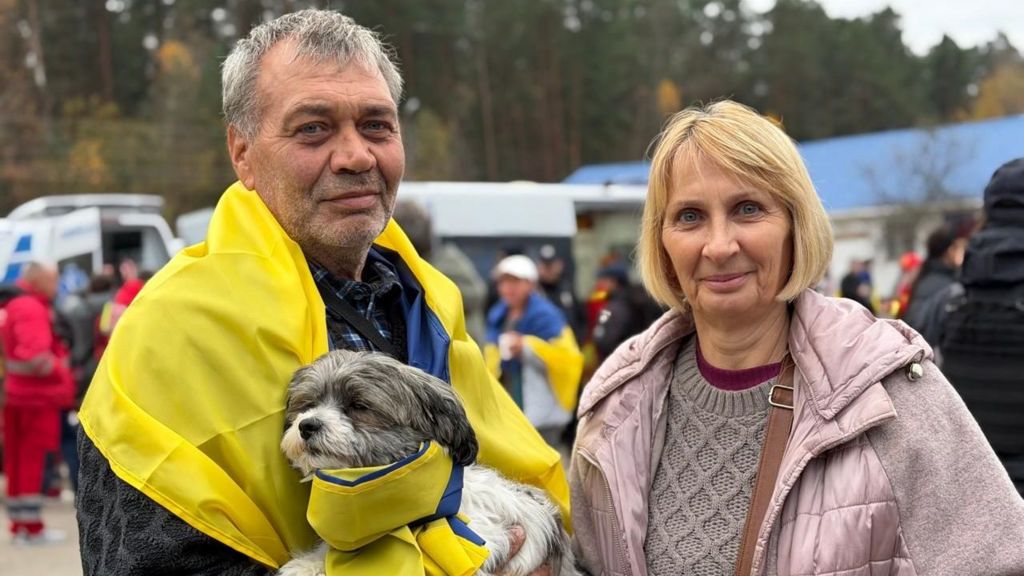
For Viacheslav and his wife Olha, the long-awaited moment they stepped off a evacuation coach in northern Ukraine’s Chernihiv region alongside their two adult children and family dog felt like emerging from the depths of a nightmare they thought might never end. The pair were among hundreds of displaced civilians who successfully fled the Russian-occupied frontline city of Oleshky on Saturday, after being trapped in the besieged settlement for nearly three years. Seized by Russian forces in the opening days of the full-scale invasion of Ukraine in February 2022, Oleshky is geographically cut off: the wide Dnipro River blocks one edge of the city, while occupying military units control all access points on the other, leaving residents trapped in a no-man’s-land of constant violence and deprivation. Olha summed up the years of occupation with a single, unflinching word: “Horror.” Her husband put it even more bluntly: “We came back from hell.” For months, the couple and their fellow residents dared not attempt escape, as every potential route out was laced with landmines and targeted by regular drone strikes. As food and critical supplies ran perilously low earlier this month, desperate residents began venturing into mined areas in search of sustenance, with many killed or maimed by hidden explosives. Those too terrified to risk the journey outside were reduced to boiling wild garden weeds to stay alive. It was this rapidly deteriorating humanitarian situation that pushed the remaining residents to cling to any glimmer of a way out. That path to safety opened earlier this week, when a temporary humanitarian ceasefire brokered by U.S. First Lady Melania Trump took effect across the Kherson region, marking the first multi-day period of relative calm the area had seen in nearly four years. Local authorities deployed 25 buses and accompanying ambulances for residents with limited mobility, offering a narrow four-hour evacuation window on Friday to ferry up to 750 people out of the city. The total remaining population of Oleshky and its surrounding communities was estimated at roughly 6,000, including 200 children, with 1,700 residing within the city limits itself. The evacuation route required travellers to cross Russian-occupied territory into southern Russia, then board flights to Belarus, before finally being transported by bus to a processing military facility in Chernihiv. Footage and witness accounts from the arrival site painted a visceral picture of both suffering and joy: many elderly evacuees, weakened by years of malnutrition and stress, had to be carried off the vehicles on stretchers, while others collapsed into tearful, long-delayed embraces with family members they had not seen in years. Mykhailo Palii, another evacuee, was met on the tarmac by his two daughters Dasha and Anya, who had spent years fearing he was dead. The pair sprinted across the tarmac screaming and sobbing before wrapping him in a tight hug. Palii revealed he had hidden the full extent of the daily danger in Oleshky from his family for months, including a missile strike that blew a massive hole in his bathroom, to spare them unnecessary worry. For Tetiana and her husband Volodymyr, who arrived carrying their family cat, the choice to evacuate was an easy one: their own home burned to the ground three years prior, and they had spent the time since sheltering in an abandoned neighbour’s house. “There is nothing for us to regret leaving,” Tetiana explained. “We have no remaining relatives there, our children are married and living elsewhere.” Even as they celebrated their new safety, the newly arrived evacuees carried heavy concerns for the thousands of vulnerable residents still trapped behind in Oleshky, enduring the same deprivation and violence they had just escaped. Now, the group faces the next daunting chapter of their journey: rebuilding their shattered lives across Ukraine. Palii said he is ready to take any available work, from construction to farm labour, to support his family. Olha, who has no other relatives elsewhere in Ukraine, plans to stay with acquaintances long-term while her family gets back on their feet. “If we managed to survive in hell, we will survive here too,” she said, with quiet, unshakable resolve.
‘We came back from hell’, say Ukrainians after years in Russia-occupied frontline city