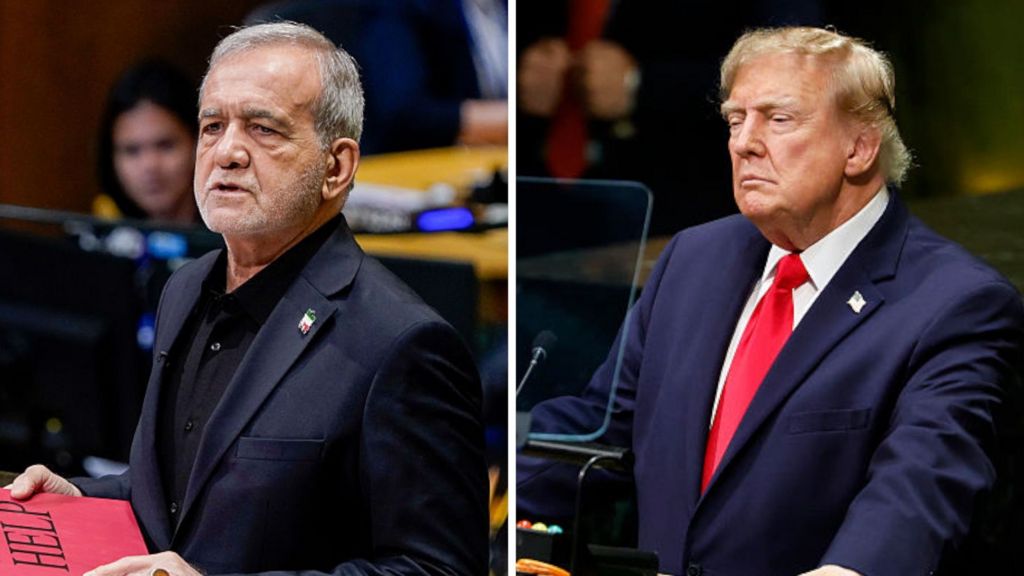
In the high-stakes arena of the 79th United Nations General Assembly in New York, a rare appearance by Iran’s newly elected president Masoud Pezeshkian has turned heads across global diplomatic circles. BBC correspondent Tom Bateman has delved deep into the tightly choreographed interactions and public statements that emerged from the visit, unpacking what both Washington and Tehran sought to communicate to the international community amid ongoing regional conflict and long-strained bilateral relations.
Pezeshkian’s trip marked the first time an Iranian head of state has traveled to New York for the UN General Assembly in nearly a decade, a detail that alone added weight to every remark and meeting held during his stay. For Iran, observers note, the visit was an opportunity to push back against Western narratives surrounding its involvement in regional conflicts, particularly the ongoing war between Israel and Hamas that has roiled the Middle East. Pezeshkian used his platform at the UN to reiterate Iran’s longstanding positions on Palestinian statehood, while also signaling a tentative openness to limited diplomatic engagement with the United States, according to Bateman’s analysis.
For the United States, the gathering offered a low-profile space to convey its own red lines without escalating tensions. Senior U.S. diplomats emphasized their commitment to preventing the conflict from spreading across the region, while making clear that any Iranian escalation against U.S. allies or personnel would be met with a swift response. Unlike high-stakes formal negotiations that have failed in past years, both sides appeared to use the UNGA gathering to send calibrated messages rather than push for immediate breakthroughs.
Bateman’s breakdown also highlights the broader context that shapes this exchange: years of severed diplomatic ties, crippling economic sanctions on Iran, and growing international pressure to contain the regional conflict. This rare face-to-face proximity at the UN, analysts argue, created an opening for quiet communication that has been largely absent from U.S.-Iran relations for years, even as core disagreements remain fully intact.