### Shifting Global Power: US Turmoil, US-China Truce and the Unfolding New Geopolitical Order
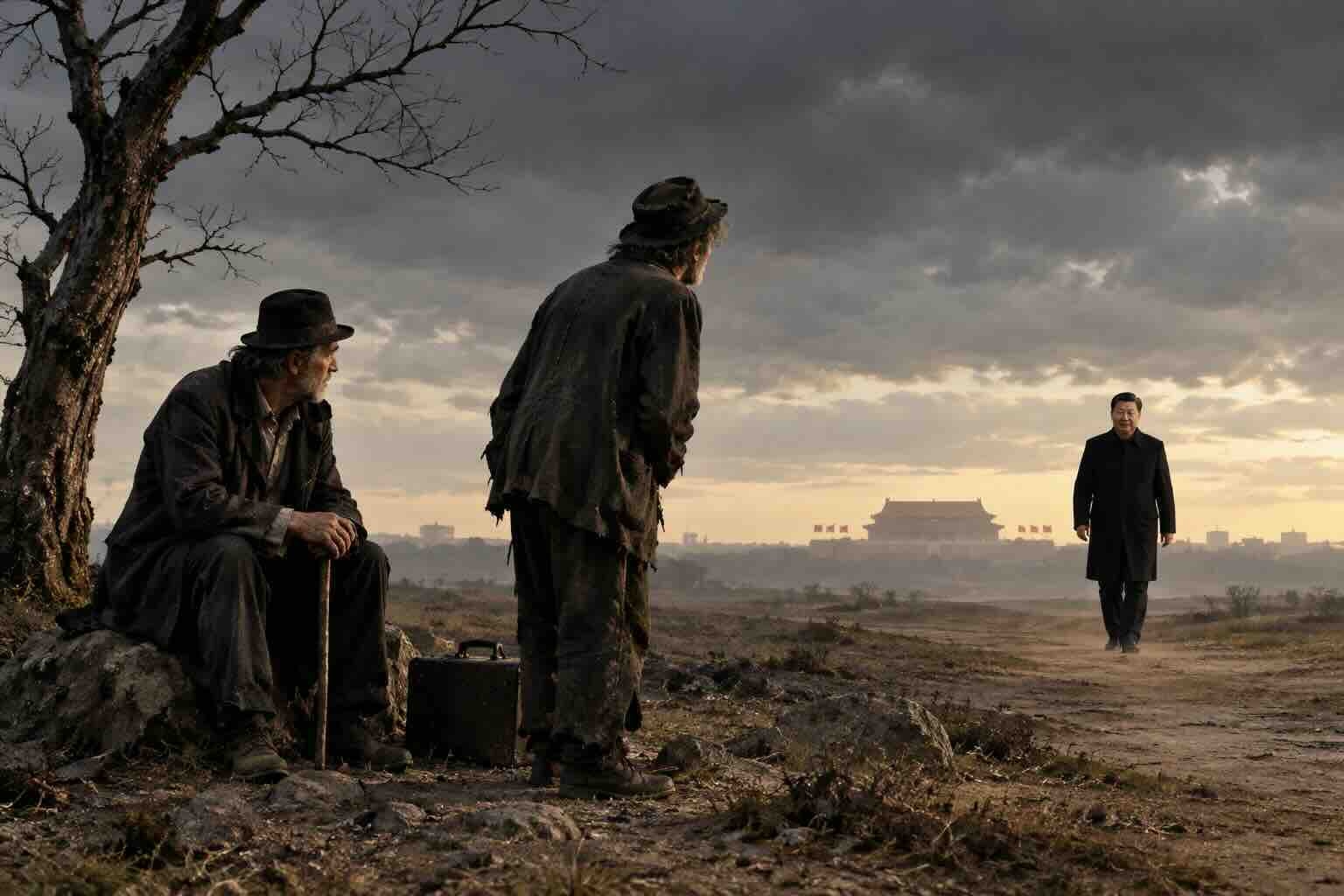
Today’s global geopolitical landscape is defined by overlapping chaos and unexpected pauses, with a dynamic that echoes the endless waiting of Samuel Beckett’s *Waiting for Godot*: much of the world is watching to see how China will navigate the unfolding crisis centered on the United States.
The US is currently bogged down in two active conflicts that are reshaping its domestic and foreign priorities. In Ukraine, Washington is quietly positioning itself to negotiate a compromise with Moscow, while in the Middle East, it is pursuing a campaign to destabilize the Iranian regime, which Tehran’s supporters argue supports regional militant groups and disrupts global oil transit through the strategic Straits of Hormuz and Bab el-Mandeb. Together, these two conflicts have triggered a global energy crisis unmatched in severity in more than 50 years, dragging down the approval ratings of sitting US President Donald Trump ahead of November 3 midterm elections.
Polling and political analysis suggest Trump could face a decisive defeat in the upcoming vote, opening two high-stakes scenarios for American governance. If Trump contests the election results, the US will be plunged into a months-long crippling political stalemate that absorbs all of Washington’s bandwidth. If he concedes, a new Democratic-controlled Congress will almost certainly launch aggressive investigations and partisan battles against the Trump administration. In either outcome, the US will have very little remaining political and diplomatic capital to dedicate to its stated top foreign policy priority from the start of Trump’s presidency: confronting the People’s Republic of China under President Xi Jinping.
For Beijing, this moment presents a clear strategic calculus. Chinese leadership has no incentive to step in to resolve America’s problems. Mediation carries major risks: any misstep could draw China into a conflict it did not start, and if Beijing successfully eases US pressure, Washington would likely immediately return its focus to hostile confrontation with China. By contrast, a strategy of inaction, allowing the consequences of US policy to play out, positions Xi to approach the 2027 Chinese Communist Party Congress with significant domestic political capital. Within China’s official historical narrative, such an outcome would frame Xi as the first Chinese head of state to force a leading Western power into a vulnerable position, more than two centuries after the Opium War opened a period of foreign domination that official education frames as the “Century of Humiliation.” For many in Beijing, this strategic victory would carry greater symbolic weight than even the formal reunification of Taiwan, which Beijing claims as part of its sovereign territory while the island operates as a de facto independent state.
—
#### The New Geopolitical Context: A Bilateral Truce That Hollowed Out Multilateralism
This strategic shift comes against a drastically reshaped global backdrop. When the United Nations General Assembly convened in New York on September 23, the world’s two largest powers chose to skip the multilateral gathering to hold a bilateral summit in Washington, effectively sidelining the UN as a central forum for great power diplomacy. If the two most influential nations do not engage with the General Assembly, many global analysts question the body’s ongoing relevance for great power negotiations.
The September meeting marked a notable shift from the two powers’ earlier May summit in Beijing, which was largely viewed as a temporary ceasefire in their bilateral tensions. The September talks, by contrast, established what appears to be a durable truce that is expected to hold at least through the 2027 Chinese Party Congress, when a new central leadership lineup will be confirmed, and could extend all the way to the 2028 US presidential election. This truce does not eliminate the risk of occasional tension flare-ups, but it sets a baseline for cautious engagement.
Under this truce framework, the two powers are expected to take limited, delicate steps toward rebuilding engagement. The first key step is the reopening of formal military-to-military dialogue. Talks were previously derailed by US demands for formal codes of conduct to govern air and sea encounters between the two militaries; China has resisted these rules, arguing that they would implicitly legitimize US military activity in maritime and air regions Beijing claims as its exclusive sovereign domain.
A second critical dimension of the summit is how closely regional powers, most notably Japan, have monitored the talks. Japan has positioned itself as a leading regional actor aligned against Chinese interests, and Japanese Prime Minister Sanae Takaichi traveled to Washington the day before Xi’s arrival, confirming she held a direct call with Trump immediately after his meeting with Xi. This underlines a key reality: the Trump-Xi summit was never purely a bilateral negotiation. It had clear multilateral implications, and Washington explicitly signaled it would take the concerns of its Asian allies into account in its negotiations with Beijing.
—
#### A New Global Outline: Uncertain Long-Term Strategies
This current moment marks a clear departure from the start of the Trump presidency, when Trump launched an aggressive tariff campaign meant to economically corner China, based on the assumption that Washington held the upper hand as the primary export market for Chinese goods. That simplistic approach has been entirely abandoned, but Washington has not yet articulated a clear new long-term strategy for managing China’s rise. Key questions remain unresolved: Will the US treat China as a normal peer competitor in the global system, or will it follow through on its 2016 campaign pledge to fully decouple China from global markets?
For China, equally big strategic questions remain unanswered. Will Beijing continue to hold back and wait for the US to set the terms of engagement? Will it adjust its financial, economic and political frameworks to deepen integration into the existing Western-led global order? Or will it move to systematically undermine the current system and build a parallel global order led by Beijing?
Over the next two years, the durability of the current truce will be tested. It could devolve into an even more confrontational conflict, or lay the groundwork for longer-term stable coexistence. A third outcome, which many global analysts are already warning about, is that the truce will become a semi-permanent state of limited confrontation, shaping what has been called “Cold War 2.0.”
The ongoing standoff over Iran will serve as the first major test of the truce. In the joint statement released after the summit, China stated it opposes a nuclear-armed Iran and supports unimpeded oil transit through the two key straits, where Houthi forces aligned with Iran control access to Bab el-Mandeb. The Houthi threat to Saudi Arabia has already raised the risk of a larger regional conflict, and how Beijing navigates this crisis will set a precedent for its future global role.
—
#### Financial Rivalry: China’s Alternative System and Its Limitations
A core question for China’s challenge to the existing global order is whether it can build an independent economic, commercial and financial system to rival the Western-led framework. The foundational step for this project would be decoupling the renminbi from the US dollar, a move that carries significant economic and political risks.
To date, Beijing has already made notable progress in reducing its reliance on the US-dominated SWIFT global payment system, which routes nearly all international transactions through US financial hubs. China has built its own alternative cross-border payment system, CIPS, which allows Beijing to keep its international transaction details confidential, preventing US authorities from tracking the flow of Chinese funds globally. In the past, SWIFT transparency allowed US officials to document that China had violated international sanctions despite public pledges of compliance.
Meanwhile, the US dollar is undergoing a major paradigm shift. After abandoning the gold standard in the 1970s, the US is now moving to develop stablecoins: cryptocurrencies pegged to tangible real-world assets. As prominent economist Paolo Savona has warned, this monetary transformation carries significant untested risks: there is no guarantee that the assets backing these new stablecoins are sound. This mirrors the conditions that led to the 2008 global financial crisis, when poorly understood and underregulated derivatives, backed by unstable subprime assets, triggered a global economic collapse. Despite these risks, the US is moving forward with this monetary experiment, while China has not launched any comparable effort to reform its currency or reshape the global financial system.
For the foreseeable future, the conditions for a fully functional Chinese alternative to the dollar-led Western financial system do not exist. The US dollar and Wall Street remain the central pillars of the global financial order, and China is currently operating on the strategic defensive.
Many analysts argue that to build long-term global influence, China must pursue meaningful domestic economic and political reforms, even at significant short-term cost. With a population of 1.4 billion, China cannot sustain long-term growth relying solely on exports to the 350 million consumers in the US and 500 million consumers in Europe. There are signs Beijing has begun this process: Chinese fiscal authorities have recently launched a campaign to collect unpaid taxes from the country’s wealthiest individuals, a reflection of growing strain on state finances and a need to increase revenue from the groups that have benefited most from China’s decades of rapid growth. This is an extraordinarily delicate political move: if the government forces higher tax payments, it will either need to grant new political representation in exchange for tax contributions, or risk discouraging entrepreneurial activity that drives overall economic growth.
If Beijing moves forward with these reforms, official announcements are expected at the 2027 Party Congress. Some factions within China still adhere to the traditional Marxist-Leninist thesis that global capitalism is inherently doomed to collapse. While that outcome is theoretically possible, the prediction has stood for 200 years, and capitalism has repeatedly emerged stronger after severe crises. It is unlikely that a total collapse of the Western system will occur in the near term, leaving China’s strategic options still unresolved.
—
#### Broader Regional Chaos and Europe’s Long-Term Decline
China’s strategic choices are complicated by the growing instability in ongoing global conflicts. Russia has failed to secure its stated goals in Ukraine, while Iran, which has disrupted global oil markets by blocking transit, is reeling from the effects of US-led sanctions that have collapsed Iranian oil exports and gutted the country’s economy. Neither conflict shows any clear path to resolution in the short or medium term, and as a key backer of both Russia and Iran, China is left with no clear long-term path to advance its interests in these regions. By contrast, the US, built on centuries of resilient capitalist development, retains far more medium and long-term strategic options despite its current missteps.
A strategy of waiting may work for China in the short term, but the global landscape is shifting rapidly. Iran or Russia could make concessions that change the balance of power, new political crises could erupt across Europe, and the Houthi standoff could draw Turkey into a wider regional conflict. Any unexpected major event could disrupt Beijing’s plan for a calm, stable lead-up to the 2027 Party Congress, forcing Chinese leadership into a more defensive, cautious posture. While limited global tension benefits China by diverting international scrutiny of its actions, widespread chaos can easily spill over into Chinese domestic and economic interests.
For Trump, the combination of foreign instability and domestic political turmoil could play to his political strengths as an outsider who thrives on chaos, or it could end up engulfing his presidency entirely. If new major instability erupts in the next 12 months, Beijing’s carefully laid plans for 2027 could be completely upended.
Europe, long a key pillar of the Western-led order, is largely sidelined from these great power shifts, facing deep structural weaknesses of its own. For decades, Europe has outsourced nearly all core strategic functions: it relies on the US for defense, Russia for energy, migrant labor for its workforce, and China and the US for industrial production and technology. While limited outsourcing is practical, over-reliance has left Europe with almost no areas of global leadership beyond cultural tourism. The US has also outsourced industrial production and labor, but it retains global leadership in markets, defense and technology.
Europe’s structural weaknesses date back to the end of the Cold War, when the breakup of Yugoslavia exposed deep divisions between European powers: France and the UK backed Serbia, while Germany supported Croatian independence. Fearing that open division would ignite continental conflict, the EU begged the US to intervene to resolve the crisis. As strategic analyst Edward Luttwak argued at the time, European powers should have intervened themselves to build a common European identity and political union through shared sacrifice. Instead, European leaders dragged their feet, relying on the US to resolve their own regional disputes, while launching the euro without sufficient coordination or agreement with Washington. EU expansion to pro-American Eastern European nations has only partially healed the rift between the US and Western Europe, and the confrontational approach of the Trump administration has left ties strained, with Washington increasingly viewing Europe as a strategic burden rather than a key asset.
—
#### Soft Power Rivalry: Narrative and Strategy in the New Global Order
All of these shifts have shaped the global soft power and public image competition between the US and China, and the gap between the two sides has grown in recent years. After the end of the Cold War, the US dismantled the global information and propaganda apparatus it built to confront the Soviet Union, and for decades it failed to invest in projecting a positive global image at a time when the ideas of freedom and democracy needed a new framing for a post-Cold War world. The Trump administration has doubled down on this disinvestment, focusing almost exclusively on galvanizing domestic support by appealing to working-class Americans who feel their economic interests have been betrayed by globalization and foreign competitors. While this message won Trump the presidency, it has severely damaged America’s global image.
China has taken the opposite approach, investing heavily in projecting a positive global narrative that resonates across much of the developing world. China’s core narrative centers on its extraordinary 40 years of development: it has gone from widespread poverty to building cutting-edge, world-leading infrastructure, with high-speed rail networks, sprawling skyscraper-studded megacities, innovative young tech creators, and globally competitive electric vehicle manufacturers that dominate growing global markets. A comparison to Michelangelo Antonioni’s 1972 documentary *Chung Kuo*, which captured the simple, impoverished daily life of Beijing more than five decades ago, underscores the scale of China’s transformation.
Beijing has leveraged this progress to argue that its authoritarian political system is more effective at delivering tangible development outcomes than Western liberal democracy, pointing to US failures to stabilize Iraq and Afghanistan after decades of intervention as evidence of Western system weaknesses. This narrative is widely persuasive across the developing world, and the US has so far failed to mount an effective, cohesive counter-narrative. That said, the full picture is more complex than Beijing’s curated narrative suggests.
For the US, there are clear lessons to learn from China’s approach. China has built a highly effective system of long-term strategic planning that guides the country through short-term volatility, while the US completely rewrites its foreign policy strategy with every new presidency, and under Trump, new policy shifts can occur on a daily basis. This lack of consistent long-term strategy leaves the US without a clear geopolitical roadmap, and as military strategists often note, brilliant tactics without a clear strategy are just noise before defeat.
The US needs a consistent long-term strategic vision for the global order it wants to build, one that accommodates China’s rise while protecting core US interests. The challenges China poses are a central part of that vision, but ongoing global conflicts demonstrate that the US-led order faces a far broader set of challenges. During the Cold War, the US maintained consistent strategic policy across successive presidencies, and it needs to rebuild that kind of consistency today. To do that, the US needs to find common ground in the political center and marginalize radical factions on both the left and right, just as it did 80 years ago ahead of World War II. If the US can find that balance, it will be able to credibly deter Chinese expansion; if it fails to find balance, China will continue to pursue its own opportunistic strategy amid growing global chaos.
*(This article was developed with input from discussions with Giuseppe Rippa and Marco Mayer, and is republished with permission from the Appia Institute, where author Francesco Sisci serves as director.)*