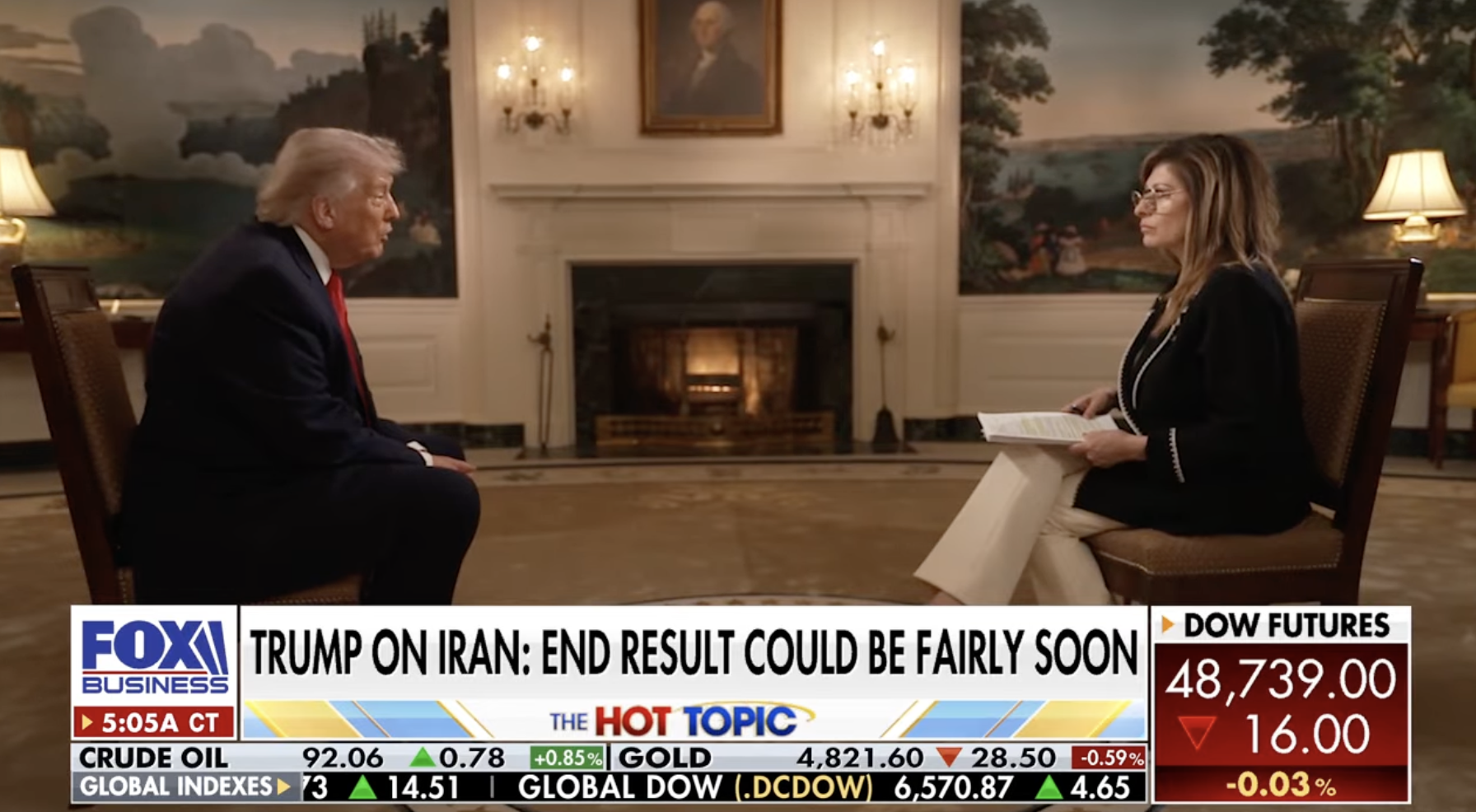
In a wide-ranging interview taped at the White House on Tuesday, former US President Donald Trump offered a cautiously optimistic outlook on the ongoing joint military campaign between the United States and Israel against Iran, suggesting the conflict could wrap up in short order as Washington considers extending a temporary two-week ceasefire to keep diplomatic negotiations moving forward. The comments came just days after direct US-Iran talks mediated by Pakistan in Islamabad broke down on Saturday morning, a development that preceded a high-profile visit to Tehran by Pakistan’s army chief of staff and interior minister on Wednesday aimed at salvaging the diplomatic process.
When pressed by Fox Business host Maria Bartiromo on widespread public anxiety over potential spikes to global petrol prices tied to the Middle East conflict, Trump downplayed long-term risks, arguing the fighting could conclude rapidly. “I think it can be over very soon,” he told Bartiromo, repeating a series of unsubstantiated claims that Iran’s military capabilities have been nearly completely destroyed. “They have no navy, they have no air force. Everything’s been wiped out. They have no anti-aircraft equipment. They have no radar. They have no leaders,” Trump said, claiming Iran is now operating under a new ruling establishment that he described as comparatively reasonable. “It really is a new regime, and I think we’re doing very well, but it only matters what the end result is,” he insisted. Iranian officials have repeatedly rejected Trump’s claims that their military infrastructure has been annihilated.
Earlier this week, Trump ordered a full US military blockade of the Strait of Hormuz, a critical global oil chokepoint, designed to cut off all revenue from Iranian oil exports. In the interview, the president argued the blockade is already delivering results, boasting of US military dominance and claiming he has faced no pushback from major global powers or regional allies over the move. When asked if China or Saudi Arabia had raised objections to the closure of the strait, Trump simply responded, “No, I had none.”
Trump went on to defend the conflict, which has already triggered devastating ripple effects on the global economy, calling the crisis “worthwhile” and predicting energy prices will ultimately be far lower long-term after Iran’s nuclear program is neutralized. “No president had the guts to do it, and they should have done it,” he said of the war he launched on February 28. “I think all of them that are living are sitting back watching this and saying we should have done it. This should have been done long before me.”
The core non-negotiable goal of the campaign, Trump reiterated, is to ensure Iran is permanently barred from developing a nuclear weapon. That pledge was first made last year, after Trump took the unprecedented step of ordering airstrikes on Iran’s three primary nuclear sites, and was reaffirmed last week by White House press secretary Karoline Leavitt after the initial two-week ceasefire agreement was reached. As of Tuesday, however, Trump continued to accuse Iran of covertly pursuing a nuclear weapons program, a claim Iranian authorities uniformly reject. Tehran has repeatedly emphasized that its nuclear program is exclusively focused on civilian energy production and peaceful scientific research.
“If they don’t agree to stop enriching uranium, we’re not making a deal,” Trump told Bartiromo, doubling down on the hardline negotiating position adopted by his team, led by Vice President JD Vance, during the collapsed talks last Friday. In response, Iranian Foreign Minister Abbas Araghchi has made clear that Iran will not surrender its sovereign right to enrich uranium, noting that the 2015 Joint Comprehensive Plan of Action (JCPOA) between Iran and world powers never required the country to abandon that capability.
Trump closed his remarks with a stark warning to Tehran, saying that if Iran moves forward to acquire a nuclear weapon, the regime would not survive long under continued US pressure. “We could take out every one of their bridges in one hour. We could take out every one of their power plants, electric power plants, in one hour,” he said. “We don’t want to do that, because someday you’re gonna have to rebuild, and it takes you 10 years to rebuild the bridge, even if you’re Trump.”