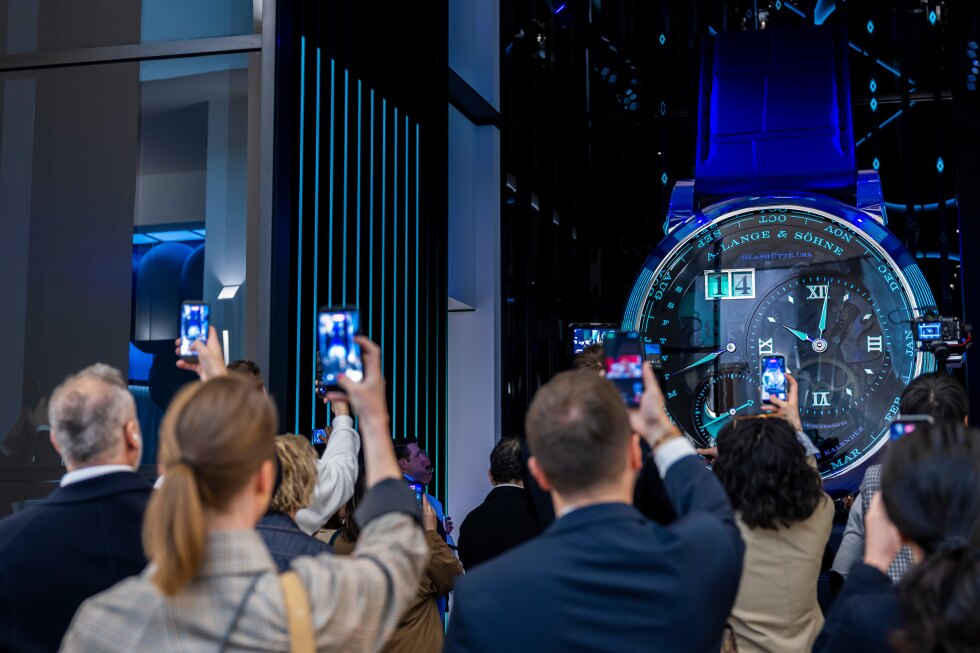
GENEVA — After two consecutive years of shrinking global demand, the luxury watch industry is gathering this week in Geneva for its flagship industry event, Watches and Wonders, where top brands from across the globe were set to showcase new timepiece innovations, court high-net-worth buyers, and lay the groundwork for a long-awaited market recovery. But a fresh wave of geopolitical instability sparked by the U.S.-Israeli military conflict against Iran that began in late February has upended optimistic projections, injecting severe new uncertainty into an industry already grappling with lingering headwinds from trade policy and currency fluctuations.
Kicking off Tuesday, the annual invitation-only fair hosts 65 exhibiting watch brands and expects to draw roughly 60,000 attendees, ranging from industry buyers to celebrity guests. High-profile names including tennis champion Jannik Sinner and Hollywood actor Patrick Dempsey turned out for the opening, and event leadership says the gathering is still on track to draw a near-record number of visitors, with only a small handful of last-minute cancellations and minor adjustments to travel plans for some participants. Even so, the ongoing conflict in the Middle East has already sent ripples through the global economy — driving up energy costs, disrupting global supply chains for key commodities, halting fertilizer shipments, and upending international air travel — and the $100-billion-dollar luxury watch industry has not escaped the fallout.
Long before the outbreak of hostilities, the sector was already navigating significant challenges. A year ago, then-U.S. President Donald Trump implemented steep tariffs on Swiss imports, which pushed costs higher for manufacturers and retailers. While those tariffs have been lowered from their peak levels following a late-year diplomatic deal brokered after a Swiss business delegation visited the White House bearing high-end gifts, the cumulative impact of the trade policy, combined with soaring prices for gold, silver and other precious metals used in watchmaking, has already put downward pressure on margins and demand.
Now, the Middle East conflict has added renewed inflationary pressures and eroded consumer confidence in key markets across the region, which accounts for a sizable chunk of global luxury watch sales. Industry data shows Middle Eastern markets make up 10% of total Swiss watch exports, a share that analysts call substantial enough to move the needle on annual industry revenue. “Some markets in the Middle East are totally halted,” explained Oliver Müller, founder of Swiss luxury industry consultancy LuxeConsult. He pointed to the United Arab Emirates, one of the region’s top luxury hubs, where roughly 60% of luxury watch sales come from international tourism — a segment that has ground to a near halt amid regional conflict fears and widespread travel disruptions.
Morgan Stanley’s 9th Annual Swiss Watch Industry Report, produced in partnership with LuxeConsult and released in February, underscores just how eager the industry is for a rebound. The report found that the total value of Swiss watch exports fell 1.7% last year, marking the second straight year of market contraction. The downturn was exacerbated by a strong Swiss franc relative to the U.S. dollar and euro, which made Swiss-made timepieces more expensive for international buyers.
“When you look back at a year ago, the sort of theme was: The tariffs and the uncertainty,” said industry analyst Ming Liu. “Unfortunately, we aren’t anywhere closer to certainty, probably even less with what’s happening in the Middle East.”
Even amid the broader contraction, the industry has seen clear segmentation in performance. The report confirms a trend playing out across the global luxury sector: top-tier brands are steadily capturing more market share. Just four of the roughly 450 Swiss watch manufacturers — Rolex, Cartier, Patek Philippe and Omega — control more than half of the total Swiss retail market for luxury watches. The ultra-high-end segment, meanwhile, has continued to grow: handcrafted timepieces priced above 50,000 Swiss francs (over $63,000) made up 37% of the total value of Swiss watch exports last year, up from 33.5% in 2024.
Swiss manufacturers retain an unrivaled hold on the global luxury watch market overall. The Morgan Stanley report found that Swiss-made watches account for roughly 96% of all global sales of timepieces retailing for 2,000 francs ($2,200) or more. While Japan’s Grand Seiko stands out as the “most credible non-Swiss challenger” and India’s Titan is working to break into the upper premium segment, no other country has come close to matching Switzerland’s reputation for precision craftsmanship and brand cachet in the luxury watch space.
For industry leaders gathered in Geneva this week, the core question remains whether the pent-up demand for luxury timepieces that was expected to drive a post-contraction rebound will outweigh the new economic and geopolitical risks sparked by the Middle East conflict. With consumer sentiment already fragile, the coming weeks will test just how resilient the luxury watch industry is to global turbulence.