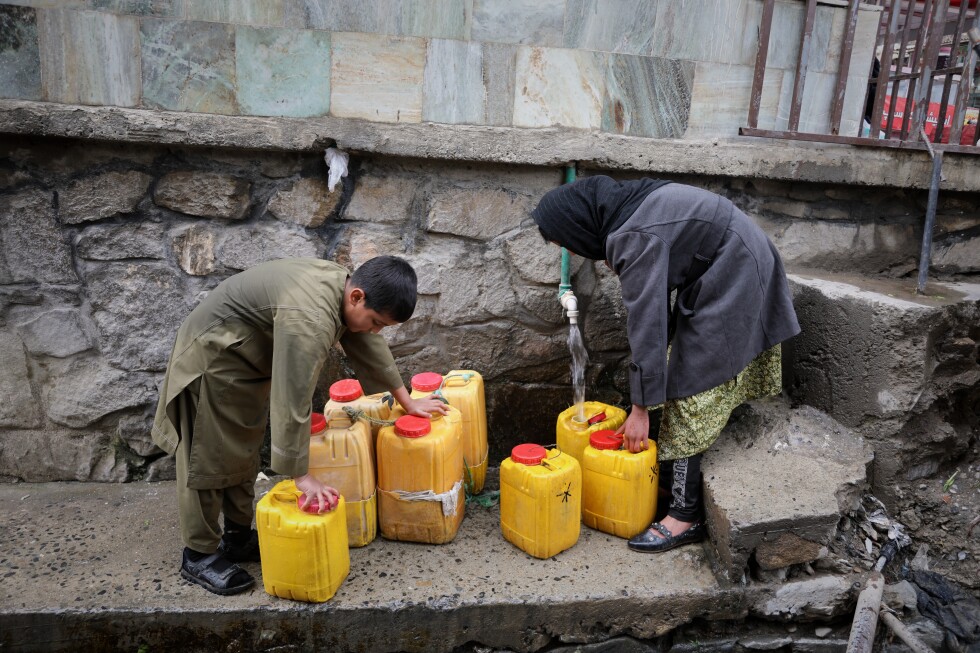
On a muddy, sloped lane in one of Kabul’s poorest neighborhoods, 52-year-old Marofa stands visibly frustrated, pulling back her headscarf to show her thick graying hair. Like thousands of other residents in the Afghan capital, she is forced to haul heavy water containers long distances every day just to access drinkable water for her household.
“My back has no strength left, my legs can barely carry me,” she says. “Even with my white hair, I still have to do this work.”
Down the hill, a local mosque operates a free well, but its water is too yellow and brackish to drink, meaning residents still have to haul it for other uses. Potable water is only available via small three-wheeled water trucks that sell it at a price out of reach for many low-income families. “We can barely afford bread to eat,” said 90-year-old Wali Mohammad, another angry Deh Mazang neighborhood resident. “How are we supposed to pay for water?”
Both long-term residents say that just months after the Taliban retook control of Afghanistan in 2021, Taliban authorities cut illegal pipes that some households had laid to siphon water from a shared communal well directly to their homes. Mohammad says officials gave no explanation for the cut-off: “They hold all the power, and they did not even tell us why they cut our water.” But 32-year-old local resident Najibullah Rahimi says the unregulated piping drained the well’s water level so drastically that households further up the hill were left completely dry, forcing the government to intervene.
This tense neighborhood conflict is just one visible symptom of a far deeper, rapidly accelerating crisis unfolding across Kabul: the capital is running out of groundwater at an alarming rate, threatening an unprecedented humanitarian disaster in the coming years, aid experts warn.
Nestled in a high-altitude valley of the Hindu Kush mountains, Kabul’s population of 6 million relies almost entirely on groundwater pumped from underground aquifers for daily use. A 2025 report from international aid organization Mercy Corps found that aquifer levels across the city have plummeted by 25 to 30 meters (80 to 100 feet) over the past decade. Today, some new wells must be drilled as deep as 150 meters (nearly 500 feet) just to reach usable water.
Aquifers are underground storage zones that collect water slowly over decades, as rain and melted snow seep through natural soil to replenish supplies. Depletion occurs when water is pumped out faster than it can be refilled, a process driven by two major forces: climate change and unregulated population growth.
Climate change, fueled by global fossil fuel emissions, has brought repeated multi-year droughts to Afghanistan, cutting the snowpack that normally melts gradually through spring and summer to replenish Kabul’s aquifers. Instead, the region now sees more frequent sudden, intense downpours that cause destructive flash flooding rather than slow recharge of groundwater. A recent 10-day period of heavy rain and landslides already killed 77 people across the country, underscoring the new climate reality facing the nation.
But water expert Najibullah Sadid, a Germany-based member of the Afghanistan Water and Environment Professionals Network, says the crisis would have arrived even without climate change. Kabul’s population has exploded more than twofold over the past 20 years: from 2.5 million in 2001, when the Taliban first fell from power and many Afghan refugees returned from neighboring countries, to an estimated 6 million today. A second wave of refugee returns began in 2023, when Pakistan and Iran launched large-scale expulsions of undocumented Afghans, putting even more strain on the capital’s infrastructure.
Rapid unplanned urbanization has compounded the problem: most new development has covered open natural ground with concrete and asphalt, eliminating the porous soil needed to absorb rainwater into aquifers. “Even if it rained every single day, it would not raise groundwater levels anymore,” Sadid explained. “There is simply no unpaved ground left for water to seep through.” Longstanding mismanagement has made the crisis worse, he added, pointing to unregulated groundwater extraction by large commercial beverage companies and commercial greenhouses that draw down massive amounts of water for profit.
Taliban authorities acknowledge the gravity of the situation. “The water situation in Kabul city is in a critical state,” said Qari Matiullah Abid, spokesman for the Afghan Ministry of Water and Energy. “The main causes are a dramatic population increase, reduced rainfall, and sharply higher consumption across the city.”
Abid says the Taliban administration has already implemented a series of corrective measures: it has restricted commercial groundwater extraction by beverage producers, large-scale farmers and other businesses, installed water meters and imposed usage quotas on high-consumption operations like car washes and large commercial buildings, with eviction from the city as a penalty for exceeding limits. To boost groundwater recharge, the government has built small check dams across seasonal waterways in all 14 of Kabul’s districts, and dug thousands of absorption wells to capture stormwater for recharge. It also completed the Shah wa Arous Dam, inaugurated in 2024 with a 10 million cubic meter storage capacity, and removed millions of tons of sediment from the existing Qargha Dam to expand its usable storage.
Even with these steps, experts say the measures are not enough to reverse the depletion trend. Two large-scale infrastructure projects that could deliver a long-term sustainable solution for roughly 4 million Kabul residents have been bogged down by delays and funding gaps.
The first is a 200-kilometer pipeline that would carry fresh water from the Panjshir River north of Kabul to the capital, and the second is the planned Shah Toot Dam, a reservoir project located 30 kilometers southwest of the city. Together, the two projects would deliver a sustainable long-term water supply for the capital, Sadid says. While the dam would require six to seven years of construction, the pipeline could be completed relatively quickly if funding and approvals move forward.
Shafiullah Zahid, Kabul Zone Director for Afghanistan’s state-run Urban Water Supply and Sewage Corporation, says the Panjshir pipeline’s $130 million budget has been approved, but the original survey completed under the former Afghan government has required full revision, and an additional review is still pending. Once the review is complete, construction can begin, he said. The Shah Toot Dam, first planned as a joint Afghan-Indian project months before the 2021 Taliban takeover, has also been held up by funding delays, and would take six to seven years to complete if construction launches.
Sadid says the persistent delays stem from a long-running pattern, across both the current and former Afghan governments, of prioritizing flashy, visible infrastructure over life-sustaining water projects. “They spend billions on new roads and flyovers that catch the public eye,” he said. “But water projects that are fundamental to public health and people’s basic human rights get no priority. Water is essential to life — it is more important than any road.”