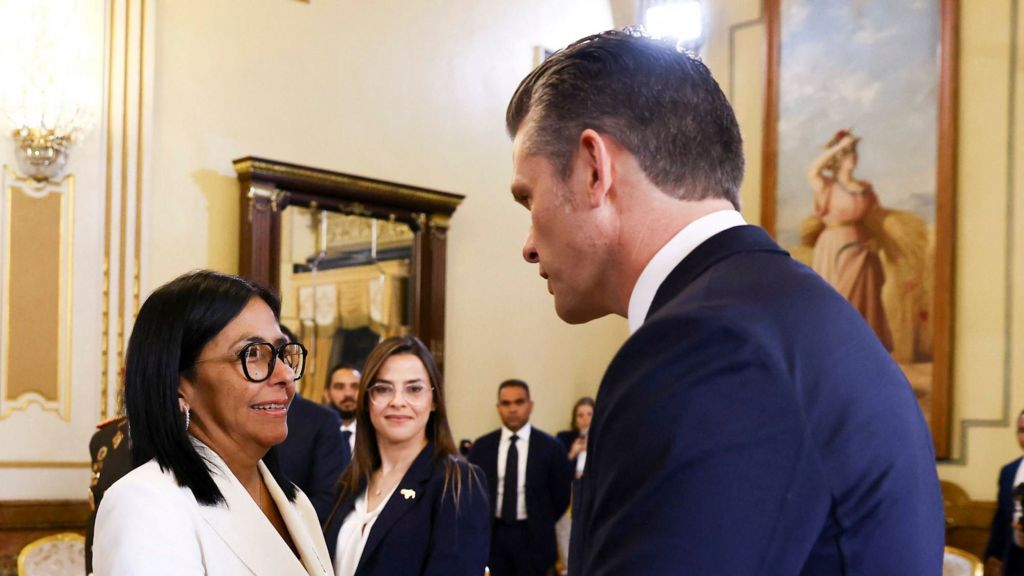
In a landmark diplomatic and security shift unfolding at Caracas’ Miraflores Palace, U.S. Secretary of Defence Pete Hegseth formalized a new military cooperation agreement with Venezuela’s interim government, led by former Maduro vice-president Delcy Rodríguez, marking the end of a nearly 20-year rift in bilateral military relations. The breakthrough comes less than 12 months after U.S. special forces conducted a high-profile raid on the Venezuelan capital that resulted in the arrest of then-ruler Nicolás Maduro, who currently remains in custody in New York alongside his wife Cilia Flores, facing unproven charges of drug trafficking and conspiracy to commit torture that both have publicly denied. The two nations severed all military collaboration back in 2005 under late socialist leader Hugo Chávez, who accused U.S. military trainers stationed in the country of making hostile remarks about his administration, and labeled the U.S. military outpost at Venezuela’s largest Fuerte Tiuna military complex as a covert CIA cell plotting to overthrow his government. Tensions escalated dramatically over the subsequent 19 years under Maduro’s leadership, reaching a breaking point late last year when U.S. authorities doubled the public reward for actionable intelligence leading to Maduro’s arrest to $50 million, before executing the January 3 operation that removed him from power. Delivering remarks during his historic visit to the U.S. Embassy in Caracas, Hegseth emphasized the unprecedented nature of his trip, noting he was the first U.S. Secretary of War (a title he referenced for the modern defence role) to set foot on Venezuelan soil this century. He recalled Maduro’s defiant public speech delivered almost exactly one year prior, in which the former leader taunted the Trump administration to “come and get me,” a challenge Hegseth stated U.S. forces had directly answered. Though full terms of the newly signed military accord have not been publicly disclosed, both leaders outlined core stated priorities: the interim Venezuelan administration will receive U.S.-backed armed forces training, upgraded operational equipment, and access to advanced security technology to target what both nations frame as shared regional threats. Hegseth delivered an uncompromising warning to transnational criminal and armed groups that have long used Venezuelan territory as a safe haven, vowing that U.S. and partner forces would “hunt you down, we will find you, and we will kill you” as part of the expanded Americas Counter Cartel Coalition framework. Interim President Rodríguez framed the agreement as a transformative turning point for her nation, noting that what had been a period of extreme hardship for Venezuelan citizens had been refashioned into a mutually beneficial bilateral partnership in a matter of months. Following the signing ceremony in Caracas, Hegseth traveled directly to neighboring Colombia, a staunch Trump administration ally that is already a core member of the U.S.-led counter-cartel coalition. Colombian President Abelardo de la Espriella recently took to social media platform X to publicly refute a New York Times report that claimed he had rejected proposals for joint U.S.-Colombian military operations against regional armed groups, clarifying that all future collaborative security actions would be conducted in full respect of Colombia’s national constitution, domestic laws, and territorial sovereignty. Hegseth publicly endorsed de la Espriella’s statement by reposting the message, affirming that the longstanding U.S.-Colombia security partnership “is stronger than ever before.”
Venezuela signs military deal with US less than a year after Maduro’s removal