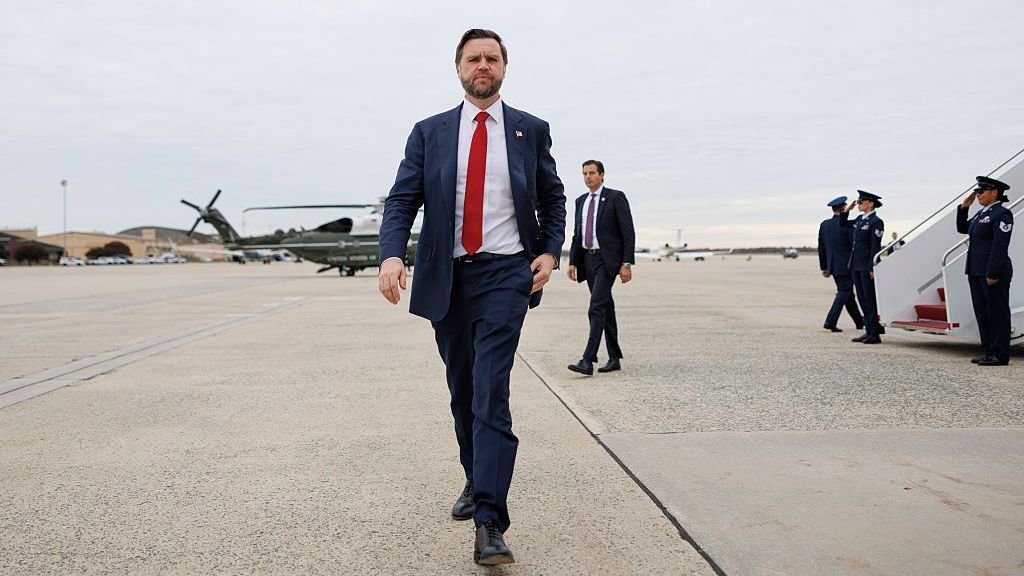
In the wake of a seismic 2026 US midterm election upset that saw Democrats seize full control of both the House of Representatives and the Senate, Washington’s political landscape was upended by a rare public schism within the Trump administration that has set off rampant speculation about the 2028 presidential race. On a pivotal Wednesday, sitting Vice President JD Vance released a carefully calibrated 600-word statement on the social platform X that directly pinned the Republican Party’s bruising midterm defeat squarely on the ongoing US-led military conflict in Iran, a move widely interpreted as a deliberate first step to distance himself from President Donald Trump as he weighs a potential 2028 White House bid. Vance, who had publicly aligned with the February 2024 joint US-Israeli strike on Tehran for months despite privately voicing dissent to senior administration officials in closed-door meetings, broke with longstanding Washington norms by openly framing the war as a fatal political miscalculation for the GOP. “The reason we lost is the war,” he wrote, noting that Trump himself had acknowledged the conflict’s impact on election results the previous night. “If you’d like to argue it was worth it, that losing the Senate for the next 6 years was worth it, then do so. Argue it was a worthwhile cost to pay. Agree or disagree, that’s at least honest.” The break was virtually unprecedented in modern US political history: no sitting vice president in recent memory had ever publicly split so sharply from a sitting president on a signature foreign policy priority, especially one that Trump had framed as a core national security achievement designed to eliminate Iran’s nuclear capabilities. In a surprising twist that defied Trump’s well-documented demand for unwavering loyalty from his inner circle, the president did not push back against Vance’s remarks. Instead, he confirmed to assembled reporters that the Iran conflict had been a major contributing factor to the midterm losses, while stressing that he “would do it again” given the same set of choices to prevent Tehran from acquiring nuclear weapons. “I know how he feels about it. I think it was fine,” Trump said of Vance’s statement, revealing that the vice president had even shared a draft of the post with him before it went live. Leading political and foreign policy analysts framed the moment as a carefully choreographed trial balloon for Vance’s future electoral ambitions. “Vance’s statement is clearly a way of separating himself from Trump,” noted Daniel Byman, a senior foreign policy expert at the Center for Strategic and International Studies, adding that drawing deliberate contrasts with the sitting president would require a delicate balancing act to avoid alienating the GOP’s loyal pro-Trump base. The vice president avoided explicitly naming Trump in his post, and attributed much of his electoral analysis to unnamed pollsters to soften the break. Republican strategist Ashley Davis told the BBC that Vance was “putting his toe in the water to see what he’s going to do” as he tests the waters for a presidential run. The statement also laid out a clear, four-point political roadmap that reads like a blueprint for a future Vance 2028 campaign platform: an immediate end to the Iran war, renewed policy focus on sky-high cost of living and inflation pressures, a recommitment to the America First doctrine, and a restructuring of the longstanding US strategic relationship with Israel. While Vance has not formally announced a 2028 bid and his aides say he is still actively deliberating a run, the statement has already sparked widespread debate over whether the missive is a minor footnote in the Trump administration’s final two years, or the official starting gun for the fiercely contested battle to lead the post-Trump Republican Party. For his part, Trump has remained intentionally vague about any potential endorsement for the 2028 GOP nomination, alternately praising both Vance and Secretary of State Marco Rubio as strong contenders, and even reviving his long-rumored, constitutionally barred suggestion of pursuing a third term in office to prolong his grip on the movement he built. The midterm defeat has already significantly constrained Trump’s domestic policy agenda, as the newly Democratic-controlled Congress now holds the power to block his legislative priorities, launch oversight investigations, and potentially move to curtail presidential war powers to force an end to the Iran conflict.
Vance walks Trump tightrope with scathing election critique blaming Iran war