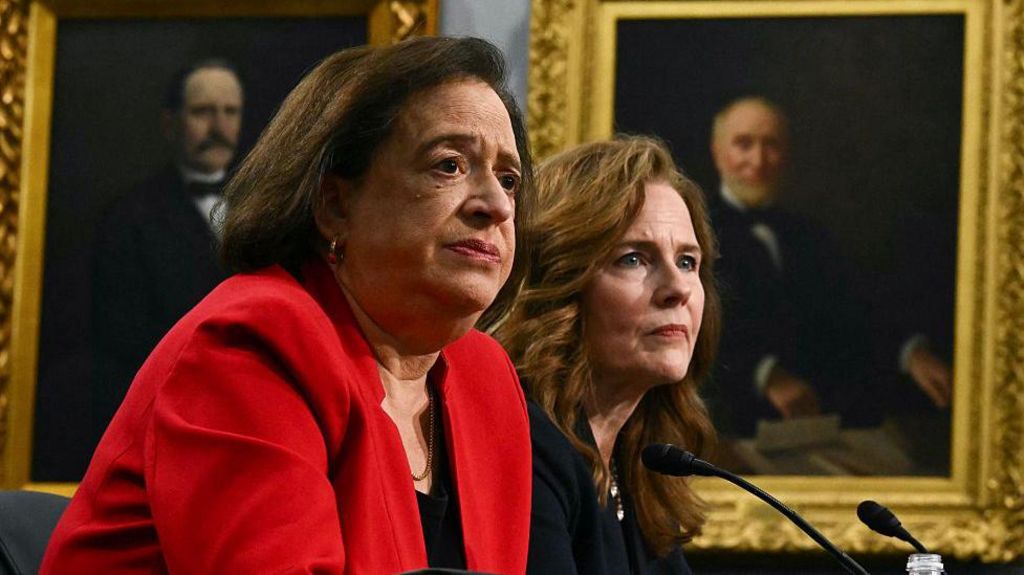
In an extremely rare public appearance before lawmakers on Capitol Hill, two sitting U.S. Supreme Court Justices from opposite ideological sides joined forces Tuesday to urge Congress to approve a massive $228 million budget request that would dramatically increase security funding for the nation’s highest court. The proposed budget marks a 53% jump from the previous year’s allocation, with the overwhelming majority of the new funding earmarked for expanded safety protections for justices and their families amid a documented surge in violent threats.
Conservative Justice Amy Coney Barrett, who joined the court in 2020, opened her testimony before the House Appropriations Committee by detailing the daily toll that constant safety risks have placed on her personal life, including two alarming incidents that brought threats directly to her door. Just six weeks before her testimony, Barrett was targeted in a dangerous swatting attack, a harmful prank where bad actors send false emergency reports to draw heavily armed police responses to a target’s home. Barrett described the chaos of dozens of law enforcement vehicles surrounding her residential property after a caller falsely reported an active shooting with multiple casualties at her home.
Barrett also recalled a troubling moment shortly after she joined the 2022 majority vote to overturn the federal constitutional right to abortion established in Roe v. Wade: her own security detail provided her with a bulletproof vest to wear at all times outside the court. She told the committee that the hardest part of the constant threat has been explaining safety measures to her children, saying, “I didn’t expect that performing this service was going to put me in the position of explaining to my children what a bulletproof vest was and why I had to wear one.”
Joining Barrett was veteran liberal Justice Elena Kagan, who echoed the call for increased funding, citing official court police projections that violent threats against Supreme Court justices will jump 38% this fiscal year alone. Kagan emphasized that growing political polarization across the United States has supercharged threats, while rapid advances in artificial intelligence have opened new dangerous vectors of attack, including exponentially more sophisticated and frequent cyberattacks targeting court infrastructure.
“For some of us, those threats have come very close, and all of us live with the knowledge that they may again materialize,” Kagan told lawmakers, adding that AI-powered cyber threats have grown “by magnitudes” in recent years, outpacing the court’s existing security capacity.
Data presented during the hearing backed up the justices’ concerns. Citing a recent report from the U.S. Marshals Service, committee ranking member Rosa DeLauro noted that as of July 1, more than 370 threats against federal judges have already been documented in the current fiscal year – a 31% increase compared to the same period last year, a trend DeLauro called “deeply alarming.”
One of the most high-profile recent threats targeted Chief Justice John Roberts: in October, a woman was sentenced to eight years in federal prison after law enforcement found a vehicle stocked with multiple firearms and discovered she had explicitly planned to harm Roberts. The incident underscored the immediate nature of the risks justices face.
Barrett told committee members that the court currently assigns between four and eight security personnel to each justice for around-the-clock protection, depending on the context and threat level. She explained that the additional funding would allow the court to expand security details to bring protection for Supreme Court justices in line with that provided to U.S. cabinet-level officials, who receive more robust permanent security support.
“The threats are constant and they’re always there,” Barrett said.
Tuesday’s hearing marked the first time sitting Supreme Court justices have testified before this congressional committee since 2019, a rare break from the court’s usual tradition of keeping public engagements with lawmakers limited. Multiple committee members used the hearing to note that more frequent public engagement between the court and Congress could help rebuild fading public trust in the nation’s highest judicial body. Recent polling from the Pew Research Center finds that just 50% of U.S. adults now hold a favorable view of the Supreme Court, down sharply from 70% just two years ago.
The appearance comes just weeks after the Supreme Court wrapped up its 2025-2026 term, which saw the court issue landmark divisive rulings on high-profile issues ranging from trade tariffs and voting rights to birthright citizenship. As with most recent terms, the decisions drew both fierce praise and fierce criticism from across the political spectrum, with a wave of targeted harassment directed at justices in the aftermath of the most contentious rulings.