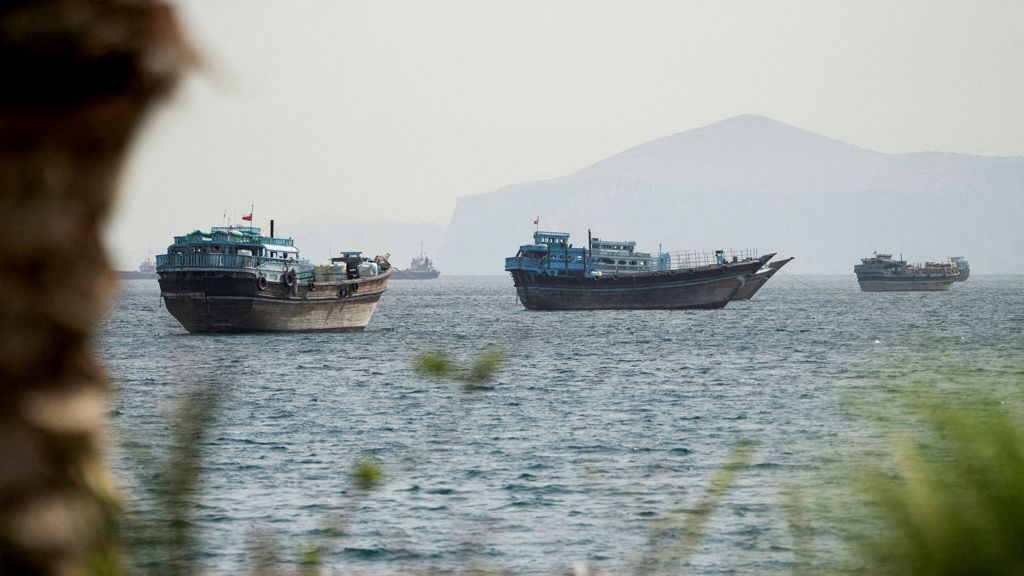
Fresh tit-for-tat military exchanges between the United States and Iran have sent tensions soaring around the strategic Strait of Hormuz over the weekend, marking the third major escalation in a week even as diplomatic efforts to reach a permanent ceasefire deal remain deadlocked.
US Central Command (Centcom), the military body overseeing American operations in the Middle East, confirmed it launched what it labeled “self-defence strikes” against Iranian military infrastructure over Saturday and Sunday. The targeted sites were radar and drone command-and-control installations in Goruk, a coastal city in southern Iran, and Qeshm Island, a key landmass sitting directly within the Strait of Hormuz. Centcom said the strikes were launched in response to escalating aggressive Iranian actions, including the downing of an American unmanned drone operating over international waters. It added that the targeted Iranian facilities posed an immediate threat to commercial vessels transiting the critical regional waterway, and that no US service members were injured in the entire episode.
Shortly after the US strikes, Iran’s Islamic Revolutionary Guard Corps (IRGC), the country’s elite military force, announced it had retaliated by targeting a US military base that Washington had used to launch the earlier attacks on Iranian territory. Two Iranian ballistic missiles fired toward US forces stationed in Kuwait were intercepted by coalition defenses, Centcom confirmed, with no casualties reported on the American side. Kuwaiti military officials had earlier reported engaging incoming “hostile” missiles and drones, triggering air raid sirens across the country. In an official statement released after the exchanges, Kuwait’s foreign ministry condemned the Iranian attacks in the strongest possible terms, calling them “heinous and repeated” acts that represent a dangerous escalation and a direct assault on Kuwaiti sovereignty. The statement added that the attacks undermine international efforts to cool regional tensions, and that Kuwait retains the full right to adopt any necessary measures to defend its territory and citizens.
This is not the first such exchange: Iran targeted the same Kuwaiti base last week in retaliation for earlier US airstrikes, which Washington said were carried out to disrupt Iranian attempts to lay mines in the Strait of Hormuz shipping lane. The waterway, which handles roughly one-fifth of global oil and liquefied natural gas trade, has remained effectively blocked since the escalation of hostilities, driving sharp increases in global energy prices.
The latest military clashes come after high-stakes negotiations for a permanent deal to end months of open conflict between the two nations failed to make progress over the weekend. According to US media reports, US President Donald Trump requested last-minute changes to the draft agreement, derailing what had been billed as a final push to resolve the dispute. Sources cited by CBS News, the BBC’s US news partner, said the requested changes center on two key sticking points: the terms for reopening the Strait of Hormuz and the timetable for removing Iran’s stockpiles of highly enriched uranium. The White House has not yet issued any public comment on the reports.
Iranian officials have pushed back sharply against the last-minute US demands, accusing Washington of shifting its position repeatedly to derail talks. “The United States is constantly changing its views and putting forward new or contradictory demands, which naturally prolong negotiations,” Iran’s foreign ministry spokesman Esmail Baghaei told reporters on Monday. Iran’s chief negotiator reiterated on Sunday that Tehran would not sign any agreement that does not fully secure Iran’s core national rights.
Baghaei also clarified that nuclear negotiations are not currently on the diplomatic agenda, despite reports that the latest draft framework includes provisions for renewed talks on Iran’s nuclear program, which Tehran has long maintained is entirely peaceful. “No negotiations have taken place on the details of the nuclear file. At this stage, our priority is ending the war,” Baghaei said. He added that a lasting ceasefire in neighboring Lebanon, which has been drawn into the broader conflict, is an non-negotiable essential condition for any final deal, and that Washington and Tehran have not yet reached a final conclusion on any terms. Iran’s foreign minister Abbas Araghchi echoed this position in a post on X on Monday, emphasizing that “the ceasefire between Iran and the US is unequivocally a ceasefire on all fronts, including in Lebanon,” and warning that “the US and Israel are responsible for the consequences of any violation.”
Lebanon entered the broader conflict between the US, Israel and Iran on March 2, after an Israeli airstrike killed Iran’s Supreme Leader Ali Khamenei. The Iran-aligned militant group Hezbollah launched a massive rocket barrage into northern Israel in retaliation, prompting Israel to launch a full-scale air campaign across Lebanon followed by a ground invasion.
Despite the ongoing escalation, President Trump struck an optimistic tone in a post on his social platform Truth Social early Monday, urging his political critics to “sit back and relax” and claiming “it will all work out well in the end.” He added that Iran “really wants to make a deal, and it will be a good one for the USA.” A temporary ceasefire between the two sides first came into effect on April 8, and Trump has repeatedly claimed in recent weeks that a permanent deal is close, though no formal agreement has been finalized to date. Last Friday, Trump met with senior aides to make a final determination on a framework to extend the existing ceasefire, but the meeting ended without clarity on next steps, shortly before reports of the president’s requested changes to the draft text emerged. The most recent US draft, according to CBS, includes a 60-day full cessation of hostilities and a binding commitment to reopen the closed Strait of Hormuz.
Iran has warned that any future American aggression will be met with a far stronger response. “If US aggression is repeated, our response will be completely different,” IRGC officials told Iran’s semi-official Fars news agency.