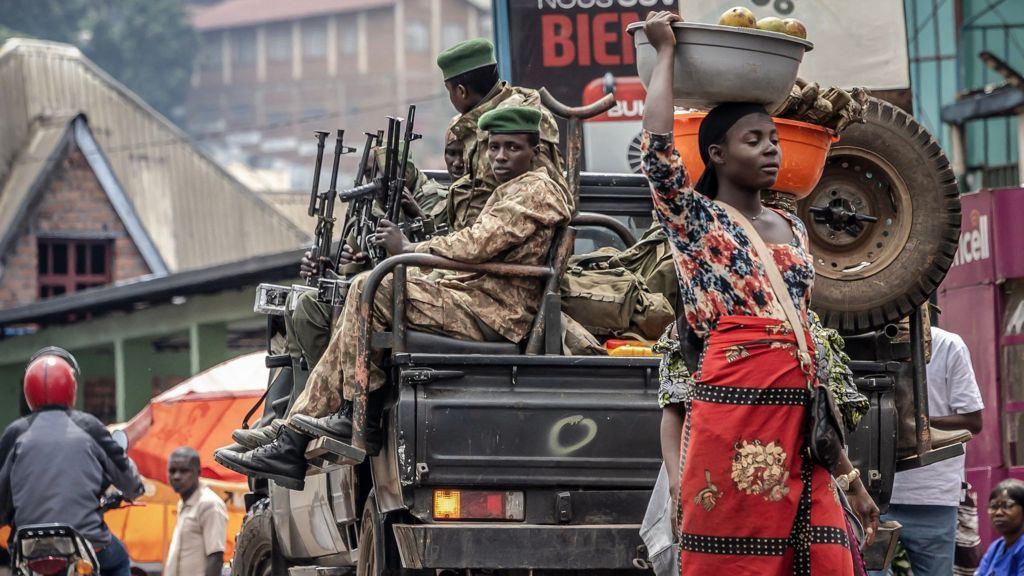
Against the backdrop of prolonged, deadly unrest in eastern Democratic Republic of Congo that saw the M23 rebel movement seize control of key urban hubs Goma and Bukavu in January 2025, the United States has rolled out sweeping new punitive measures targeting Rwanda’s Ministry of Defence, ramping up diplomatic and economic pressure on Kigali to end its alleged backing for the insurgency and pull all its military personnel out of Congolese territory.
U.S. Treasury Secretary Scott Bessent issued a stark public directive alongside the announcement, stating unequivocally: “Rwanda must halt its support for M23 and withdraw its troops from eastern DRC.” The latest sanctions mark a major escalation of Washington’s efforts to enforce the terms of the U.S.-brokered Washington Accords, a landmark peace deal signed by the Rwandan and Congolese presidents in December 2025 that was designed to de-escalate cross-border tensions, end years of armed confrontation, and unlock expanded regional trade and investment opportunities. Despite the high-profile signing, widespread fighting has persisted across resource-rich eastern DRC, with M23 forces capturing swathes of mineral-dense land across North and South Kivu, including lucrative gold mining sites in South Kivu and Rubaya, the world’s top coltan producing region critical to global electronics supply chains.
The U.S. Treasury’s formal investigation alleges that Rwanda’s defence ministry deployed thousands of its own active-duty troops to fight directly alongside M23 insurgents inside Congolese borders, while supplying the rebel network with heavy weaponry, military equipment, logistical support, and specialized combat training. U.S. officials further claim that minerals extracted from M23-held territories are systematically funneled into Rwandan domestic supply chains, pointing out that Kigali’s official export volumes for key minerals far outstrip the country’s domestic production capacity, a discrepancy that can only be explained by transit of conflict resources from eastern DRC.
In addition to targeting Rwanda’s defence ministry, the U.S. Treasury designated the Zigama Credit and Savings Society, a financial institution that exclusively serves Rwandan security and military personnel, for punitive measures. Washington accuses the lender of facilitating tens of millions of dollars in opaque transactions for M23 and its political affiliate, the Congo River Alliance, processing payments for Chinese-sourced military hardware for Rwandan forces, and enabling the smuggling of Congolese gold from rebel-held zones directly to Kigali. Under the terms of the sanctions, all assets belonging to the two designated entities that fall under U.S. jurisdiction are immediately frozen, and all U.S. citizens, companies, and organizations are prohibited from engaging in any form of transaction with the sanctioned parties unless granted explicit, case-by-case exemption by U.S. regulators. Violations carry heavy civil and criminal penalties for both U.S. and foreign entities that run afoul of the rules.
These new measures build on a series of earlier U.S. punitive actions dating back to March 2026, when Washington sanctioned Rwanda’s national army and four of its most senior operational military commanders, followed by additional sanctions in June 2026 targeting the Gasabo gold refinery and three Rwandan mining firms accused of running illegal conflict mineral smuggling rings.
Hours before the latest sanctions were publicly announced on 24 October, Congolese President Félix Tshisekedi made an urgent public plea to the global community to ramp up collective pressure on Rwanda. “We must firmly demand that the international community impose concrete sanctions against Rwanda and exert increased pressure, so that we may finally secure a lasting peace in our country,” Tshisekedi stated. The Congolese foreign ministry later issued an official statement formally welcoming the U.S. sanctions, and calling on Rwanda to abide by all of its commitments under the Washington Accords, respect the core tenets of the UN Charter, and fully withdraw all military personnel from sovereign Congolese soil.
Rwandan government spokesperson Yolande Makolo pushed back forcefully against the allegations in an official statement provided to the BBC, arguing that the unmet obligations under the Washington Accords fall on Kinshasa, not Kigali. “The Washington Accords contain clear commitments regarding Rwanda’s security, specifically the neutralization of the DR Congo-sponsored FDLR genocidal militia, which are wholly unmet, and with no accountability,” Makolo noted. The FDLR, a armed group whose leadership includes perpetrators of the 1994 Rwandan genocide, operates out of remote bases in eastern DRC, and Kigali has long cited its existence as an existential national security threat to justify its ongoing military deployments across the border. Makolo went on to confirm that “Rwanda remains ready to fully implement the Washington Accords, concurrently with the willingness of the DRC to fulfill those commitments, and with the mediator holding all parties accountable.”
Parallel to the diplomatic and financial pressure, Rwanda’s high-profile global sports partnerships are also coming under growing scrutiny. Two prominent U.S. senators, Jeff Merkley and Marsha Blackburn, sent a formal letter to National Basketball Association (NBA) commissioner Adam Silver on 23 October, urging the league to immediately review and reconsider its ongoing commercial partnership with Kigali, on the grounds that it may contradict the NBA’s publicly stated organizational commitment to upholding global human rights standards. The NBA has not yet released a detailed, substantive response to the senators’ inquiry.
For years, Rwanda has leveraged high-profile international sports sponsorships and event hosting deals to boost its global soft power profile and attract international tourism and investment. Earlier in October 2026, the country secured a landmark 10-year agreement to host Formula 1’s long-awaited African Grand Prix starting in the early 2030s. However, two of its highest-profile European football partnerships have already collapsed, with its sponsorship deal with English Premier League side Arsenal expiring in 2026, and German Bundesliga giant Bayern Munich also terminating its commercial collaboration with the Rwandan tourism marketing initiative Visit Rwanda.
US sanctions Rwanda’s defence ministry over DR Congo conflict