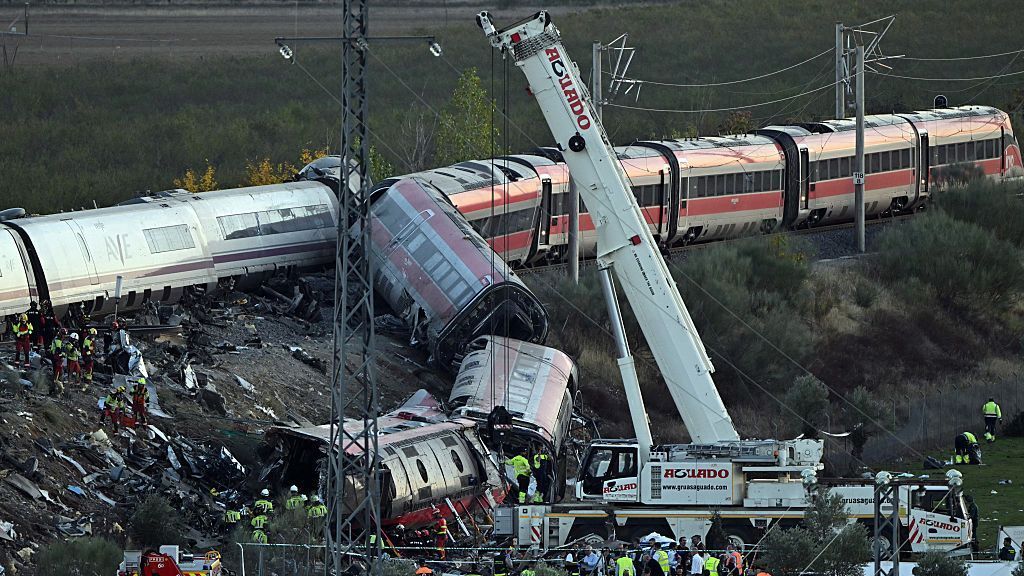
Spain has plunged into an official three-day period of national mourning following one of Europe’s deadliest modern rail disasters, which claimed no fewer than 68 lives and left dozens severely injured after two passenger trains collided on a high-speed corridor connecting Madrid and Seville early Wednesday morning. The catastrophic incident unfolded when a state-owned Renfe service carrying 397 passengers barreled into a stationary private Iryo train that had halted on the tracks due to an unplanned computer system failure. The sheer force of the impact sent multiple carriages tumbling down a nearby embankment, igniting a blaze in one of the derailed units and plunging the crash site into immediate chaos. Eyewitnesses recounted harrowing scenes of trapped passengers screaming for help, bleeding commuters wandering through smoke-choked wreckage, and widespread panic as survivors scrambled to escape the mangled metal carriages. Emergency response teams, totaling more than 500 deployed personnel, worked nonstop through the night under blinding floodlights, using heavy cutting equipment, drone surveillance, and helicopter support to sift through rubble, extract trapped victims, and recover human remains, with dozens of deceased passengers still awaiting formal identification as of press time. Preliminary investigative findings shared by Transport Minister Óscar Puente point to a critical, “inexplicable” operational failure at Madrid’s 24-hour national rail control hub: after the Iryo train stalled due to its onboard computer fault, controllers issued clearance for both trains to resume movement with no mandatory speed restrictions, a directive that directly contradicts standard safety protocols. Leaked audio recordings of radio communications between Madrid controllers and train drivers corroborate this lapse, showing the Renfe high-speed service was given full permission to proceed at regular operating speed even as the Iryo train remained stalled on the same stretch of track. The disaster marks the second fatal high-speed rail crash on the same Madrid-Seville line in less than 12 months, following a January incident near Córdoba that killed 46 people, a pattern that Prime Minister Pedro Sánchez described as “unacceptable” in a public address Wednesday. “The entire nation is grieving today: lives have been shattered, families torn apart, and the weight of this pain is almost too great to bear,” Sánchez stated, as nearly all major Spanish political parties suspended pre-election campaigning out of respect for the victims. The far-right Vox party was the sole exception, with leader Santiago Abascal arguing the pause amounted to an attempt to “exploit public mourning to stifle legitimate criticism of Spain’s crumbling rail infrastructure.” Public anger boiled over overnight in central Madrid, where roughly 1,500 demonstrators gathered outside the national Transport Ministry headquarters, calling for the resignations of both Sánchez and Puente over repeated safety failures. The otherwise peaceful protest turned violent after a small group of demonstrators threw glass bottles and lit flares, prompting police to deploy tear gas to disperse the crowd, though no arrests or reported injuries resulted from the clash. The national rail drivers’ union SEMAF confirmed it will proceed with a pre-scheduled strike planned for Thursday, framing the industrial action as a necessary stand for systemic rail safety overhauls rather than a standard labor action. Opposition People’s Party leader Alberto Núñez Feijóo echoed widespread public demands for full transparency, stating “the Spanish public has an undeniable right to a full accounting of what has gone so catastrophically wrong with our national rail network.” Spanish Civil Guard units have set up dedicated missing persons support and identification bureaus across Madrid, Toledo, Seville, and Córdoba, prioritizing DNA sample collection to match recovered remains with grieving family members who spent hours Wednesday scrambling for information about loved ones aboard the two trains. Local residents near the crash site in Toledo held a solemn candlelight vigil with a minute of silence to honor the victims, while the European Commission ordered all EU flags at its Brussels headquarters flown at half-mast as a formal gesture of pan-European solidarity with Spain during its mourning period. The collision is the deadliest rail disaster Spain has recorded since the 2013 Santiago de Compostela derailment that killed 80 people.