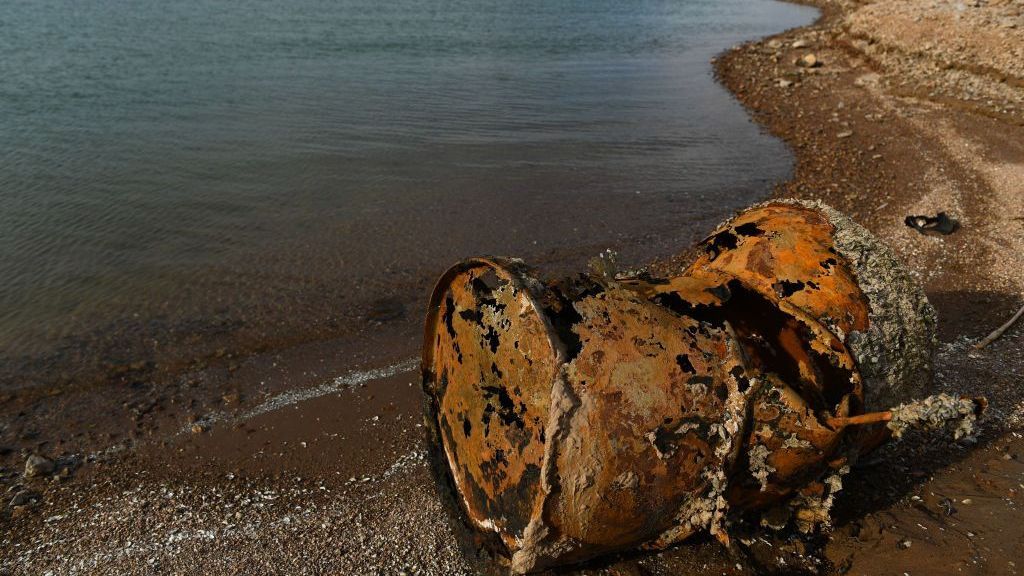
Receding water levels driven by climate change-fueled drought have unearthed a decades-old mystery at Lake Mead, the United States’ largest man-made reservoir, and investigators have finally identified the human remains found in a corroded barrel near the shores of the lake more than a year ago.
After years of exhaustive investigation, law enforcement officials in Nevada have confirmed the identity of the victim found stuffed inside the rusted barrel as Edward “Buddy” Lelburian Jackson. The remains were first discovered in May 2022, when falling water levels triggered by a record-breaking severe drought exposed the barrel that had laid hidden for decades. When authorities recovered the barrel, they found Jackson’s body with a single gunshot wound to the head, indicating he was the victim of a homicide.
For more than a year, the victim remained a John Doe, until investigators recently used DNA testing to trace Jackson’s identity and connect with his surviving family members, according to a statement from the Las Vegas Metropolitan Police Department. Homicide detective Robert Price addressed widespread public speculation that the killing had ties to organized criminal activity in the Las Vegas area, noting that at this stage of the investigation, no evidence has emerged to link Jackson’s death to any known criminal groups or the mob.
“At this point in our investigation, we don’t have information to support those theories,” Price said during a press briefing Thursday.
Investigators believe Jackson was shot and killed sometime in the 1980s, when he was between 55 and 59 years old. A native of Arkansas, Jackson was known for his frequent cross-country travels, particularly across the Western United States, and had previously lived in both California and Utah. He had a prior arrest record in Salt Lake City, Utah, but Price confirmed that Jackson had no known connections to Las Vegas and was never filed as a missing person. His extended family in Arkansas told authorities that Jackson was a habitual traveler who would disappear for long stretches and reappear without warning.
“He would travel the country. He would show up when he showed up,” Price explained.
Beyond the victim’s clothing, no other evidence — including the fatal bullet — was recovered from the barrel, complicating the ongoing investigation into Jackson’s killer. Authorities are still working to trace potential associates of Jackson and determine a clear motive for the shooting. Price noted that Jackson was not known to be a gambler, which makes tracking down people who may have known him decades after his death a particularly challenging task.
Jackson’s identification marks the fourth set of human remains recovered from the receding waters of Lake Mead since drought conditions began worsening. Two of the previous sets of remains were determined to be victims of drowning, while the third remains unidentified and the cause of death remains unexplained. Law enforcement has warned for months that as drought continues to push water levels lower, more human remains are likely to be discovered as areas previously submerged for decades are exposed.
Lake Mead, which supplies drinking water to more than 20 million people across the Southwest from Las Vegas to Los Angeles, has seen steady water level decline since 2000. Climate scientists confirm that human-caused climate change has accelerated the rate of drying in the region, worsening multi-decade megadrought conditions across the American West.
This phenomenon of long-dormant discoveries emerging from receding waters is not unique to the American Southwest. This year alone, drought conditions across Europe have exposed long-submerged remnants of past conflicts. In Budapest, Hungary, the receding waters of the Danube River revealed the remains of two German World War II soldiers alongside a mostly intact Wehrmacht motorcycle, while other WWII wreckage, including a broken ship hull, has been found near Prahovo, Serbia in recent months.