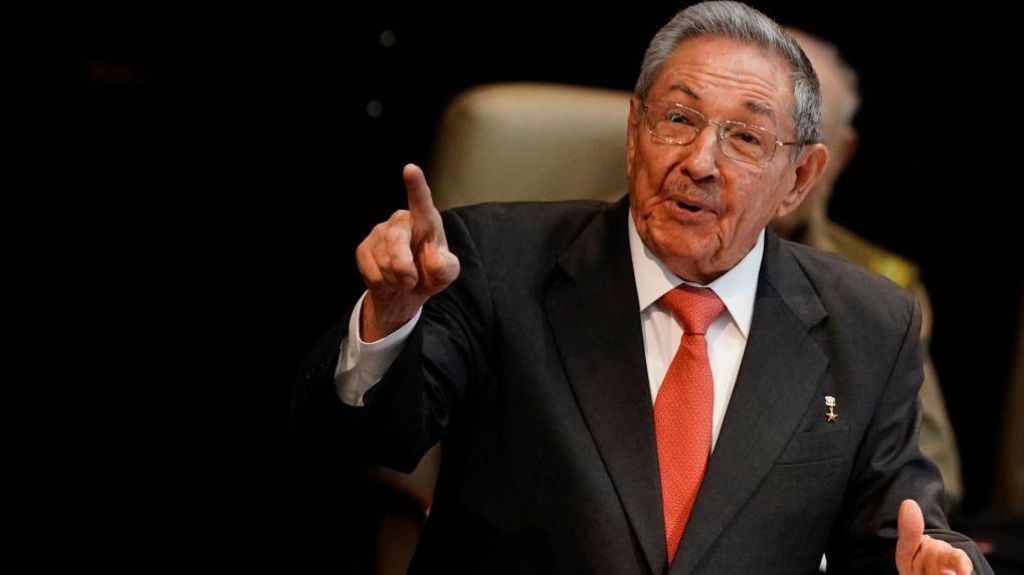
Tensions between the United States and Cuba have spiked dramatically in recent days, after multiple anonymous U.S. Department of Justice sources confirmed that federal authorities are moving forward with a planned criminal indictment of 94-year-old former Cuban leader Raúl Castro, connected to the 1996 downing of two U.S.-linked aircraft that left four people dead. The expected charges, which require formal approval from a federal grand jury before they can be unsealed, come at a uniquely sensitive moment: just one day before the first reports of the indictment plan emerged, CIA Director John Ratcliffe traveled to Havana to hold rare direct talks with senior Cuban security officials.
Raúl Castro, who retired from the top post of Cuba’s Communist Party in 2011 after leading the island nation for 15 years, closed out six decades of uninterrupted rule by the Castro family when he stepped down. He assumed the presidency in 2006 after his older brother, longtime leader Fidel Castro, resigned due to poor health, and previously served as Cuba’s armed forces minister at the time of the 1996 incident.
The case that forms the core of the potential indictment dates back 30 years, to February 24, 1996, when Cuban military forces shot down two small civilian planes operated by Brothers to the Rescue, a Miami-based Cuban exile group with a stated mission of rescuing migrants crossing the Straits of Florida and an open anti-Castro political agenda. The group had repeatedly dropped anti-government leaflets in Cuban airspace prior to the incident, and Havana maintained at the time that the aircraft had violated Cuban national airspace. However, an investigation by the International Civil Aviation Organization concluded the shootdown occurred in international waters. All four people on board the two planes were killed in the attack.
According to unnamed DoJ officials, the public indictment could be released as early as next Wednesday. When asked about the reports during a press gaggle on Air Force One Friday, U.S. President Donald Trump declined to comment on the details of the ongoing investigation, saying he would leave all statements to the Department of Justice. He did not hold back from broader criticism of the Cuban government, however, telling reporters: “But [Cubans] need help, as you know. And you talk about a declining country. They are really a nation, a country in decline.”
The planned indictment is the latest escalation in a sustained U.S. pressure campaign against Havana that already includes a full oil embargo, sweeping economic sanctions, and open political rhetoric calling for regime change on the island. Trump’s oil blockade has already pushed Cuba to the brink of an energy crisis: just this week, the island’s energy minister publicly acknowledged that the country has effectively exhausted its supplies of fuel oil, leaving essential services and civilian livelihoods at risk. Expectant mothers across Cuba are already reporting severe struggles accessing basic care and supplies amid the ongoing fuel shortages.
The move to reactivate the investigation into the 1996 shootdown gained momentum earlier this year, when Florida’s attorney general announced the state would reopen its own probe into Raúl Castro’s alleged role in the incident. Florida Governor Ron DeSantis echoed that momentum Friday, praising the planned federal charges as “long overdue.”
Cuba has not yet issued an official formal response to the reports of the impending indictment, but Foreign Minister Bruno Rodriguez made clear Friday that Havana would not back down to U.S. pressure. “Despite the [US] embargo, sanctions and threats of the use of force, Cuba continues on a path of sovereignty towards its socialist development,” Rodriguez said, per Reuters.
Acting U.S. Attorney General Todd Blanche, who leads the Department of Justice, has also declined to confirm the reports, telling Fox News: “If and when there’s a time to talk about about that, we will, obviously.” Under U.S. federal procedure, prosecutors must first present evidence of probable cause to a grand jury composed of ordinary citizens before any formal charges can be filed.
Ratcliffe’s visit to Havana Thursday, which included a meeting with his Cuban counterpart at the Cuban interior ministry, was notable for the attendance of Raúl Rodríguez Castro, the grandson of the former Cuban leader. A CIA official told CBS, the BBC’s U.S. partner, that Washington was open to talks on economic and security cooperation, “but only if Cuba makes fundamental changes” to its governing system. The Cuban government’s official readout of the meeting framed it as an effort to improve bilateral dialogue, and reiterated that Havana does not pose a threat to U.S. national security. The talks also followed a renewed U.S. offer of $100 million in humanitarian aid to help mitigate the harm caused by the American oil blockade.
The heightened focus on Cuba comes on the heels of a dramatic U.S. action in the region: in January, American authorities indicted Venezuelan leader Nicolás Maduro, and removed him from power in a rapid overnight military operation. Analysts have warned that a similar move to target Raúl Castro could trigger severe consequences for the United States, even as the indictment is widely seen as part of a broader pressure strategy.
William LeoGrande, a professor of Latin American politics at American University in Washington and author of *Back Channel to Cuba: The Hidden History of Negotiations between Washington and Havana*, described the impending indictment as “one more element of the pressure campaign” that Trump has sustained since returning to office. He warned that further destabilization of the Cuban government could backfire spectacularly on Washington. “If the Cuban economy and social order collapses, it would actually be a disaster for the United States, because it’s likely to touch off a mass migration crisis,” LeoGrande explained. The professor added that the move appears to be a deliberate warning: “It looks like the US is sending a warning to Raúl Castro that he should use his influence to get the government to make concessions. Or else the US military may be coming for him, just like it came for President Maduro in Venezuela.”