Just days before scheduled high-stakes peace negotiations between the United States and Iran were set to kick off in Pakistan’s capital Islamabad, the entire process hangs in the balance, as both sides have traded sharp accusations over violations of a fragile two-week ceasefire that was meant to pave the way for a permanent end to their deadly conflict. As of Friday, no official confirmation had been released regarding the arrival of negotiating delegations, leaving regional observers and global markets bracing for potential renewed escalation.
The temporary truce, negotiated to create space for dialogue aimed at ending a conflict that has already claimed thousands of lives and sent shockwaves through the global economy, has been fraying almost from its inception. US President Donald Trump has openly criticized Iran’s management of the strategic Strait of Hormuz, a critical global energy chokepoint that was supposed to be fully reopened under the terms of the ceasefire deal. Data from shipping trackers shows only a tiny fraction of the usual volume of vessels have transited the waterway since the truce was announced, despite the fact that roughly 20% of the world’s daily oil supply, alongside massive volumes of natural gas and fertilizer, normally passes through the strait in peacetime.
In a series of social media posts Thursday that reignited fears the truce could collapse entirely, Trump accused Iran of doing a “very poor job” of upholding its ceasefire obligations and blocking energy shipments through the strait. On the Iranian side, officials have reacted with fury to intense Israeli airstrikes in Lebanon, carried out just 48 hours after the truce went into effect. Tehran insists that the Lebanese front falls within the scope of the agreed ceasefire, a claim Washington explicitly rejects. Iran’s foreign ministry spokesman Esmaeil Baqaei has framed Iran’s participation in the Islamabad talks as conditional on the US forcing an immediate halt to Israeli attacks on Lebanon, stating: “The holding of talks to end the war is dependent on the US adhering to its ceasefire commitments on all fronts, especially in Lebanon.” Senior Iranian officials have even gone so far as to label the planned negotiations “meaningless” if the strikes continue, though Iran’s powerful Revolutionary Guards has reaffirmed its commitment to the truce, telling state broadcaster that it has not launched any offensive operations against any nation.
Adding to the growing cloud of uncertainty, Iran’s ambassador to Pakistan deleted a social media post Thursday that had originally announced an Iranian delegation would arrive in the country that same day. Despite the open disputes, Pakistani authorities have continued moving forward with logistical preparations for the talks, which official sources confirm will cover a range of highly sensitive topics, including Iran’s nuclear enrichment program and guaranteed unimpeded trade through the Strait of Hormuz.
For its part, the US delegation is still scheduled to arrive this weekend, led by Vice President JD Vance, with special envoy Steve Witkoff and Trump’s son-in-law Jared Kushner also in attendance.
Pakistan’s role as a neutral mediator has already been thrown into question by a controversial remark from its top defense official. On Thursday evening, Defence Minister Khawaja Asif posted a statement labeling Israel a “cancerous state” and “a curse for humanity” amid the Lebanese strikes, a post that was removed several hours later. The Israeli prime minister’s office condemned the comments as “outrageous”, saying the remarks could not be tolerated from a country claiming to act as a neutral peace broker. Pakistan does not formally recognize the state of Israel, and has repeatedly insisted that the ceasefire agreed for the US-Iran talks must include the Lebanese front, a position that puts it at odds with Washington.
Public opinion inside Iran remains deeply divided and skeptical of the negotiations’ outcome. A 30-year-old Tehran resident, speaking to AFP on condition of anonymity for security reasons, dismissed most of Trump’s public statements as “pure noise and nonsense”, arguing that the US president was only seeking to manipulate the Iranian government into accepting a one-sided deal. Another Tehran local, Sheida (who also withheld her last name over safety concerns), summed up the widespread anxiety gripping the country: “I am scared of the war starting again, and at the same time I’m scared of the regime staying.”
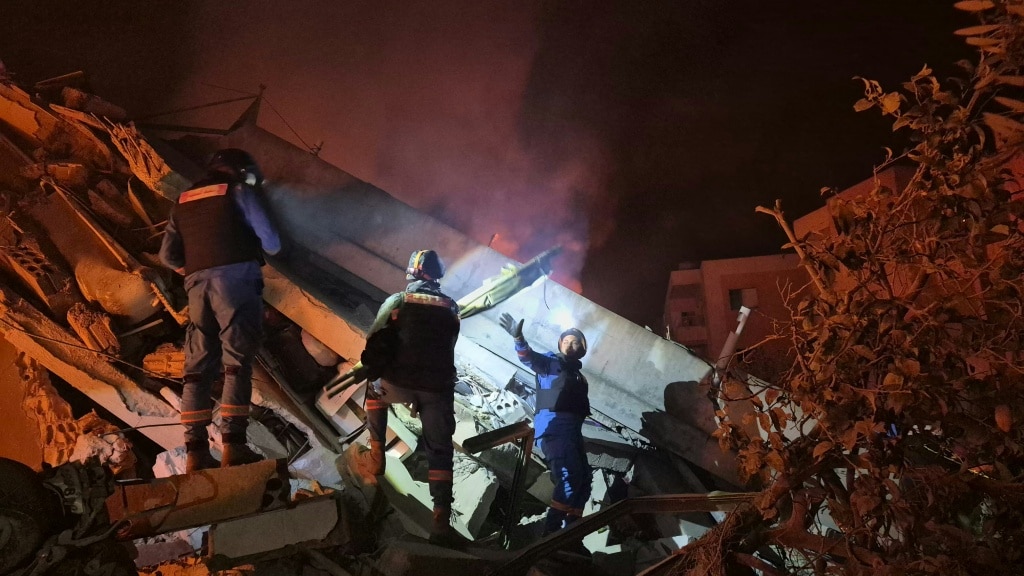
Parallel to the planned Islamabad talks, separate negotiations are being arranged to address the ongoing conflict on the Lebanese front, after Israel carried out its heaviest bombardment of Lebanese territory since Iran-backed Hezbollah entered the war on Wednesday, killing more than 300 people. Early Friday, Hezbollah announced it had carried out fresh drone and rocket strikes targeting Israeli military positions along the bilateral border and a town in northern Israel, triggering air raid sirens across Tel Aviv and other parts of the country. Trump has claimed that Israeli Prime Minister Benjamin Netanyahu assured him strikes would be scaled back to “low-key” operations after the international backlash, and a Western diplomat speaking anonymously confirmed that European nations, Gulf Arab states and Egypt have all placed heavy pressure on Israel to hold off on further large-scale airstrikes in the Lebanese capital Beirut following what observers have dubbed “Black Wednesday”. As of Friday morning, the Israeli military had not followed through on prior warnings of widespread strikes in southern Beirut.
Washington has confirmed that it will host separate talks next week focused exclusively on ceasefire negotiations between Israel and Lebanon, a plan that aligns with the US position that the Lebanese front should be handled separately from US-Iran negotiations. The US announcement came shortly after Netanyahu ordered Israeli ministers to pursue direct dialogue with the Lebanese government focused on disarming Hezbollah. Neither the Israeli government nor Lebanon’s caretaker administration has publicly confirmed the planned talks, while a Lebanese official told AFP that Beirut will not enter any negotiations before a formal truce takes effect across the border.