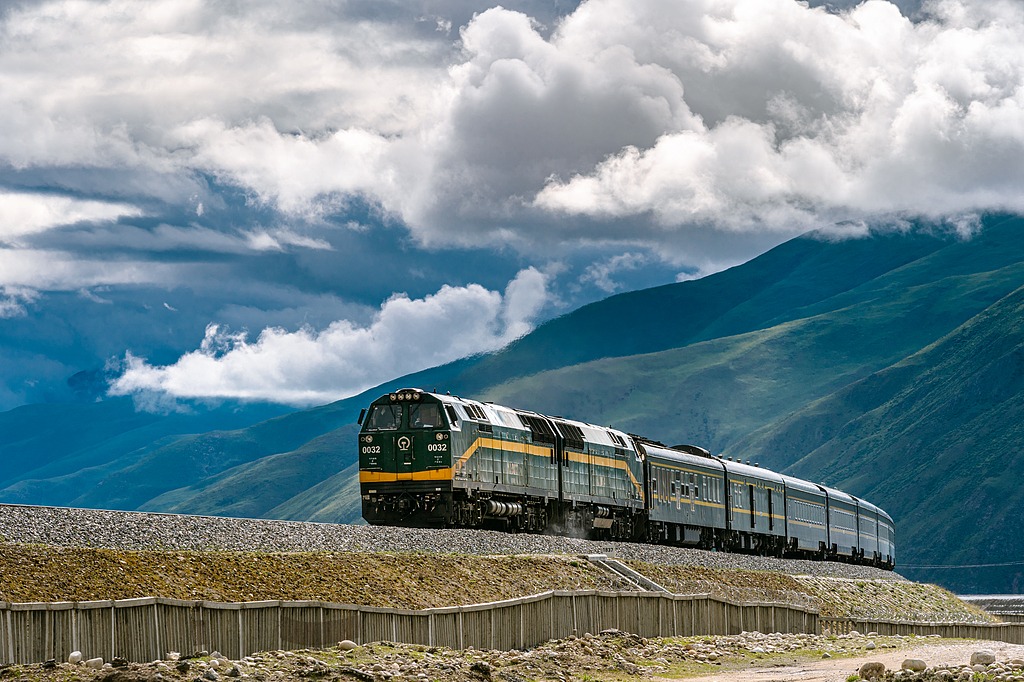
Two decades after cutting through the world’s highest plateau to connect the Xizang Autonomous Region to the rest of China, the Qinghai–Xizang Railway has hit a historic transportation milestone: it has moved more than 100 million metric tons of cargo into and out of the plateau region since launching commercial operations in 2006, according to official data from China Railway Qinghai–Xizang Group.
When the railway first opened to traffic on July 1, 2006, it achieved a feat once thought impossible by engineering standards. It ended Xizang’s centuries-long history of being disconnected from the country’s national rail network, turning the long-held dream of a rail link across the “Roof of the World” into tangible reality. The landmark infrastructure project immediately ushered in a new era of seamless connectivity between the plateau region and China’s inland provinces.
Over the 20 years since opening, freight volume along the line has grown at a steady, robust pace. Official statistics from the operator show that annual cargo throughput stood at just 361,000 tons in the railway’s first year of operation. By 2025, that figure had surged to 8.31 million tons, marking an average annual growth rate of 18 percent.
The growth has been seen across both inbound and outbound cargo flows. Inbound freight, which consists primarily of essential commodities including coal, cement, construction materials, and grain, has jumped from 340,000 tons in 2006 to 6.9 million tons in 2025. Outbound cargo has expanded even faster, climbing from just 21,000 tons two decades ago to more than 1.4 million tons in 2025.
Zeng Qiang, deputy director of the operator’s Passenger and Freight Management Department, explained the transformative role the railway plays for the regional economy. “The railway ensures efficient delivery of essential supplies to the plateau while enabling specialty products such as highland barley and Tibetan beverages to reach national markets,” Zeng said.
Beyond growing cargo volumes, the rail network around the Qinghai–Xizang line has expanded dramatically in both capacity and coverage. The core Golmud–Lhasa section now operates 58 stations, can handle maximum traction loads of 2,880 tons, and runs 17 pairs of freight and passenger trains daily. Following the completion and integration of the Lhasa–Shigatse and Lhasa–Nyingchi rail lines, a Y-shaped regional rail backbone network has been fully established across Xizang.
Today, Xizang’s total rail network exceeds 1,000 kilometers, featuring five dedicated freight stations and strengthened freight hubs in the major cities of Lhasa, Shigatse, and Nyingchi. The operator reports that a comprehensive logistics system made up of seven regional freight centers and 47 service outlets now covers Qinghai, Gansu, and Xizang, streamlining cargo movement across the vast plateau region.
The railway’s impact is no longer limited to domestic connectivity: it is now expanding cross-border trade links to serve international markets. Since 2021, combined rail-road intermodal transport services have launched new routes connecting Xizang to South Asia and Central Asia, with total export volumes via these cross-border routes already reaching 113,000 tons as of the milestone announcement.